
Click image to go to larger resolution.
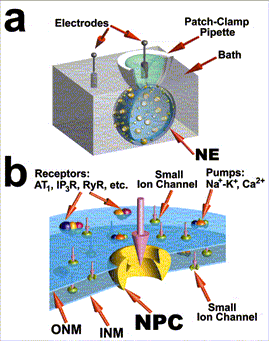
Fig. 1.
Ion channels at the nuclear envelope. (a) Schematics of a nucleus-attached patch-clamp recording. A pipette is placed to the cytoplasmic
surface of the nucleus and the ion current is recorded while a known voltage is
applied between the electrodes inside the pipette and the bath (reference set
to ground or zero potential). Under physiological
saline, the NPCs (shown as large channels) outside the pipette tip facilitate
the virtual grounding of the nucleoplasmic side of the NE. As the dominant pathway for ion flow is that
of the NPCs, electrical signals must derive from NPCs. Only when all the NPCs are plugged or closed
is that we can say that the recorded ion channel activity derives from ion
channels other than NPCs. (b) Diagram
illustrating the different channel types that may be found at the NE. The only conspicuous channel under EM and
AFM is the NPC. Ion channels at the
outer and inner nuclear membranes, ONM and INM, may also contribute to ion
fluxes. The arrows show the inward
direction of the electrical current (i.e. the movement of positive ions such as
K+) when the voltage in the cytoplasmic side of the NE is greater
than the voltage at the nucleoplasmic side of the NE. When negative ions (e.g. Cl-) are the charge carriers,
the direction of the electrical current will remain inward, although the ions
will move toward the nuclear exterior.
When the voltage at the cytoplasmic side is smaller than that at the
nucleoplasmic side, the electrical current is outward, the flow of positive
ions is outward, but the flow of negative ions is inward. Finally, if there is no voltage gradient,
the electrical driving force for the charge carriers is absent and there is no
ion flow. As the force determining the
movement of ions is electrochemical in origin, ion gradients must be taken into
account as done for classical ion channel currents. To date, patch-clamp data suggests that, under steady-state
conditions, the chemical gradient is negligible (Bustamante, 1992; Boehning et
al., 2001). Finally, references are
made to receptors found at the NE such as for angiotensin II (AT1),
IP3 (IP3R), and ryanodine (RyR) as well as to pumps such
as Na+-K+ and Ca2+.