SHEVCHENKO SCIENTIFIC SOCIETY in LVIV
Ecological commission
21, Gen. Chuprynka Str., Lviv, 290013, Ukraine
e-mail:[email protected]
Human impact on vegetation changes on the Upperdnister plane during late Holocene
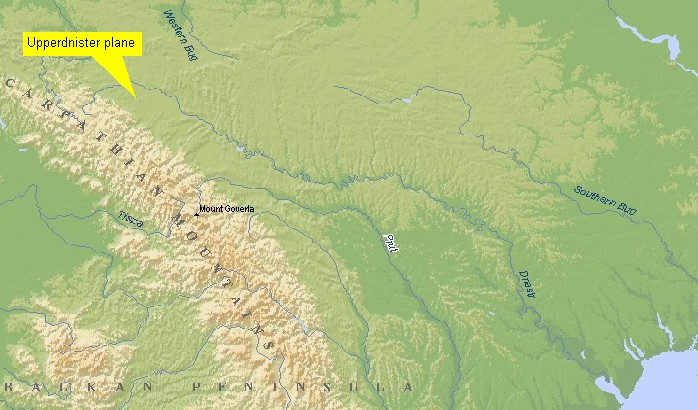
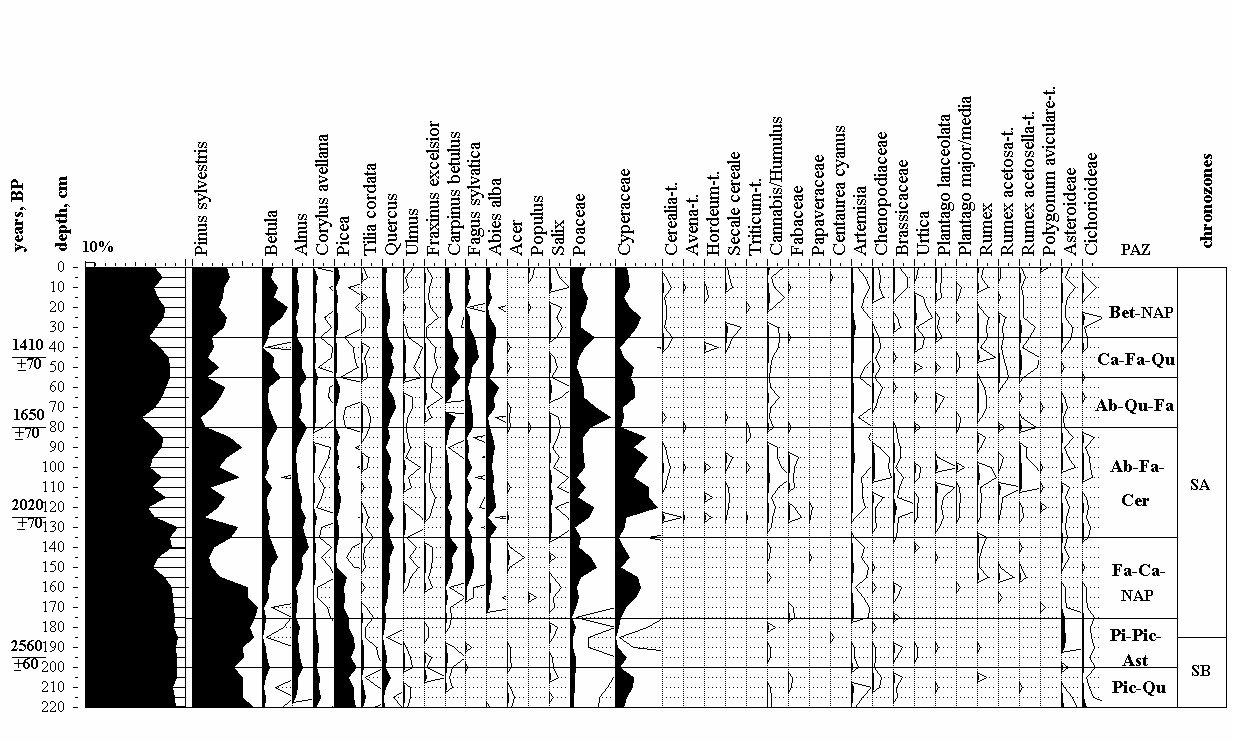
Fig. Simplified pollen diagram from Ozerne profile
This paper presents the results of palaeobotanical studies of peat profile from Grate Sambir Bogs on the Upperdnister plain (Ukrainian Carpathians north-western foreland). The aim of investigation was to reconstruct the history of the vegetation in this area. Contemporary plant cover of territory is caused with climatic condition and human activities. On the Dnister terraces and its tributaries small areas are covered with the broad-leaved forest with Quercus robur as a dominant. In the valley small alder-willow forests are found. About 80% of areas is used by agriculture as pasture and meadows.
Samples for investigations were collected with borer. Material was subjected to Erdtman’s acetolysis. The identification of the pollen grains carried out using light microscope with magnification 400 and 1000. The results of analyses are presented in simplified pollen diagram (figure). Four radiocarbon data showing the age of the sediments are presented in diagram too.
The whole diagram has been divided into seven pollen assemblages zones (PAZ) and two chronozones.
Pic-Qu-zone corresponds to Subboreal period (SB). The Pinus curve slightly falls and Picea keeps a 20 % level. Percentage of deciduous trees is small. Proportion of herbaceous plants is not large but Artemisia, Chenopodiaceae occurrence.
Pi-Pic-Ast-zone corresponds to early phase of Subatlantic period (SA) as well as a beginning of Picea curve fall and appearance Carpinus betulus and Fagus sylvatica.
In next zone (Fa-Ca-NAP) these two species curves rise and proportion of deciduous trees in forest still increases. Abies alba appearances. Picea falls to a few percents and Pinus to 20 % that may be interpreted as their absence in plant communities. The sum of herbaceous plants (without Cyperaceae, hygro-, hydrophytes and sporostrote plants) increases and reaches maximally 40 %. I in two next samples we can see maximum of Betula and Alnus.
Ab-Fa-Cer-zone. Quercus is dominant, though its curve shows some decline. Proportion of Pinus pollen fluctuates from 15 % to 50 % that demonstrate not great role of pine in plant communities. In the samples of this zone significant quantity of anthropothytes presents as well as the pollen grains of cereals.
Next three zones are characterized by fluctuation and gradually decreasing of deciduous trees and Abies alba proportion. Every sample contains the pollen of synanthropic plants. In the some samples Cerealia are found.
In the last four zones we can see clear correlation between the phases of deforestation and presence of considerable quantity of ruderals and cereals pollen grains. This bears witness to significant human influence on vegetation during the last 2000 years.
 This WEB-side is made by
November 22 2001.
This WEB-side is made by
November 22 2001.
