
Compare the photo taken in 1986 (on the left) to the photo taken 10 years later (on the right).
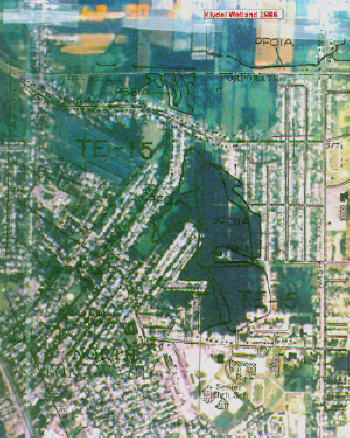
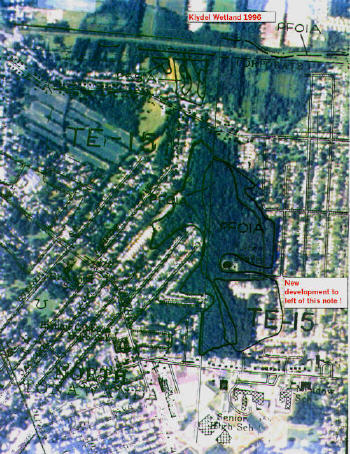
Compare the photo taken in 1986 (on the left) to the photo taken 10 years later (on the right).
Piece meal development of the Klydel Wetland has severely impaired this wetland. These aerial photos show homes that were built significantly after federal laws were put in place to protect wetlands.
In particular, note the Gable Heights subdivision that was added south of the water tank (circle near the center of the photos). Upscale homes were built on Bowen Court/Drive in this wetland without federal wetland permits starting in the mid-1990's.
To accommodate those who "want evidence" of homes built in wetlands, please view our web page entitled "3 Easy Steps to Building Homes in Wetlands in New York" which uses the Gable Heights subdivision in North Tonawanda as the prime example. If the subdivision was not in wetlands, why would "grandfathering" with respect to New York wetland laws be necessary? This grandfathering did not extend to federal wetland laws for this subdivision.
The City of North Tonawanda did not apply for federal wetland permits for roads built into this wetland. There is an article further down this web page that was published in the Tonawanda News concerning a letter of intent to sue the City over this issue. For more updates about this issue, see our archived news from 2003 and more information further down this web page.
Learn about glacial Lake Tonawanda and what it means for communities like Amherst, Grand Is., and North Tonawanda.
Check out flooding problems in North Tonawanda.
Here's a link that compares similarities between soils common to Amherst and North Tonawanda.
In 2005 the wetlands legislation is again making its way through the New York State legislature. One good reason to protect wetlands is the cost to homeowners of residences that are built in wetlands and unstable soils. To learn more about the costs in Amherst, NY, hit here for a statement by the Office of the New York State Attorney General.
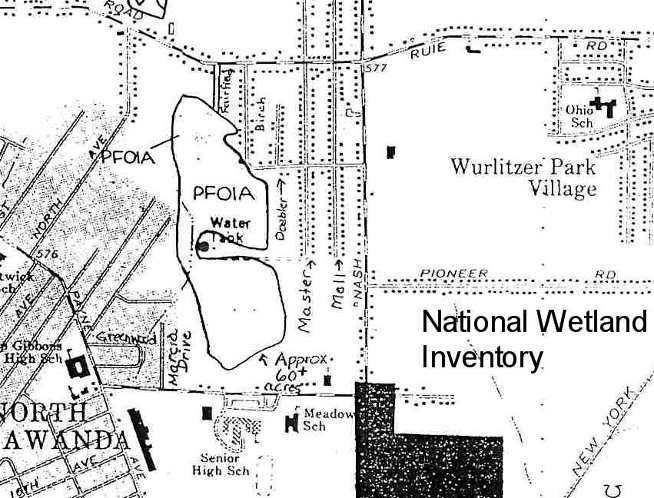
Learn more about updated wetland maps of North Tonawanda by clicking here.
Is your North Tonawanda home built in a
wetland? (see maps above)
Guest View published in the Tonawanda News on
September 3, 2003
If you�ve noticed a cracked foundation or a flooded basement, or taken up canoeing in your backyard, then welcome to the world of wetland sports and
games-- brought to you by some folks in NT City Hall.
It is said that he who smiles in a crisis has found someone to
blame. Can we pinpoint the
blame?
* Would NT officials promote homes/roads being built into
wetlands in violation of federal
law?
Yes, they would and
they have. The Gable Heights
subdivision is an example. The use
of the term �heights� creates an oxymoron here since the homes weren�t built on
a high and dry location.
A wetland map from
the early 1980�s shows this proposed subdivision to be located in the Klydel
Wetland. That map was altered but
that is a story for another day.
The map change didn�t make the wetlands magically disappear on the ground
where so many homes have been built and continue to be built since that
time.
The altered map also did not absolve developers and the City from obeying federal wetland laws. The City promoted the development of Bowen Court into the heart of the wetland even
though the engineering department was alerted about required federal wetland
permits during construction in 1993/1994.
Documents obtained
under the Freedom of Information Act show that the City did not bother to obtain federal wetland permits for roads it owns that were blazed into the
wetland. The NT Comprehensive Plan
details this responsibility quite clearly but it was ignored.
In addition, Daniel Drive has been the subject of both federal and state
wetland enforcement actions. The
City paid for the street/sewers for some lots on Daniel Drive that were not
supposed to be developed.
City Hall clearly
facilitated violations of Section 404 of the Clean Water Act. Worse than that, they caused, and
continue to cause, unsuspecting citizens to build their homes in wetlands.
Wetlands are great
for nature observation, for habitat, and to control flooding-- but living in
them is not so great. Wetlands have been decimated over the past two decades from the combined influence of
unscrupulous developers, their pseudo-scientist consultants, incompetent
politicians, and timid oversight by regulators. The Town of Amherst gives stark
testimony to what can happen when science is ignored. The town has over 500
�sinking homes� that were built in wetlands and/or unstable soils. North Tonawanda shares one of these
soils.
* Where are wetlands located in North
Tonawanda?
Wetland TW-4 and the Donner Creek floodplain: In the vicinity of Witmer, Drake, and
Doyle.
Wetland TE-12: In the vicinity of Zimmerman, Cramer, and the Deerwood
Golf Course.
Wetland TW-25: In the
vicinity of Homestead but north of St.
Joseph.
Wetland TE-15: Located on/near Bowen Drive, Bowen Court, Selkirk, Moll,
Master, Doebler, Birch, Fairfield, Ruie, North, Daniel, Linwood, Woodward,
Sunset, Greenwood, Marcia, Kinkead, and Meadow
Drive.
* What response do residents receive when they are
flooded?
They receive an inadequate response. The City does not alleviate flooding at
the dead ends of the sewer system. Since Gable Heights was developed, storm
sewers back flow during peak flooding into some of the neighborhoods surrounding
the Klydel Wetland. Some streets
don�t even have storm sewers.
*
Which
regulatory agencies enforce the federal Clean Water Act (that includes wetlands
protection)?
The US Army Corps of Engineers and the US EPA enforce this law. For
projects that are not "wetlands dependent", the parties wanting to do
construction must explain the need for the project.
Homes don�t �need� to be built in wetlands. Only after a project sponsor has
satisfied three conditions � establishing need, investigating alternative sites,
and planning for minimal environmental impact � will the Corps consider granting
a wetland permit.
Even if a developer does obtain a permit to destroy wetlands, they have
to compensate for them. When the
permit process is neglected as in NT, bad things
happen.
* What sort of bad
things?
One city official recently told an inquiring federal enforcement official
that it isn�t his problem that folks want to build their homes in wetlands. Now how did he expect residents to know
any better?
Stay tuned. They might not
be smiling in Amherst yet since they haven�t figured out whom to blame.
In North Tonawanda, however, we cannot accept frequent flooding as merely
being due to �Mother Nature� as some would have us believe. Those who caused the problems had better
be ready to fix them.

WETLANDS: Eye Spy
Massachusetts has an eye in the sky waiting to swoop in on developers illegally building on protected wetlands. The Department of Environmental Protection now has software that digitizes its aerial maps and links them to a computer database for wetlands protection. These kinds of photos are often more convincing to a jury than paper maps. And the proof is in the pudding.
In December, the agency announced fines totaling $280,000 against an auto parts company and a concrete company. Massachusetts is the first state to use this kind of technology for wetlands enforcement. Officials were appalled to discover that more than 3,000 protected locations had been filled between 1991 and 2001, a net loss of more than 700 acres than they had previously known about.
Read an article from the Christian Science Monitor at this link:
http://www.christiansciencemonitor.com/2004/0122/p11s02-sten.html
We've been monitoring North Tonawanda's wetlands using aerial photos for years. View photos at the top of this web page.
Back to our MAIN PAGE.
Please send comments to: [email protected]