Trends of Thai Retail Business1/


   Thailand’s trade sector consisting of wholesale and retail trades plays an important role in Thai economy. It accounts for 16.5 percent of GDP and generates good deal of employment in commercial sector of around 5 million or 15 percent of the total employment.   

   Prior to the crisis (1996 to mid-1997), the percentage change in retail trade showed a continued expansion of 11.3 percent per quarter against the contraction of 31 percent in 1998 following the outbreak of the crisis. However, the percentage change in retail trade expanded by 30.7 and 24.9 percent in 1999 and the first half of 2000 respectively due to the economic recovery.

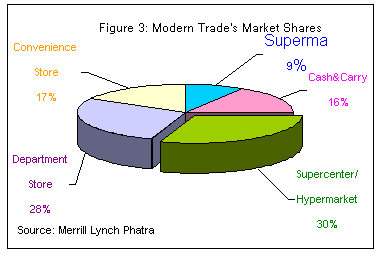
   Retail businesses, particularly, hypermarkets (e.g. Tesco-Lotus, BigC and Carrefour) have accelerated their expansion scheme to open more branches in an attempt to seize more market shares. As a result, hypermarkets are now holding the highest market shares (30 percent) in a modern retail business.

   The entries of discount stores having low margin helps prevent soaring consumer prices.          

   Most retailers keep the stock of their goods for approximately 1-3 months. Category Killer (Power Buy, Power Mall) is a retailer having the lowest stock level  (7 days) while that carrying the highest one is a department store (1-3 months). Retailers so far have attempted to maintain constant stock level for each month, which in turn will help bring down the cost of operation.   

   Competition in the retail business is heating up. The main strategy is to lower prices. Moreover, technology and innovation have been used by modern retailers thus affecting both Thai traditional retailers and department stores. Government support in putting up strategies is essential especially in crediting fair business environment so that Thai retail business stand a better chance in the competition.


1/ Data obtained from the interviews of 8 modern retailers consisting of Central Retail Corporation Co.,Ltd., Tung Hua  Seng Department store Co.,Ltd., Carrefour Co.,Ltd., Ek-Chai Distribution System Co.,Ltd., Siam Makro Public Co.,Ltd., Boots Retail  (Thailand) Co.,Ltd., C.P. Seven-eleven Public Co.,Ltd. and Worldphone Shop Co.,Ltd. (AM/PM) during August to September 2000.


   The trade sector of Thailand accounted for 16.5 per cent of GDP


9/11/00

                In 1999, trade sector (retail and wholesale) contributed to 16.5 percent of gross domestic price (GDP: at 1988 price). This sector was only second sector to the industrial sector. It provided a backward & forward linkage between consumers and producers. Moreover, the trade sector gave rise an employment around 5 million employees or 15 percent of total employment. Retail trades accounted for 46.9 percent of private consumption expenditure (PCE: at 1988 price) whereas PCE accounted for 53.1 percent of GDP.

  Trade performance before and after the crisis


          Figure 1 showed the consistent direction of a change in the retail trade, growth rate of GDP and PCE.  During 1996 to mid-1999, the quarterly growth rate of the retail trade averaged 11.3 percent. Due to the crisis, the growth rate had declined to 31.0 percent in 1998, but subsequently rose to 30.7 percent after May 1999 and continued to rise at a rate of 25.4 percent in the first half of 2000. This was a result of the economic recovery and a continual expansion of supermarket and hypermarket businesses such as Big C, Tesco-Lotus and Carrefour. In addition, the expansion of retail trade in the second half of  2000 was expected to be close to that of the first half.


       Retail trade: traditional and modern trades

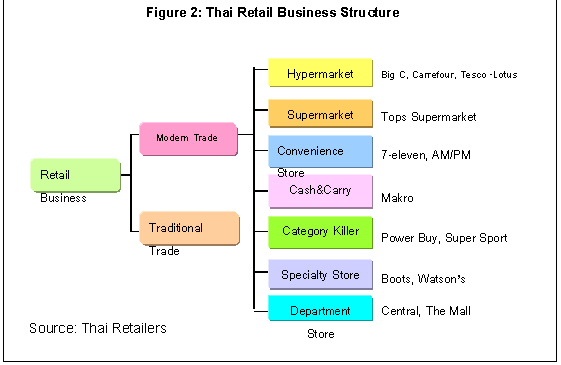
       Retail business can be classified into two types: a traditional trade and a modern trade.  Characteristics of the traditional trade can be defined as follows: being family-oriented in its nature and owned by Thais; providing old-fashioned services and exhibiting outdated displays: running business with non-standardized management systems and limited investment; being located in small commercial buildings or in local community. The modern trade’s characteristics, on the other hand, are as follows: providing modern services and displays; running business with standardized management systems; putting large investment in technology and innovation to attract customers (see Appendix 1).


    Modern trade’s market shares

        Data from Merrill Lynch Phatra showed the distribution of market shares in the retail business in 2000 as follows: hypermarkets (30%), department stores (28%), convenience stores(17%), cash&carry (16%) and supermarkets (9%). 


    The expansion of modern trade in 2000

As a result of the economic crisis and the policy to promote investment for retail business, discount stores do come in existence (e.g. Carrefour and Big C from France, Tesco-Lotus from the UK and Makro from the Netherlands). Their branches are extended   throughout Bangkok and provincial areas. This expansion has seized a large proportion of market shares especially from traditional retailers and department stores.    


Table 1: Branch Expansion Plan of Discount Stores in 2000-2001

Company

Country

Number of Branches  in 1997

Number of Existing Branches

Future Branches

Location of New Branches

Big C

France

19

20

10

2000-Huamark, Hat Yai, Samutprakarn andFasion Island2001-Pinkhlao, Suksawat, Bangkae, Bangna,

Ubonratchathani and Phuket

Tesco-Lotus

UK

12

24

11

2000-Rama 4, Sukumvit 50, Jangwattana, Raminthra,Lak si, Ngamwongwan, Korat, Hat yai, Songkla, Suratthani and Nakornsitummarat

Carrefour

France

6

11

8

2000-Rattanatibet, Rama 4

Makro

Netherlands

15

18

2

Sathorn , Nakornprathom

Source: Thai Retailers Association, surveyed and collected by Bank of Thailand.

Note: surveyed in August 2000.


   Price competition helps to maintain consumer prices

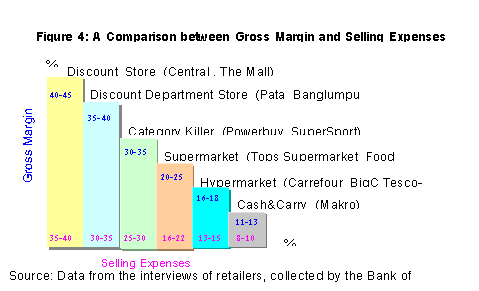
Currently, consumer product sales have, to a certain extent, shifted from a traditional trade having a high gross margin (net profit 20%) to a discount store (e.g. hypermarket, supermarket and cash&carry) having a low gross margin (net profit 3-5%). The low gross margin strategy which leads to a lower selling price has helped prevent consumer price index (CPI) from soaring.


     Keeping constant stock level leads to a lower cost

            In the retail business, keeping the stock of goods varies in its length of time, but mostly 1-3 months. Category Killers (such as Power Buy, Office Depot and Power Mall) keep their stock level and limit them to a period of 7 days, convenience stores and supermarkets keep theirs less than 15-20 days while department stores hold their stocks, approximately 2-3 months, due to a wide range of products they carry. Stock management for the retailers, therefore, should be aimed at minimum stock level and time. These businesses have been trying to bring their cost base to a tighter control by keeping constant stock level for each month with the minimum stock of goods. A distribution center (DC) and logistic system are available to diminish costs and enhance stock efficiency.  


    Trends of Thai and foreign retail trades

        The trend of retail trade is likely to be more competitive, particularly in terms of prices. The entry of the foreign discount stores, hypermarket and cash & carry has somewhat threatened Thai traditional retailers. Thai retailers are now standing on a shaky ground as some proportions of their market shares have been seized by foreign retailers. The authorities, on one hand, should help boost Thai competitiveness by providing know-how, technological and other supports such as computerized-aid, logistic system, DC and E-commerce etc. On the other hand, they should establish strategies to create fair business arena so that Thai retailers stand a better chance in the competition while sustaining fair market prices for the consumers.


Hosted by www.Geocities.ws

1