MRS. PADUA'S HOMEPAGE
ST. PATRICK'S/ASSUMPTION/ALL SAINTS SCHOOL
JERSEY CITY , NEW JERSEY
|


Dear Parents,
It is again the start of an exciting learning year. As your child's Science Teacher, I would like to welcome you to this science website which will give you the chance to have a bird's eye view of what we are doing in class. I will post announcements and reminders for your information. Feel free to access this website and to work with me so that we can encourage our kids to be the best they can be. You can email me at [email protected] .
REMINDERS :
Classes will start on Sept. 8 for students in pre-K to g-4 and Sept. 9 for g-5 to g-8, this is a 12 o'clock dismissal.
Whole day classes starts on the 12th of September.
Candy Sale will begin on Sept. 14 and the Open House will be on the 27th at 7:30 PM
WHAT'S NEW IN SCIENCE
SHUTTLE RETURNS TO SPACE-July 26-Space shuttle Discovery lifted off with commander Eileen Collins and her crew at 10:30 a.m. EDT. The launch is the first since Colombia broke apart during re-entry in 2003.
LIST OF RESOURCES
Earth science
Biology
Chemistry
Physics
OTHER RESOURCES
WELCOME STUDENTS!!!
I designed this website especially for you and our Science Class. Here you will find information about our lessons, projects, homework and other fun-learning activities. You will be able to play some cool learning games , watch amazing real-time videos and work with students in other parts of the globe for our upcoming Science Fair and learn about their cultures, traditions and lifestyles.
Use this site to its fullest extent and ENJOY!
MRS.NANCY
F. PADUA
g-6 and g-7 Science Teacher
 musical
plates
musical
plates
a study of
earthquakes and plate tectonics
activity for grade 6 Earth Science
Earthquakes, a physical and scientific phenomenon continuously amazes the scientific community as well as simple individuals like us. It definitely affects our lives in many ways. And up to now, no one is equipped with the full knowledge about this natural phenomenon. Even the most modern devices cannot exactly predict when , where and how strong a certain earthquake is. But we are well informed of why and how it happens.
In this activity students are expected to:
* Use real - time
data to solve a problem
*Study the correlation between earthquakes and tectonic plates
* Determine whether or not there is a correlation between volcanoes and
plate tectonics
Materials :
-world map
-pencil
-computer with internet access
-world map on a transparency
Teacher activities and directions:
After distributing the materials , forming groups and assigning roles from a hat, you will be given time to brainstorm your idea about what earthquake is, plate tectonics, historical earthquakes and your own experiences about earthquakes. You will then work individually for the rest of the project. Click the link below to continue with the activity. Follow the direction before proceeding with the project. You will only be given 45 minutes for each core activity. At the end of the activity you are also expected to ask-an-expert about this phenomenon and answer the questions below. Be ready to share your answer and experiences with the rest of the class. A sufficient time for computer use is needed.
click here MUSICAL PLATES PROJECT
NOTES:
Submit as a group:
(typed)
~the name of the group members and their roles
~ summary of your sharing from day 1and day 6
Submit
individually:
~the world map with the plot
~the website ,your question and the answer of the expert to your
question. (separate sheet of paper)
~the answer to the questions
QUESTIONS
1. Based on your plots. where are earthquakes likely to occur? Why?
2. List the different plates and briefly describe each.
3. Is there a correlation between volcanoes and earthquake? Explain your answer.
4. If you know a relative that resides on an active plate, what advice will you tell him concerning earthquakes?
chemical bonding
a lesson and activity for grade 7 science
While there are only 118 or so elements listed on the periodic table, there obviously more substance in nature than 118 pure elements. This is because atoms can react with one another to form new substances called compounds. Formed when two or more atoms chemically combined, the resulting compound is unique both chemically and physically .
|
|||||
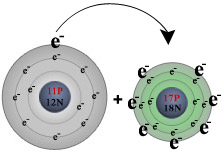 sodium (on the left) loses its one
 resulting in
 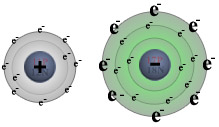 a positively charged sodium
The second major type of chemical bond occurs when atoms share electrons. This most commonly occurs between two non metals and is called covalent bond. Click on the link below to learn more about chemical bonding.
Be able to complete the quizzes and all scores in this activities will be recorded. If you have questions finishing any of the activity ask for help.