| Home | Set As Home Page | Add To Favorites | Music | Webmaster | Chatroom | Contact Me |
 |
Rif War: The Rif Republic and its Influence of Past and Present |
Posted on 23-10-2003
From my experience in
Morocco I have found that issues regarding the Rifi tribes of the north appear to be
quite sensitive. Indeed, they seem the least integrated of all the various types of people that make up what now is Morocco. This lack of integration is viewed with different outlooks. On one side the Rifi people have a great sense of pride and identity in their ethnicity. Many insist that they are of Germanic descent and some anthropologists concur. In keeping with this idea, there is a strong sense of keeping the blood line pure, and so marriage with outsiders is very rare. In addition, they have held on very strongly to their original Tarifit language while at the same time being viewed as perhaps the most conservative Muslims. Much of the Riffian mentality lies in their deep seated sense of honor which, being upheld brings great pride to these people. This pride has led them to resent outside rule to such an extent that many would like to actually proclaim the land that they inhabit as a separate state apart from Morocco.
While the average Rifi probably views the separatist nature of his culture as simply pride for their ethnicity, in my experience this has often been referred to as racism by other Moroccans. The fact that parents in these Berber areas often let the schools teach their children Arabic, while the parents only pass on Tarifit has often been an issue of contention as these people are practicing Muslims and do not wish to use the language of the faith. The strong sense of having a bloodline apart from the rest of Morocco, and the practice of marriage within this bloodline makes many outsiders accuse these people of racism. Overall, the most heated issue of debate over the Rifi people is over what has come to be called “Rif Land.” The “Rif Land” is the movement to create a separate state in the Rif Mountains and in that an autonomous state for the Rif Berber inhabitants.
With all of this being said one has to question the origin of such political controversy involving these people. How is it that one group within a nation has become so separatist and, in their view, marginalized? The answer to this political issue lies in the formation of modern Morocco. A large part of the formation of what is now Morocco came as a result of what is known as the Rif Rebellion or Rif War. This conflict is quite multi-faceted and to truly understand its past and present influences requires a full understanding of its leader, Muhammad ibn ‘Abd al-Karim al-Khattabi, its history and its immediate and long term national and international affects. Indeed, this war like every popular uprising has had long lasting sentiments that have shaped the people and the nation. In this discourse we will first examine all the aspects of the Rif War and then how these aspects have led to the Rifi identity of today.
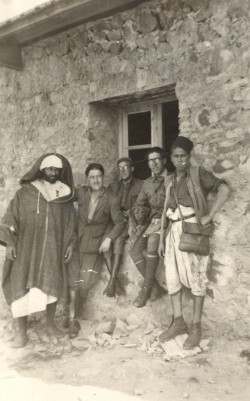
To begin, it is necessary to introduce the leader of the Rif War, Muhammid ibn ‘Abd al-Karim al-Khattabi. Spellings of this name vary from source to source, but for this purpose he will be referred to as ‘Abd al-Karim. ‘Abd al-Karim although being the leader of the massive revolt against the Spanish, was first in their service. Ironically, while his father supported Moulay Abdelhafid, a staunch colonialist opponent, in 1908, ‘Abd al-Karim had entered the Spanish service as the quadi of the Muslim community at Melilla. ‘Abd al-Karim came into this position after his graduation from the Quarawiyyan, considered as the pinnacle university of North Africa. The training that he received there and the power of his father as a wealthy man made him a good candidate for the position of the quadi, a type of religious judge. The Spanish used the quadi to ease opposition to the colonial power by creating a sort of go-between for the Berber tribes and the Spanish. In addition, this was often a strategy to create disunity between the Arabs and Berbers of the Maghrib by seeking Berber support. This practice of using members of the society as “puppets” in order to gain a greater control over the masses had been in practice long before the Spanish. In fact, even during the Roman occupation the practice was in place of using the Berber “notables” as an intermediary between the conquering government and the conquered.
The actions of the quadi were closely monitored by the Spanish and functioned to keep the native populations at peace, and the efforts of these people did not go unrewarded. “In the central Rif they gave a large monthly pension to ‘Abd al-Karim al-Khattabi [father]…and in 1913 they awarded a medal to his son Muhammid, the future Rifi leader, who was quadi of Melilla.” Indeed, such a position yielded great benefits in terms of wealth and prestige from the colonial overlord. Although he profited from his position with the Spanish government, the benefits that ‘Abd al-Karim received meant less to him in the end than fighting for his people. Indeed, it has occurred all too common in history that a person in such a position that ‘Abd al-Karim was in opted to remain a friend to the enemy in return for material wealth. This made the dramatic break from puppet to revolutionary a truly remarkable move for ‘Abd al-Karim.
The decisive break with the Spanish for ‘Abd al-Karim came when the Spanish began to advance from Melilla. “It was a period of upheaval and violence in Morocco generally, and one in which, in the Rif in particular, although colonialism had not yet been solidly implanted, its presence was nonetheless strongly felt and greatly detested.” The Spanish advance was able to progress fairly easily at first because the various tribes of the Rif were unable to ally themselves and form a strong front against the colonizers. This changed when the Rif’s largest tribe, the Banu Waryaghal, demanded that the Spanish pensioners break their ties. ‘Abd al-Karim’s father was the first to obey and at his urging ‘Abd al-Karim returned from Melilla, and inspired by the Salafi [Islamic Revivalism] ideas of social and religious reform, was determined to stop the advance. The basic Salafi principles that influenced ‘Abd al-Karim were very much turned toward the nation seeking Islamic reform, and for this reason was critical of controversial institutions as the zawiyyas which were often viewed as non-Islamic. The zawiyya had long been a staple of Moroccan spirituality, and especially Berber spirituality, and consisted of a type of shrine at the tomb of a holy man. These zawiyyas were highly criticized throughout the Arab world for being a form of idolatry and not truly Islamic, and ‘Abd al-Karim felt the same way. It was this type of religious fanaticism that ‘Abd al-Karim wanted to do away with in his republic, however this does not mean that he was in favor of creating a state based purely on Islam.
The arrival of ‘Abd al-Karim from Melilla after turning on his colonial employers marked the beginning of a unified Rifi front to meet the Spanish. Knowing that the political disunity of the tribes of the Rif led to a weak resistance front, ‘Abd al-Karim created a strong vehicle for the needed unity: The Rif Republic. “The rout of the Spanish army gave the Rifi leader…the time and the opportunity to impose upon the disparate tribes of the mountains the elements of a modern state in which administrative decrees overrode customary law.” Before discussing other aspects of the new republic it is important to first see the impact it had in response to the Spanish. Before the establishment of the republic the Spanish met little resistance from the tribes, at least the resistance was of a small enough scale that the colonial army had no problems. This all changed with the establishment of The Republic of the Rif. The most immediate and important effect of the declaration of the new state was a strong army and the victories that followed. The first important victory for the new Rifi army came when they attacked a Spanish blockhouse at Annoual. At the time of the attack the Spanish troops were ordered to evacuate and upon their retreat the tribes around the area rose up to kill 10,000 Spanish troops. This decisive victory started the Spanish retreat from the Moroccan interior. Upon this retreat the Rifi army turned their sights elsewhere and advanced on the French held city of Fez. At this time Fez was under French control, and thus any aggression toward the city would be directed toward the French and not an act of war against the Moroccan authorities. Although the army never attacked Fez, the threat to the French and the previous defeat of some Spanish forces led the French and Spanish to join forces to meet the Rifi resistance. The result was the amphibious landing of 16,000 more Spanish troops along with the advance of the French from the south and additional Spanish from the East; all of this to combat only 5,000 Rifi troops. With such a strong Franco-Spanish army ‘Abd al-Karim, fearing that he would otherwise be killed, surrendered and was banished to the Island of Reunion.
While the declaration of a Republic created a force to be reckoned with for the French and Spanish, it also served as an important source of unity for Morocco’s Rif Berbers. An interesting aspect of this unity lies in its religious versus its secular aspects that he saw as the keys to establishing a strong, unified republic. “After the war, ibn ‘Abd al-Karim complained that most Rifis had seen his leadership as a temporary expedient before restoring the traditional tribal structure of society.” Much to his dismay, while ‘Abd al-Karim wanted to unify the Rifi people into a legitimate nation most Rifis were happy with the status quo of having many separate tribes functioning independently, and thought that it would be better to revert to this structure after the Spanish were expelled and their unity was no longer necessary to their cause of autonomy. Even though the Rifi tribes had seen the benefit from unifying in their defeat of the Spanish they still did not want to create a new republic. This thinking may seem backwards, however a staple feature of Berber society has been that of disunity between tribes, even sometimes in warfare with one another, except when faced by an outside enemy and then, in this case, the formation of a unified front.
Although the tribes of the Rif may have been perfectly happy with their status as many separate groups of common genealogy, ‘Abd al-Karim still “wanted to set up ‘a country with a government and a flag’.” In order to establish this country ‘Abd al-Karim saw the nations of Europe as a guide, and thus began to establish his country in such a manner. First of all, in his desire for a republic as opposed to, perhaps, a religious monarchy, ‘Abd al-Karim showed a progressive mode of thought very much in line with what he saw as progress. Also, as mentioned before, he was quite influenced by the Islamic Revivalist movement of Salafi, ‘Abd al-Karim acknowledged that “The Islamic countries cannot achieve independence unless they free themselves from religious fanaticism and follow the path of the European peoples.” At the same time that ‘Abd al-Karim acknowledged that freedom from this fanaticism was the key to independence he also used one very important religious aspect to attempt to strengthen the unity of the republic: shari’a. Within the tribes were laws that were based on customs of that tribe and, therefore, specific to that tribe. ‘Abd al-Karim realized that unity could not be achieved with each tribe functioning on a different set of ethics so “Imposition of the Shari’a served a practical purpose too, because only a single system of law could supplant fragile tribal alliances and guarantee unity.”
As has been stated
previously, ‘Abd al-Karim’s desire ideal image for his republic was that it be
free of so-called religious fanaticism. At the same time ‘Abd al-Karim instituted the
shari’a in place of traditional tribal structures of law. It may seem contradictory
to have shari’a as the law and be free of fanaticism; however the delicate
combination of the two was badly needed to create a legitimate nation-state. It is
impossible that the society would ever be able to function with the legal disunity of so
many separate tribes, and instituting the shari’a law would allow all the tribes to
function according to the same law and social structure. Without a set of laws common to
all the tribes how could they effectively function as a national unit? This is not to say
that tribal traditions would need to be disbanded, but the shari’a would have to be
the dominant doctrine in order to have the necessary legal unity. It could be asserted
that the shari’a is contradictory to ‘Abd al-Karim’s desire for a
non-religiously fanatic state that desires to follow European countries as a guide;
however the shari’a provides a basic set of laws and regulations with a religious
foundation. Instituting shari’a does not necessarily encourage religious fanaticism.
‘Abd al-Karim, through his influence from the salafiyya, wanted freedom from the type
of fanaticism that was rampant in Morocco, most notably being the exaltation of saints and
the pilgrimages to zawiyyas. This type of fanaticism was of, perhaps, a heretical nature
as it was not seen as being in line with true Islam. For the new republic, shari’a
created a unified front in terms of laws and in terms of the religion. In other words,
although ‘Abd al-Karim wished to dispose of the religious fanaticism often present in
the region, however by instituting shari’a he did not call for an entirely secular
state, nor did he call for a state founded on religious extremism. In short, perhaps
‘Abd al-Karim simply called for a religiously moderate state that did not lean too
far into either sector.
In addition to the unity that the shari’a was imposed to create, it also could have functioned to create legitimacy of the republic in the eyes of other Islamic countries. Indeed, for The Republic of the Rif being seen as a rogue state by Europe for its colonial uprising it had little chance of being honored there. However, with much of the Middle East either struggling or having struggled with colonialism, the emergence of an Islamic state through rebellion of the western imperialist would give invaluable credibility to The Republic of the Rif.
To return back to history, we will start at the banishment of ‘Abd al-Karim from Morocco. With the banishment of ‘Abd al-Karim and the crushing of the Rif Rebellion by the combined French and Spanish armies, the movement of the Republic of the Rif ended. From that point the Spanish kept a close watch on the Rif regions fearing a future rebellion. In 1945 Franco, the Spanish dictator, appointed a new High Commissioner in Jose Enrique who “prohibited public gatherings and banned suspected nationalists from traveling to the Rif.” Obviously, the threat from the Rifis was still very real to the Spanish even long after the rebellion had ended. With this in mind, we look now to the protectorate period of 1949-1953. During this time the foreign investment of the settlers soared, and through it the rich became only richer, and with high rates of inflation the poor became poorer. In the Rif the poverty was perhaps the worst. With a low rainfall for several years and a lack of demand for its products, the Rif Mountains became more and more impoverished. This poverty was made even worse by Moroccan independence when “the border with Algeria was closed, so emigration was no longer easy; there was no colonial army to enlist in and economic integration with the rest of Morocco pushed up prices.” Although hard to believe at the current time, Algeria was a popular point of emigration for Rif Berbers seeking work, and with the closing of the borders this option was now much more difficult. Secondly, for Rifis desperate to work the Spanish army provided a source of income for their service. Most importantly, the Rif was under Spanish control while the rest of Morocco was under the French. With independence the integration of the separate French and Spanish zones of the country was economically unfavorable for the former Spanish zone. All of these factors combined with agricultural issues left the Rif area in a sad economic state.
The economic situation of the Rif, understandably, created a strong undercurrent of dissatisfaction. All of this finally exploded in 1958 with another rebellion. At this time the political party of power, with the backing of King Hassan II, was the Istiqlal, or Independence Party. The Rifis, long a proud people, strongly opposed the rule by outsiders and “there was resentment at Istiqlal which monopolized the administrative posts and filled them with outsiders who spoke Arabic or French, not Berber or Spanish.” Eventually this resentment reached a head and the result was a revolt where “Istiqlal offices were attacked and rebels occupied the town of Al Hocema” and Hassan II reacted “with great ferocity. Using 20,000 troops, some of whom made an amphibious landing at Al Hocema, he crushed the rebellion.” The revolt of 1958 had much in common as the first revolt against the Spanish. The basic nature of both revolts was the Rifis resentment of being lorded over by an outsider while they were living in poor economic conditions. The 1958 rebellion was not necessarily a rebellion against Morocco; perhaps it would not have taken place if Rifi Moroccans were put in administrative posts as opposed to those Moroccans seen as foreigners. Perhaps a huge factor was that with the poverty of the time the general Rifi population felt that an outsider could not understand their plight and, in that case, would not care. It is valid that the administrators in the Rif should be Riffian; they, were just as Moroccan as the Arabic or French speakers and if they were qualified should have had just as much right as anyone else to hold such a position. Secondly, given the economic situation, not assigning local people to government populations could be viewed as an attempt to keep the population down and for the zones that benefited from the protectorate status to further enhance their wealth by now controlling the so-called Independent government. Overall, the rebellion of 1958 can be viewed as simply a people seeking autonomy within a newly autonomous country that they then became a part of.
Having investigated the recent historical issues of the Rif, we must now correlate them with the meaning for the current status of Riffians in terms of how they are viewed by outsiders. First of all, to look into the strong sense of identity that is now in the Rif I interviewed Toufik Attaheri. Toufik was born in Nador, Morocco. He is a former professional athlete, US citizen, holds a PHD in economics and he currently resides in Dallas, Texas. Toufik’s opinion on the ideas of Muhammid bin ‘Abd al-Karim and the Republic of the Rif is that they are simply symbols of the pride of the Rif people. As for the Republic, he says most see it now as simply the expression of a unified people, and in the example of ‘Abd al-Karim they see a man that loved his country more than the wealth from any colonialists. By outsiders ‘Abd al-Karim and the Republic of the Rif may seem revolutionary or threatening to the unity of Morocco, but perhaps too much is being read into that. Perhaps these simply stand for the Rifi ideals of pride and the want for soverignity within a free nation, not necessarily separation from that nation.
In regards to the government view of the Rif, there is indeed a threat from the Rif tribes if they feel they are being oppressed. The danger is evident in the rebellions of the Rif that this is not a people to take oppression. Secondly, the ideals of the Republic of the Rif can be seen as contradictory to the current government. First of all, with a rising Islamist popularity in Morocco the progressive nature of the secularism of the republic could be threatening to this movement. Most importantly, the very name of the Republic of the Rif containing the word republic takes away the presence of a king. In both ways the Republic of the Rif could be seen as contradictory to the status quo of Morocco’s present government.
In the end, perhaps the greatest problem in the outsider view of the Riffians is simply misunderstanding. Often misunderstanding is the root of fear and fear is often the root of prejudice. Is the strong unity of the people racism or simply pride in their heritage? Are the ideals of Muhammid bin ‘Abd al-Karim and his Republic of the Rif revolutionary images that are a threat to the country or are they simply a source of pride in the results of the unity within an ethnicity? Were the rebellions of the Rif irrational rural uprisings or were they simply frustrated response to outside rule and the poverty that was coming with it? Maybe it is overly optimistic to take the simplistic view to these issues, nevertheless I believe that this is a people of a strong honor, and with a strong honor within a community comes a strong honor to outsiders. However, this honor is only given to those who are seen as worthy. In the end, I feel that this honor will be shown to those who are seen as worthy, and those seen as worthy should feel no apprehension toward the core values of these people.
Written By George Kleuser
A student in Alakhawayn University from The United Stats
Read More in the Related Topics :
 1911 - 1927 Rif War / Second
Moroccan War.
1911 - 1927 Rif War / Second
Moroccan War.
Morocco
Bans Historical Conferences.
.: Home :.|.: Set As Home Page :.|.: Add To Favorites :.|.: Webmaster :.|.: Contact Me :. All Rights Reserved , No part Of This Publication May Be Reproduced , Noumidia.Tk © 2003/2004 Al-Hoceima |