Batman: Tenses Part II
(2003)
Writer: Joe Casey
Illustrator: Cully Hamner
Inker: Dexter Vines
Colorist and Separator: Lee Loughridge
Letterer: Sean Konot
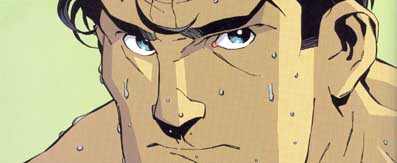
Tenses Part II opens with a William Black TV newscast, as Black charges that Bruce Wayne's "brutal layoff policies" (or "economic streamlining") forced Ted Krosby into a life of crime. Bruce listens to the broadcast in his palatial mansion beneath the stern, almost disapproving portrait of his parents. His face shows no reaction.
Later, in an extraordinary sequence, Bruce Wayne gets a yearly physical checkup from a doctor. For the first time, we see how a medical professional deals with Bruce's amazing physical condition and brutal scarring. ("Don't be alarmed," Bruce tells the doctor upon the revelation of his scars, "I'm an extreme sports fanatic. The idle rich need their distractions.") The doctor seems troubled by the results of Bruce's tests. "Normally," he says, "a man in your position, a certain level of stress is to be expected. But you have no stress. None. It's unprecedented." Bruce again shows no reaction to this news, and the doctor goes on to relate a story about a man who beat a lie-detector test, calling that man the "greatest liar of all time". The reader is led to question Bruce's mental state, and his emotional one as well.
Perhaps feeling guilty, perhaps only curious about the criminal mindset, Bruce visits Ted Krosby in a mental institute. The old Ted, the harmless schlub who drifted through daily life, is gone. He's been replaced by a wild-eyed prophet of the future, who has the nerve to accuse Bruce Wayne of visiting in order "to see how the little people live, the people you crush without thinking, like insects". In flashbacks, we see the horrible abuse Ted suffered at the hands of his father, who deserted Ted and his mother. Bruce prepares to leave, saying that the visit has been a waste of time. Ted stops him by asking Bruce "If you knew how much time you had - or didn't have - to waste, would you do things differently? Not a question you feel comfortable asking yourself, is it? More denial, more blindness, more lies. Rich in everything except vision...Have you ever stopped to consider your own inferno, rich man? Consider it now..."
Perhaps most disquieting for Bruce Wayne is that Ted knows, or at least guesses, about the tragedy of his own life. Ted says that he admires Bruce for being able to pull himself out of tragedy while Ted let it destroy him, let it keep him a "small man" while Bruce rose to the upper echelons of social and industrial Gotham. Before being hauled away by the guards, Ted cries out that "you have to hate your father as much as you love him", speaking to the endless father-son issues that seem to infiltrate every Bruce Wayne-centric story. Finally, Ted says that, according to his futuristic visions, Bruce will die alone. Perhaps that disturbs him more than anything else.
An overreaction? Certainly. This entire exchange brings up questions regarding Bruce's sexual orientation and the way it bleeds into his mission, creating or perhaps confirming some very confusing issues for fans. It is Bruce's reaction to Black's insinuation, and the next scene in which he beats the beejesus out of a group of armed thugs, which underscore the fact that Bruce is, at best, uneasy in his own skin. He is, indeed, a man in deep denial of his own nature. Whether that translates into sexual confusion is best left to the slash writers; as it functions in canon, Casey is telling a story about a human being in crisis. And it works.
Another being in crisis is, of course, Ted Krosby. Lance, one of the men who was pushing Ted to rob Kane's Department Store, has sprung Ted from prison. Ted, it seems, has devolved into murder and cannibalism, apparently driven insane by his gift. He murders Lance in a gruesome scene involving an eyeball (readers of Catwoman #16 won't blink, but everyone else will) and after slaughtering the rest of the building, sets his prophetic gaze on the man who ruined his young life: his father. Batman is needed.
Black comes to Wayne Manor for yet another confrontation with Bruce Wayne. Bruce is more accepting of Black's company. The reporter offers him first companionship and then simple understanding; Wayne refuses both, although more diplomatically than he did previously. Finally, Black offers Wayne a psychiatrist's phone number in the hopes that Bruce might reach out for help.
It is interesting that, in the final showdown, Batman tosses a Batarang (perhaps intentionally) and plucks out one of Ted's eyes, echoing Krosby's earlier dismemberment of a thug. The similarities between the two men seem stronger than ever as Ted gives in to lunacy and Batman to his less-than-heroic instincts. He allows Ted to wander off into the woods to die (one of the few times it's even hinted at in the comics that Batman won't take direct action to save a life) and as he refuses to help Ted, he also refuses to help himself. In a final scene, Bruce Wayne grants William Black an interview in which he explains his actions as CEO of Wayne Enterprises. Black shakes hands, clearly regretting that now, the interview over, his excuse to connect with Bruce has dissolved. During the handshake, Bruce slips the shrink's number back into Black's hand.
And so Tenses concludes as it began, with Bruce Wayne alone in the Batcave, exercising, pushing himself to exhaustion. And here is Casey's final stroke of strong, powerful characterization. Because never, in any post-Crisis version of the character, has it been suggested that Bruce Wayne has chosen to be unhappy.
Bruce Wayne has, more than anything else, been written as a victim, first as young child orphaned by urban violence and crime, and then as an adult paralyzed by his own emotions. However, in Tenses, Bruce becomes something more: a man who has deliberately chosen to remain in pain and isolation. Like Ted Krosby, childhood tragedy has forced him to construct walls, preventing him from realizing his full potential as a functional human being and instead be confined to an existence that is somehow smaller, and more narrow, than would be otherwise possible. Batman is not a good choice for Bruce Wayne; everything that has occurred in this story is evidence of that. With no tempering influence, with no close family or friends, Batman is a scary, ugly thing. Like Darwyn Cooke's Ego or Frank Miller's The Dark Knight Returns, Batman is an aberration. The implication of Tenses is that Bruce Wayne not only created him, but kept him going.
Tenses is certainly a darker and more pessimistic look at a character generally known in the superhero genre for being dark and pessimistic. The story works as a moibus strip, beginning in one place, traveling along a linear line, and then bending and twisting back upon itself to start at the beginning again but at an entirely new perspective. The beginning panel in Part One showed a contemplative Bruce Wayne exercising; by the last panel in Part Two, we understand the meaning behind his look, and the reason for his punishing regimen.
Tenses is communicated mainly through sparse dialogue in which people talk around things rather than about them. Lacking the traditional internal monologue favored by contemporary comic book writers, Casey often lets the visuals speak for themselves. It's here that Cully Hamner's gift with facial expression comes into play: with the wrong artist, or an artist who focused more on action panels than emotional detail (I'm looking at you, Jim Lee) the story might have failed. Instead, it's a rousing success, one of the most insightful and complicated Batman stories I've ever read.
To read some other people's opinions about this story, as well as some comments from writer Joe Casey, check out the official DC message board thread here. There's also a fairly good Fourth Rail review here, and, for a very different opinion, a Simply Comics review which gives the two-parter 1 out of 5. But please, check out the book for yourself and see what you think - it's worth it, folks.
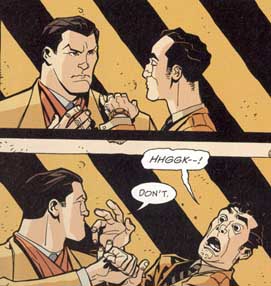 In a dark mood, Wayne heads down to the underground parking complex to retrieve his car and runs into William Black, setting the stage for one of the strangest encounters in this odd and intriguing story. Black says that Wayne has "been coming across like a guy in deep denial", and tells him that he too lost his parents at a young age. Bruce is stand-offish, believing Black is simply manipulating him to get a better story. Black continues to talk, revealing the fact that he was suicidal after his parents' death and that his parents disapproved of his homosexuality. Black struggles to find a common thread he can use to reach Bruce, mistaking Bruce's secret mission for concealment of an unacceptable sexual orientation. "If you just want to talk to someone..." Black offers, resting a hand on Bruce's shoulder. Bruce responds by nearly breaking Black's hand.
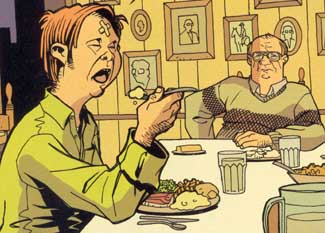 Meanwhile, Ted Krosby has made his way to his father's house in the country for a final, brutal confrontation. Here the writing slips a bit; Casey subverts Ted's potential as a truly unique and intriguing Bat villain and turns him into a clich�d serial-killer who spouts lines Hannibal Lector might have once considered and then rejected as being too hammy. Ted murders his abusive, absent father, eating his intestines and, at one point, wearing his head as a hat. Rarely has even the Joker been given such gruesome scenes, but the last few pages of the story lack any true impact, simply because the Ted Krosby we once felt sorry for, once sympathized with, is gone, replaced by yet another hackneyed bad guy.