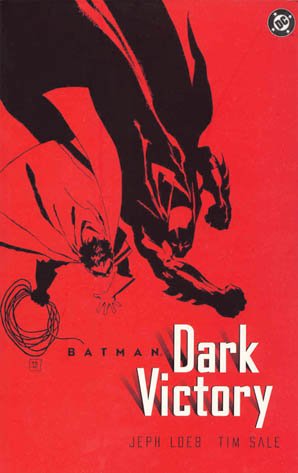
Batman: Dark Victory
(2001)
Writer: Jeph Loeb
Illustrator: Tim Sale
Colorist: Gregory Wright
Letterer: Richard Starkings
Archie Goodwin, the great, departed group editor at DC Comics, is credited as the "inspiration" for this story of paternal love both perverted into violence and bloodshed and asserted as one damaged soul tries to heal another. One senses the dedication and affection both Jeph Loeb and Tim Sale hold for their mentor, transmuting those feelings for Goodwin into the story which showcases the post-Crisis introduction of Dick Grayson into Bruce Wayne's lonely life. DV is a story of fathers and sons (and daughters), although it takes a while for that theme to come to the surface.
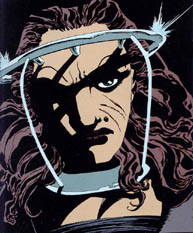 The story begins by recapping the consequences suffered by those in TLH: Alberto Falcone, one of the Holiday killers, is behind bars at Arkham, sharing a Hannibal-Lectorish cell with Julian Day, the Calendar Man. Sofia Falcone, last seen being tossed out a window by Catwoman, is alive and busily assuming control of her father's criminal empire. She has been left crippled from Catwoman's attack, her massive body confined to a wheelchair, a silver halo holding her neck firmly in place, and three long scars grace the side of her face (an echo of Catwoman's wounding of her father in Batman: Year One).
The relationship between James Gordon and Batman has grown increasingly strained after the events in TLH: Batman has isolated himself in his quest, divorcing himself from working with Gordon in favor of taking to the night alone. A new DA, Janice Porter, is making life difficult for Gordon, and both men miss Harvey Dent constantly. Dent, of course, is now making a name for himself in the underworld as Two-Face. Partway through the story, Bruce confides to Alfred that he was about to share his secret with Harvey Dent, right before the DA was scarred by acid in court and transformed into Two-Face. The key theme Loeb works with throughout the story is personal and professional isolation: none of the characters save Gordon make any effort to reach out to one another, and the results are destructive, leading into the years of regret and lost opportunities for friendship and trust seen in later-set Batman stories.
"I am alone," Batman tells himself as he begins investigating the Hangman murders, a series of killings which target Gotham cops. The first to go is Chief O'Hara, a friend of Gordon's who has a nice monologue about how being a cop in Gotham used to mean something "until the Wayne murders". He's strung up on a bridge, a child's game of hangman left as a clue. The murders work better in DV than they did in The Long Halloween: both the killer's identity and the targets make more sense, and the resolution of the mystery is satisfying without being too obvious. Loeb does a much better job in this story of keeping the Gotham crime families straight for his readers. He focuses on a key cast of characters and shows us who they are and why. Sofia Falcone is a great villain, her eyes brimming with rage and hate as she vows to restore her family's criminal empire via brutal tactics and intimidation. Mario Falcone is another brilliant addition to the story, brought on board as a honest man from a bad family who tries to make things better and, in the end, succumbs to the insanity plauging Gotham.
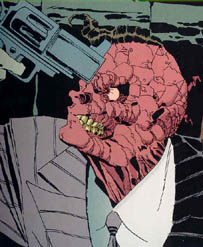 Loeb seems more interested in this story in exploring the "freaks" of Gotham and Batman's role in their creation. At one point, Gordon asks Batman if he's aware that the theme criminals and evil masterminds such as the Joker, the Scarecrow and, yes, even Two-Face, all came to Gotham as a direct result of Batman's presence in the city. This is a story about the last stand between the old, traditional criminals (the mobsters, the gun-runners, the dealers) and the new guard of insane, brightly-colored adversaries, who fight among each other and with Batman. Occupying the gray area in between is Catwoman, unique among Batman's rogues in that she has a mission and an agenda of her own. The romance between Bruce Wayne and Selina Kyle is continued into this story from The Long Halloween, and her eventual abandonment of him is presented as one of the reasons he takes young Dick Grayson into his care. Their relationship is sad, doomed, and interesting in the way it is permitted to continue as sexual flirtation in later Loeb-penned stories and, in Ed Brubaker's relaunch, an alliance between two people who might have been lovers but weren't.
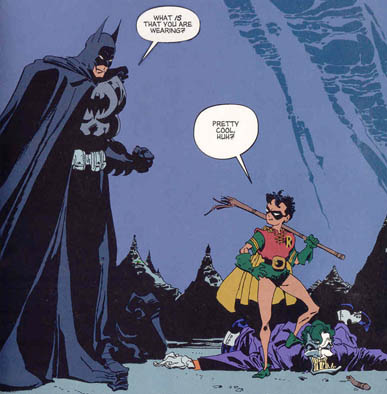
Batman is perhaps even more grim and driven in this story than he is 10 years later in the Bruce Wayne: Murderer/Fugitive arc. Discovering himself to be alone in the world, he goes after the Hangman killer with a vengence, and when a pair of circus acrobats are killed through low-level Falcone employee Tony Zucco's clumsy attempts at extortion, Batman takes Dick Grayson under his wing as both a way to bring down the mob in Gotham once and for all and to assuage his own loneliness. As Tim Sale writes in his introduction: "Batman is a loner. What sense did it make for him to have a companion? Or for us to give him one? Jeph [Loeb]'s answer lay in the contrast: his depecition of Dick as an extroverted, talkly little kid, and the conflicts in personalities that arose from that...made sense to me."
It makes sense to me, too, and while the thought of the forbidding figure of Batman taking on a little kid seems a bit circumspect, Dick fits into this story with remarkable ease. For all the freaks and weirdos inhabiting Gotham, there's something natural about Batman and his sidekick Robin, and there is a great deal of poignancy in the scene where Dick realizes both he and Bruce are orphans and need each other not just as partners but as brothers, or perhaps as father and son.
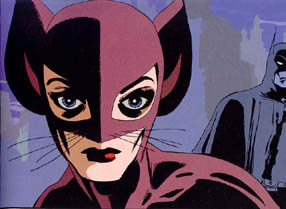 There's also a revelation here about Selina Kyle's parentage, one that some fans were upset by but one I personally found almost poetic, giving Catwoman a reason to lash out against both hostile social forces and the Falcone family without being motivated entirely by either money or self-interest. Loeb does such a delicate job of characterization on Catwoman that we feel alternately sorry for the woman and awed by her percise insight into Batman's mind. "Isn't there anything left inside of you?" she asks him at one point, slapping him across the face to get her point across. Like Gordon, Catwoman is a character of moral accuracy in Loeb's stories, conflicted but able to see what is the right thing to do whereas Batman struggles with the same issues. Sale and Loeb are in the midst of creating a book called 'Catwoman: When in Rome', which fills in the missing time when Catwoman is off-screen in Dark Victory, and the character is rarely used so well as love interest and shaping moral influence than in this story. With enemies like these, why does Batman need friends?
In the end, Dark Victory is more a character study of these particular individuals in this particular setting than the crime thriller that The Long Halloween was. The identity of the Hangman killer isn't that much of a mystery, and while the usual Loeb affectations are employed (look! The Joker shows up! hey, Two-Face puts someone on trial!) he manages to invest his characters with a hell of a lot of gray areas both emotionally and psychologically. One understands why Batman needs a partner and why Gordon needs his cop friends; one also understands why Catwoman is a worthy love interest in the Batman universe, and why Harvey Dent's psychosis is deep-running and nearly impossible to reverse. There is a lot of good in this story which seems to prove that, starting with this book, Batman is no longer alone.