
NORTH
SHORE WARGAMES CLUB
Moderns
| Home | Moderns links | News | Club moderns competition |
New models
Game report
Moderns NatCon winners
Moderns
wargaming is a
contemporaneous period,
covering warfare from the second half of the twentieth century onwards. Our club plays moderns in micro scale, that is
either 1/300th or 1/285. We use WRG's Wargames
Rules for All Arms Land Warfare From Platoon to Battalion Level 1950-2000.
New Moderns Rules
Phil Barker has written a new set of naval rules, inspired by some recent contract work he did for the British
Department of Defence. The latest draft of the rules are available on Phil
Barker's Web Page. "If anyone wants to see what
has been distracting me for the last two months, they will find the
current version of "Subs & Sams" on my web page. I did
consider "Subs & Missiles", but the initials would have been
unfortunate..."
Another of his new rules systems is "The Sharp End", being company level rules.
New Army Lists ^
The latest army list book for WRG Moderns was published in December 2005 by Al Donald.
The title is Wargame Army list for the Modern Period 1950-2005 and follows the army list format used in the WRG 1925-1950 rule book published in 1988 which had WWII army lists appended to it.
It covers:
Introduction
Information Accuracy
List Layouts
List Organisations
Artillery Support
Specialised Artillery Shells
Reconnaissance
Infantry Transport
Inert Defence Supplement conversions from Hasty Defence Lists
Air Support
Electronic Warfare
Imbalance Costs
Observer Elements
List Abbreviations
Major Conflicts
Select Bibliography
Websites
Acknowledgements
It also contains:
AFV Characteristics and Cost (additional or errata from the WRG rules section)
Contemporary ATGM (additions such as the Israeli Spike missiles)
Expendable Air Weapons
Example Army Lists
Terrain Laying Suggestions
The list cover the following armies:
Afghanistan, Albania, Angola, Argentina, Australia, Austria
Belgium, Brazil, Bulgaria
Canada, Chile, People's Republic of China, Cuba, Czechoslovakia / Czech Republic / Slovakia
Denmark
Egypt, Ethiopia
Finland, France
East Germany, Unified Germany, West Germany
India, Iran, Iraq, Israel
Jordan
North Korea, South Korea, Kuwait
Netherlands, Norway
Pakistan, Poland
Qatar
Russia / Soviet Union / Confederation of Independent States
Saudi Arabia, South Africa, Spain, Sweden, Switzerland, Syria
United Arab Emirates, United Kingdom, United States Army, United States Marines
Each list has a table on:
- the nation's troops from 1950 to 2010, including points values and element counts and full descriptions, including battlegroups, battalions, companies, squadrons, platoon, troop and section organisations
- artillery in use
- the make-up and equipment of the infantry and support weapon elements
Each army list table covers:
Battlegroup make-up
Antiaircraft
Anti-tank
Recce
Tank
Mechanised infantry
Motorised infantry
'Leg' infantry
Parachute/Airborne units
Marines
Artillery
Fighters
Ground attack
Helicopters
All have entry and exit dates where applicable.
This enables players to easily make up armies using WRG and fight battles throughout the period.
^
Flashpoint Miniatures is a New Zealand company based in Whangarei currently working on rules, models and terrain for modern Middle East and Vietnam wars.
New releases (as of
September 2005) from Eureka
Miniatures
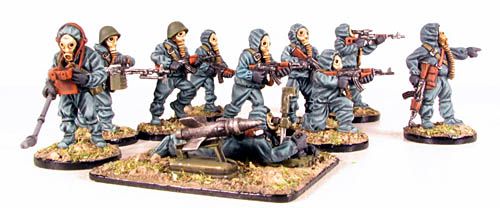
This new 28mm range depicts troops wearing the multi-piece chemical
protective suit that was issued to Soviet and Eastern Bloc Chemical
Defence Force Personnel from the 1960�s, right through to the late
1980�s. The infamously uncomfortable rubberised NBC (Nuclear,
Biological, Chemical) suit, coupled with gasmask, was supposed to
provide adequate protection in contaminated environments. It is
faithfully reproduced here with its distinctive elasticated hood and
sleeves.
One trooper uses a DP-2 Contamination Survey Meter to sweep for
radioactive contamination, while another operates the AT-3 Sagger
wire guided missile. Although now considered obsolete, the Sagger
had its hey-day in the early 1970-80�s when it equipped many
Soviet client states, and would have been in front line service in
many 1980�s war scenarios. An SVD sniper rifle and a PK machine
gun round-out the rest of the squad, along with, of course, the
ubiquitous AK-47.
| From:
Lieutenant-Colonel Humphrey Fortesque-Hockley, Officer Commanding,
'A' Squadron, The Queen's Dragoon Guards To: Major Rupert Pertherington-Smythe, Life Guards (attached), 7th Armoured Brigade Headquarters Pre-Action Report, SIMFICS exercise SANDY BOOTS, Kuwait Theatre of Operations, 1 February 1991. Dear Rupert How's things back at HQ? Had a chukka with Uncle Sam's Marines next door yesterday. Marvellous show by the lads, even the Staffords did well for infantry. Started off over a bet that 'flexible defence' can withstand 'The Marine Way'. Decided to settle the argument using laser training aids. The Queen's Dragoon Guards deployed two troops of Scimitars and a Striker Anti-Tank troop, a platoon of Staffords in Warriors, and had some on-call assistance from the heavies of the 39th. The leathernecks seemed to have rustled up some infantry in large mobile barns they call AAV-7s, a few M60's with some add-on Israeli armour and a recce platoon in LAVs which aren't much smaller than an AAV-7. Give me a Scimitar any day. However, the cheats seem to have enlisted the USS Iowa off the coast which came as a nasty surprise to the artillery. We wound up being deployed in a series of low sand-dunes and small villages 2 miles north of ZINC along highway BAMBER, with the Marines advancing south-west. Camouflage was excellent and we saw no evidence that the Marines had detected our positions in advance of the exercise. Initial contact was made by the 39th's advanced artillery observer who detected some vehicular movement to the south-east and called a fire programme down. A cloud of pyrotechnic smoke went up after the MLRS 'bomblet' strike so we knew we'd got some of the blighters - turned out it was an AAVP-7 full of leathernecks who weren't too happy at being forced back to the casualty tent so early in the scrap. One of the USN Shore Patrol had to hit one. This is when the 39th were radioed that they'd been detected by the Iowa and they were being engaged by 16 inch ordnance. This caused some consternation at the missile position and after much running around (where they missed a rendezvous with their reload trucks) it was judged that they'd lost one MLRS and couldn't come back on line for 40 minutes. Next contact was in the same area when a Striker launched a Swingfire missile that set off another AAVP-7 strobe light and smoke, leading to more leathernecks in the casualty tent and more thwacking by umpires and Shore Patrol to maintain order. So far, two mobile barns down for an MLRS. Further to the northwest, we detected some movement near the village, but since the artillery were still driving aimlessly around 15 km to our rear we couldn't engage. The Strikers launched another missile at a fleeting target that turned out to be a turret-down TOW launcher on a LAV but hit the base of the rise about 200m away. The sooner the MOD gets around to deploying that new ACLOS Swingfire development the better - the stuff we have now was developed in the '60s... It turned out the two AAVP-7's were part of a Marine company attacking the other village to the southeast. We'd deployed the Staffords in this village and the two forces ran into each other. A heavy firefight ensued (and the occassional kicking too I am informed - it would seem our infantry are quite capable of starting a fight as the Marines) where the leading Marine elements were cut down. Return fire from their pinned foot and some M60's kept our men down and depleted two sections, one of which was the platoon CO. That'll teach him to keep his head down. The LAW 80 heavy anti-tank rockets worked a treat and knocked out several M60's and surviving AAVP-7's, in conjunction with some Warrior Rarden fire, stopping the attack dead. We lost a Warrior to a Marine Dragon round after the first hit had failed to detonate against that new Chobham armour, but with 6 men 'down' the Staffords platoon held out throughout the engagement. Good show! Over the rest of the battlefield the Marines resorted to their feet and advanced slowly through the rises and ridges around BAMBER. The Queen's Scimitar troop deployed near that area snapped off a few shots and retired - 30mm of aluminium armour wouldn't have stood up to the Marine disposable anti-tank weapons. There was a tussle with the Queen's Striker deployed in that sector and the Marine LAV recce platoon where the LAVs themselves came off worst. We didn't see any armour but it turned out they were hiding in the sand dunes out of sight - the Swingfire missle may be 1960's technology but it was forcing the Marines to keep their heads (or should I say turrets) down. We need to whizz up some ideas how to frighten the Iraqis with them. The 39th came back on line but the Marines jammed their comms so we didn't see them again. Eventually the battery packs in the infantry SIMFICS ran down and we called off the exercise. Certainly the Queen's defence slowed the Marine attack considerably and I can confidently say that, should the 7th Armoured Battlegroup get attacked in the flank by Iraqi forces in the next couple of weeks we'll be well placed to hold their attack until the Challengers arrive. Toodle-pip PS Regards to Cynthia and the boys
|
Moderns NATCON winners ^
1980 P Emmanuel
1981 A D Taylor
1982 R L Patton
1983 A D Taylor
1984 A D Taylor
1985 A S Hunter
1986 T Semmens
1987 A L Donald
1988 A L Donald
1989 T Rowe
1990 A L Donald
1991 A S Hunter
1992 K Bristow
1993 B Trott
1994 G Roach
1995 A L Donald
1996 A L Donald
1997 G Roach
1998 A L Donald
1999 B Trott
2000 B Trott
2001 S Holroyd
2002 S Holroyd
2003 D J Cassidy
2004 B Trott
2005 G Dale
2006 D J Cassidy
2007 K Mahoney
