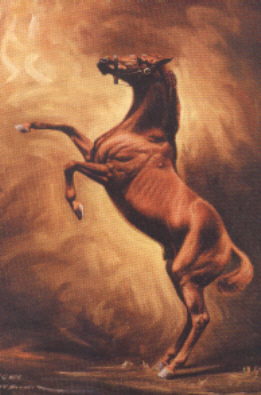
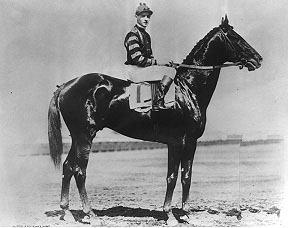
It was near the end of the first World War, and America was in desperate need for a distraction from the blood bath that was happening to the world over seas. The sport of kings seemed to be lacking in attraction for some Americans, even though Sir Barton had a Cinderella story in the making of 1919. But as Sir Barton was becoming a house hold name, a large Fair Play colt came on the racing scene just as Sir Barton was wrapping up his soon to be named Triple Crown. Man O'War was just what America needed. It seemed like the large chestnut was sent from heaven to fill the hearts of Americans with optimism, faith and hope, in such a time of dispair.
Man O'War raced back in the days where thoroughbreds had the strength to race days after day; where they could flatten fields of horses, carrying now what would be unheard of weight. Man O'War was no different, and certainly no less. He was the poster horse for all horses. He was the origional "Big Red".
On June 6, 1919, Man O'War ran his very first race, a 5 furlong maiden at Belmont Park. He won easily, beating his 6 rivals by 6 lengths and stopping the clock at :59 seconds. Not bad for a horses first start. Only three days later (and two days before Sir Barton won the Belmont Stakes), Man O'War raced again. This time he won a stakes race, the Keene Memorial. Next, Man O'War was taken to the Jamaica Race Course, where he won the Youthful Stakes.
It seemed already to the racing stewards that Man O'War was maybe too good for the fields he was racing against. So in Belmont's Hudson Stakes, they piled 130 pounds on the two year olds back. Would this slow down this monster? No. Only 2 days after his Youthful victory, Man O'War carried that weight to a one and a half length win. Now, America was taking notice. Here was a horse that seemed to tare up the track under extreme conditions, and no one had yet seen what this colt could really do.
Man O'War would next take the Tremont Stakes and then the US Hotel Stakes at Saratoga. It was this race that Man O'War would be introduced to a colt named Upset who came second. How ironic is the name of a colt that would next give the great Man O'War's only career defeat. After a terrible start in the Sandford Memorial, Man O'War shuffled through the horses and tried to rally late on Upset who was leading. But the finish line came to quickly and Man O'War lost by one half of a |