 |
| KELSO |
| No introduction is needed when Kelso is mentioned. He holds the record for the number of Horse of the Year titles...five. Yes five, consecutive wins, among other awards. Kelso has accomplished things that some other great horses never have. Although Kelso, a gelding by Your Host out of a Count Fleet mare, did not do much on the track as a two year old. He ran three times, all at Atlantic City, breaking his maiden the first time about and then coming second in |
|
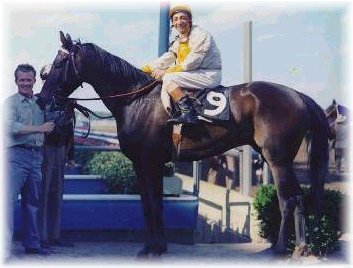
| Kelso, winner of the 1961 Metropolitan Handicap. |
| two allowance races. And even though Kelso would not be recongnized as a top juvenile, he would go on to virtually dominate his divisions for years. Kelso did not run until late June of 1960, well after the ending of the Triple Crown trail. His first two races were spectacular, easily destroying his rivals in allowances by ten and twelve lengths. He was then sent to the Arlington Classic where he came eigth, finishing behind Kentucky Derby winner Venetian Way, a future top stakes winner John Willaim and the winner T.V. Lark, a horse in which Kelso would meet up with many times in the future. After the Classic, Kelso was unstoppable. He won the Choice Stakes at Monmouth Park by seven lengths, and then Jerome(the great Eddie Arcaro was riding Kelso from this point to the end of his four-year-old year), Discovery Handicap and Lawernce Realization Stakes by a combined amount of six. Kelso then took on elders in the Hawthoren Gold Cup. The favorite in the race, Kelso lead almost from wire to wire, and beat the pack by six lengths. Next came the two mile Jockey Club Gold Cup. Although he carried less weight than the other horses, Kelso beat them hands down by more than three lengths, beating such horses as champion Bald Eagle. Kelso would dominate the Jockey Club Gold Cup, winning it five consecutive times. His efforts in the two handicap races would earn him titles as Best Three-Year-Old and Horse of the Year. 1961 was not that much different for Kelso. He only lost two races all year, one of which he was caught behind horses. He started off the year at Aqueduct. First he got back into the game by stretching in an allowance race and then won the Metropolitan Handicap, while carrying 130lbs, almost 30 more then some of his rivals. In the Whitney Handicap, Kelso was bumped repeatedly in the stretch by Our Hope who carried 19lbs less than Kelso's 130lbs. Even though Our Hope woulid cross the line a head infront of Kelso, Arcaro would make an inquiry against Our Hope, and Kelso was placed first after Our Hope was disqualified. Back at Aqueduct, Kelso would sweep the 'Handicap Triple Crown' by taking the Suburban and Brooklyn Handicaps (including the Metropolitan two months before. |
 |
The Washington Park Handicap would be Kelso's worst race of the year. He got caught between horses coming into the far turn, and never got the chance to really run. But Kelso redeemed him self in tthe Woodward Handicap, taking the lead by the stretch and drawing off to win by eight lengths. He would beat Carry Back, that year's Kentucky Derby and Preakness Stakes winn, who came in third. Kelso and Carry Back would meet a few more times in the years to come. Kelso ended off his year by and five length romp in the Jockey Club Gold Cup, and a courageous attempt at the grass, coming second to T.V. Lark in the DC International. Kelso received the Horse of the Year award again that year, as well as Handicap honors. Kelso's 1962 year did not start out as great as his last. He was attempting to sweep the Handicap Triple Crown once again. But the Metropolitan Handicap would not be successful test. Jumping from the gate a little late, Kelso found himself a little farther back in the pack then he would like. Carry Back, the champion three-year-old was right beside him. When the stretch unfolded before them, Carry Back rushed forward, but Kelso did not follow. He finished sixth that day, more than eight lengths behind Carry Back, the winner. But Kelso carried 133lbs. that day, while Carry Back had ten less, and the other horses carried even less. Carry Back would however not take the Triple sweep, he |
| came fourth in both the Suburban (behind Kelso) and Brooklyn Handicaps. After the Metropolitan, Kelso's trainer, C. Hanford and owner, millionairess Mrs. Richard DuPont decided to let the gelding get back on his feet in an allowance. Kelso won easliy, finally getting a break in the weight, carrying a mere 117lbs. In July, Kelso would go back to stakes company in the Suburban Handicap, but he couldn't catch the leader Beau Purple and settled for second, beating fourth place finisher Carry Back. Ten days later Kelso and Carry Back faced each other in the Monmouth Handicap, with Carry Back being vitorious over Kelso, and Beau Purple. Kelso headed back to a few turf allowance races after the Monmouth. He won the first one at Saratoga, and then tired badly, finishing fourth in a race at Atlantic City. |