December 17, 2004 Jennie Jones Giles
Times-News Staff Writer [email protected]
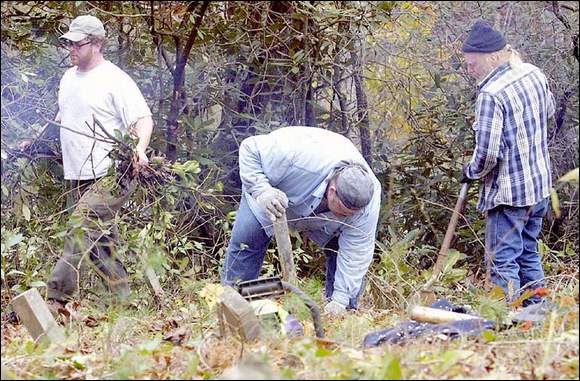
From left to right, Jason Combs, SCV - Tim Tapley, SCV and Richard Crawford, Volunteer clear brush last month during the cleanup of Edney Cemetery near Bat Cave. (MATT BORN/TIMES-NEWS)
Within the two months since the plight of the county's historic cemeteries came to the attention of residents, the Henderson County Board of Commissioners has formed a Cemetery Advisory Committee and the Sons of Confederate Veterans have sponsored the second cemetery cleanup.
Commissioners nominated residents Wednesday to study the issue of cemetery preservation and the steps the county needs to take to be in compliance with state statutes.
N.C. Rep. Carolyn Justus, R-Dana, is also interested in helping preserve cemeteries locally and statewide and is waiting on advice from the committee and the Henderson County Genealogical and Historical Society on what the state Legislature can do to help.
"Current state laws need to be enforced, but who is responsible for the enforcement?" Justus said. "There is also no clear definition for public and abandoned cemeteries. I'm just waiting to see what people come up with who work in this area.
"Our cemeteries need to be preserved," she said. "They are part of our heritage. We need laws that are easily interpreted."
Sons of Confederate Veterans
In September, the Sons of Confederate Veterans began a project to locate, document and preserve the grave sites of Confederate and Union soldiers.
"We realized one of the best things we could do to portray a positive image was come up with creative ideas on ways to help the community," said Norman Miller, chairman of the group's Cemetery Committee. "We decided to try to locate, mark and preserve the grave sites of Civil War veterans."
Miller quickly hit a snag. He could not find many of the cemeteries. When the cemeteries were found, he could not locate the graves because of neglect or destruction.
"Within a very short time I began to find more and more cemeteries gone, disturbed or neglected," he said. "We had to move past marking and locating and move into what was more important, the preservation and conservation of old cemeteries."
The Will Smith, Shafer, Walter Williams and Livingston family cemeteries were gone.
"The Livingston situation just added insult to injury," Miller said. "There are three broken stones in an area where the bodies are not even located and it's called 'historic Livingston.'"
Briars, trees, impassable thickets, weeds and other overgrowth impeded movement in many cemeteries and graves could not be located. Out of approximately 172 identified church, family and public cemeteries, Miller has visited at least 50 in the past three months.
"The Hammett Family Cemetery is in the middle of a field surrounded by a sawbriar thicket," he said. "Each time the plow comes around, another six inches is shaved off."
Joe Young, commander of the local Sons of Confederate Veterans Camp, said members became outraged and concerned.
"We shouldn't have people building on the ground where our forefathers are buried," said Young, whose ancestors were some of the first pioneers into the county. "Our culture is being erased."
When Miller and other camp members find a grave site of a Confederate or Union soldier, they mark it. He said only about 50 percent of the Civil War veterans have Confederate or U.S. monuments or markers. Miller has the roster lists of county residents who fought on both sides of the war.
"We'd better get a list of where they are buried and get them marked before the cemeteries are gone," Young said.
Miller was contacted by Jackson descendants to possibly place a marker on the grave site of their ancestor who fought in the Civil War. When Miller finally located the site, he found that a monument erected in 1978 had been toppled by heavy machinery.
John Jackson family members became outraged and contacted the Times-News.
County government
Within a week of the Times-News publication about the plight of the county's old cemeteries, county commissioners began researching and discussing the situation.
One cemetery that has disappeared to development, the Livingston Family Cemetery, held the graves of County Commissioner Shannon Baldwin's ancestors.
At the meeting Oct. 19, commissioners expressed the desire to protect historic cemeteries from destruction by expanding construction.
County staff began exploring legal issues regarding the protection of old grave sites, including determining their authority in such matters and making a plan as to how to enforce laws regarding the cemeteries. Staff members were asked to report back at the next commission meeting.
On Dec. 8, commissioners discussed a timetable for enacting stronger rules to protect the cemeteries and voted to proceed with protections for historic cemeteries, agreeing to form a Cemetery Advisory Committee. But two commissioners said measures should be taken before a three-year time frame laid out by staff.
Commissioner Shannon Baldwin said "graves are in danger" and that protections enacted in fiscal year 2007-08 would be too late.
"I think the process is pretty good, but I think the time frame is too long," said Baldwin, who has pushed for protections and a possible moratorium on disturbing such sites.
Commissioner Larry Young, who supported language in the county comprehensive plan to protect historic sites, agreed.
"Like Commissioner Baldwin, I think three years is too long," Young said.
On Wednesday, nominations were made for a committee to begin working on the preservation of the historic cemeteries.
"We're on the right track," said Commissioner Charlie Messer. "The Sons of Confederate Veterans are doing a great job and now that we've formed a committee, I think the preservation of our cemeteries is really going to take off.
"We have to define what is public and what is private and set a time frame," Messer said. "If it takes a year or a year and a half, that would cut in half the 2007 Comprehensive Land Plan's time frame.
"Paper progress has been made," said Commission Chairman Bill Moyer. "Progress is being made in bringing attention to the issue. Now we will see what the committee comes back with, and I'm hopeful it will function well."
Baldwin expressed concern that the committee's charge may be too narrowly defined and he wants the time frame kept at less than 18 months.
"Why would we want to stall the issue when graves are being dug up now?" he said. "The focus should also be much broader than just identifying what is a public cemetery. We also need to work on cemetery identification and keeping up a list of historically significant cemeteries."
Cemeteries are an important link to the county's past, Baldwin said.
"What is our county's history?" he said. "It is these early pioneers hacking out a living out of the wilderness."
Baldwin wants the county's slave cemeteries found and marked, along with veterans' grave sites.
"It's a dangerous thing to remove tangible reminders of who we are, where we came from and what our history has been," he said.
There could also be an economic value in preserving the old cemeteries. A historic heritage trail through the county, interpreting local history as it relates to state and national history, could help tourism, Baldwin said.
Members who accepted their nominations to the Cemetery Advisory Committee expressed optimism and want to begin work soon.
"I have probably half a dozen of my people in just the endangered cemeteries," said Richard Waters, retired WHKP-AM 1450 news director. "If we don't want people to inadvertently build and develop on top of these cemeteries, we need some way to enforce the existing state laws. It should be generally understood that graves are sacred."
"It was disconcerting having to help deal with the Jackson Family Cemetery situation," said Jay Jackson, manager of Jackson Funeral Service. "I want to do something to help out. I'm interested in preserving the history of our county."
"We on the committee are to advise the county on how to comply with existing state laws and how to protect the cemeteries through the county ordinances," said Michael Arrowood, a Russian language interpreter and translator. "I want to focus on mapping and registering the cemeteries so people will know when buying, selling or developing land what is expected of them."
Arrowood and Miller, who is also on the committee, both belong to the Sons of Confederate Veterans.
"I want to help rescue from neglect and development the old family cemeteries that have little or no one watching over them," said Wanda Case, genealogist.
"I have lots of family in these old family cemeteries," said Vanessa Mintz, who is self-employed. "We need to take care of our past for the future generations."
John Boyd, director of business services at Blue Ridge Community College and member of the Travel and Tourism Board, will also serve on the committee.
The Rev. Anthony McMinn, director of the Hendersonville Rescue Mission, said he will advise as needed concerning location and preservation of black and slave cemeteries.
This website is maintained by Wanda Elaine Case[email protected] 2004