 |
 |
 |
 |
| The conceited apple-branch |
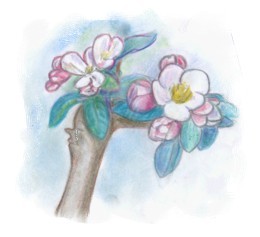
| It was the month of May. The wind still blew cold; but from bush and tree, field and flower, came the welcome sound, "Spring is come." Wild-flowers in profusion covered the hedges. Under the little apple-tree, Spring seemed busy, and told his tale from one of the branches which hung fresh and blooming, and covered with delicate pink blossoms that were just ready to open. The branch well knew how beautiful it was; this knowledge exists as much in the leaf as in the blood; |
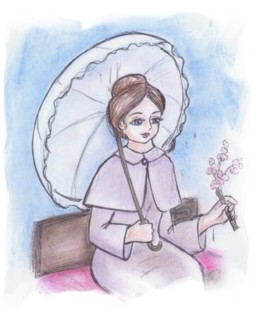
| I was therefore not surprised when a nobleman's carriage, in which sat the young countess, stopped in the road just by. She said that an apple-branch was a most lovely object, and an emblem of spring in its most charming aspect. Then the branch was broken off for her, and she held it in her delicate hand, and sheltered it with her silk parasol. Then they drove to the castle, in which were lofty halls and splendid drawing-rooms. Pure white curtains fluttered before the open windows, and beautiful flowers stood in shining, transparent vases; and in one of them, which looked as if it had been cut out of newly fallen snow, the apple-branch was placed, among some fresh, light twigs of beech. It was a charming sight. Then the branch became proud, which was very much like human nature. People of every description entered the room, and, according to their position in society, so dared they to express their admiration. |
| Some few said nothing, others expressed too much, and the apple-branch very soon got to understand that there was as much difference in the characters of human beings as in those of plants and flowers. Some are all for pomp and parade, others have a great deal to do to maintain their own importance while the rest might be spared without much loss to society. So thought the apple-branch as he stood before the open window, from which he could see out over gardens and fields, where there were flowers and plants enough for him to think and reflect upon; some rich and beautiful, some poor and humble indeed. "Poor, despised herbs,"said the apple-branch; "there is really a difference between them and such as I am. |
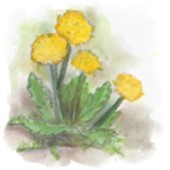
| How unhappy they must be, if they can feel as those in my position do! There is a difference indeed, and so there ought to be, or we should all be equals." And the apple-branch looked with a sort of pity upon them, especially on a certain little flower that is found in field and in ditches. No one bound these flowers together in a nosegay; they were too common; they were even known to grow between the paving-stones, shooting up everywhere, like bad weeds; and they bore the very ugly name of "dog-flowers" or "dandelions." |
| "Poor, despised plants," said the apple-bough, "it is not your fault that you are so ugly, and that you, have such an ugly name; but it is with plants as with men,- there must be a difference." "A difference!" cried the sunbeams, as he kissed the blooming apple-branch, and then kissed the yellow dandelions out in the the fields. All were brothers, and the sunbeam kissed them- the poor flowers as well as the rich. The apple-bough had never thought of the boundless love of God, which extends over over all the works of creation, over everything which lives, and moves, and has its being in Him; |
| he had never thought of the good and beautiful which are so often hidden, but can never remain forgotten by Him,- not only among the lower creation, but also among men. The sunbeam, the ray of light, know better. "You do not see very far, nor very clearly," he said to the apple-branch. "Which is the despised plant you so specially pity?" "The dandelion" he replied. "No one ever places it in a nosegay; it is often trodden under foot, there are so many of them; and when they run to seed, they have flowers like wool, which fly away in little pieces over the roads, and cling to the dresses of the people. They are only weeds; but of course there must be weeds, O, I am really very thankful that I was not made like one of these flowers." There came presently across the fields a whole group of children, the youngest of whom was so small that it had to be carried by the others; and when he was seated on the grass, among the yellow flowers, he laughed aloud with joy, kicked out his little legs, rolled about, plucked the yellow flowers, and kissed them in childlike innocence. The elder children broke off the flowers with long stems, bent the stalks one round the other, to form links, and made first a chain for the neck, then one to go across the shoulders, and hang down to the waist, and at last a wreath to wear round the head, so that they looked quite splendid in their garlands of green stems and golden flowers. |
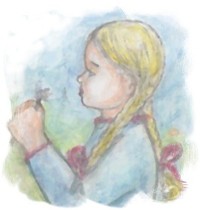
| But the eldest among them gathered carefully the faded flowers, on the stem of which was grouped together the seed, in the form of a white coronal.These loose, airy wool-flowers are very beautiful, and look like fine snowy feathers or down. The children held them to their mouths, and tried to blow away the whole coronal with one puff of the breath. They had been told by their grandmothers that who ever did so would be sure to have new clothes before the end of the year. The despised flowers was by this raised to the position of a prophet or foreteller of events. "Do you see," said the sunbeam, "do you see the beauty of these flowers? do you see their powers of giving pleasure?" "Yes, to children," said the apple-bough. |
| By-and-by an old woman came into the field, and, with a blunt knife without a handle, began to dig round the roots of some of the dandelion-plants, and pull them up. With some of the these she intended to make tea for herself; but the rest she was going to sell to the chemist, and obtain some money. "But beauty is of higher value than this," said the apple-tree brach; only the chosen ones can be admitted into the realms of the beautiful. There is a difference between plants, just as there is a difference between men." Then the sunbeam spoke of the boundless love of God, as seen in a creation, and over all that lives, and the equal distribution of His gifts, both in time and eternity. "That is your opinion," said the apple-bough. Then some people came into the room, and, among them, the young countess,- the lady who had placed the apple-bough in the transparent vase, so pleasantly beneath the rays of the sunlight. She carried in her hand something that seemed like a flower. The object was hidden by two or three great leaves, which covered it like a shield, so that no draught or gust of wind could injure it, and it was carried more carefully than the apple-branch had ever been. Very cautiously the large leaves were removed, and there appeared the feathery seed-crown of the despised dandelion. This was what the lady so carefully plucked, and carried home so safely covered, so that not one of the delicate arrows of which its mist-like shape was so lightly formed, should flutter away by the wind, "See," she exclaimed, "how wonderful God has made this little flower. I will paint it with the apple-branch together. Every one admires the beauty of the apple-bougt; but this humble flower has been endowed by Heaven with another kind of loveliness; and although they differ in appearance, both are the children of the realms of beauty." Then the sunbeam kissed the blooming apple-branch, upon whose leaves appeared a rosy blush. |
| THE END. |
| Hans Christian Andersen |
| The money-box |
 |
 |
 |
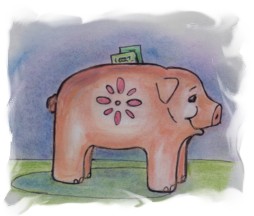
| In a nursery where a number of toys lay scattered about, a money-box stood on the top of a very high wardrobe. It was made of clay in the shape of a pig, and had been bought of the potter. In the back of the pig was a slit, and this slit had been enlarged with a knife, so that dollars, or crown pieces, might slip through; and, indeed there were two in the box, besides a number of pence. The money-pig was stuffed so full that it could no longer rattle, to which is the highest state of perfection to which a money-pig can attain. |
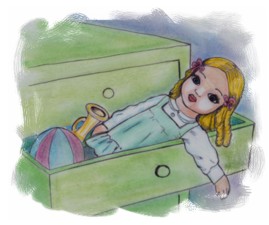
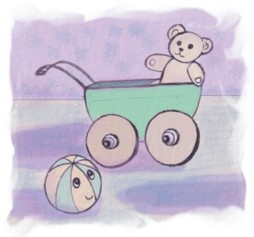
| There he stood upon the cupboard, high and lofty, looking down upon everything else in the room. He know very well that he had enough inside him to bay up all the other toys, and this gave him a very good opinion of his own value. The rest thought of this fact also, although they did not express it, for there were so many other things to talk about. A large doll, still handsome, though rather old, for her neck had been mended, lay inside one of the drawers which was partly open. She called out to the others, "Let us have a game at being men and women, that is something worth playing at." Upon this there was a great uproar; even the engravings, which hung in frames on the wall, turned round in their excitement, and showed that they had a wrong side to them, although they had not the least intention to expose themselves in this way, or to object to the game. It was late at night, but as the moon shone through the windows, they had light at cheap rate. And as the game was now to begin, all were invited to take part in it, even the children's wagon, which certainly belonged to the coarser playthings. "Each has its own value," said the wagon; "we cannot all be noblemen; there must be some to work." |
| The money-pig was the only one who received a written invitation. He stood so high that they were afraid he would not accept a verbal message. But in his replay, he said, if he had to take a part, he must enjoy the sport from his own home; they were to arrange for him to do so; and so they did. The little toy theatre was therefor put up in such a way that the money-pig could look directly into it. |
| Some wanted to begin with a a comedy, and afterwards to have a tea party and a discussion for mental improvement, but they commenced with the latter first. The rocking-horse spoke of training and races; the wagon of railways and steam power, for these subjects belonged to each of their professions, and it was right they should talk of them. The clock talked politics- "tick, tick," he professed to know what was the time of the day, but there was a whisper that he did not go correctly. The bamboo cane stood by, looking stiff and proud: he was vain of his brass ferrule and silver top, and on the sofa lay two worked cushions, pretty but stupid. When the play at the little theatre, began the rest sat and looked on; they were requested to applaud and stamp, or crack, when they felt gratified with what they saw. But the riding-whip said he never cracked for old people, only for the young who were not yet married. "I crack for everybody," said the cracker. "Yes, and a fine noise you make." thought the audience, as the play went on. it was not worth much, but it was well played, and all the characters turned their painted sides to the audience, for they were made only to be seen on one side. The acting was wonderful, excepting that sometimes they came out beyond the lamps, because the wires were a little to long. |
| The doll, whose neck had been darned, was so exited that the place in her burst, and the money-pig declared he must do something for one of the players, as they had all pleased him so much. So he made up his mind to remember one of them in his will, as the one to be buried with him in the family vault, whenever that ever should happen. |
| They all enjoyed the comedy so much, that they gave up all thoughts of the tea party, and only carried out their idea of intellectual amusement, which they called playing at men and women; and there is nothing wrong about it, for it was only play. All the while, each one thought most of himself, or of what the money-pig could be thinking. His thoughts were on, as he supposed, a very distant time- of making his will, and of his burial, and of when it might all come to pass. Certainly sooner than he expected- for all at once down he came from the top of the press, fell to on the ground, and was broken to pieces. Then the pennies hopped and danced about in the most amusing manner. The little ones twirled round like tops, and the large ones rolled away as far as they could, especially the one great silver crown piece who had often to go out into the world, and now he had his wish as well as the rest of the money. The pieces of the money-pig were thrown into the dust-bin, and the next day there stood a new money-pig on the cupboard, but it had not a farthing inside yet, and therefore, like the old one, it could not rattle. This was the beginning with him, and we will make it the end of our story. |
| THE END. |
| Hans Christian Andersen. |
 |
 |
 |
| The farm-yard cock and the weather-cock. |
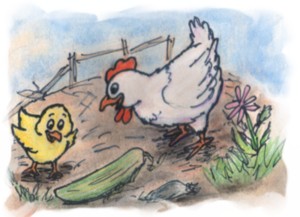
| There were two cocks- one on the dung-hill, the other on the roof. They were both arrogant, but which of the two rendered most service? Tell me your opinion- we'll keep to ours just the same though. The poultry yard was divided by some planks from another yard in which there was a dung-hill, and on the dung-hill lay and grew a large cucumber which was conscious of being a hot-bed plant. "One is born to that," said the cucumber to itself. "Not all can be cucumbers; there must be other things, too. The hens, the ducks, and all the animals in the next yard are creatures too. Now I have a great opinion of the yard cock on the plank; |
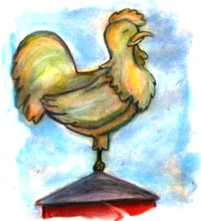
| he is certainly a of much more importance than the weather-cock who is placed so high and can't even creak, much less crow. The latter has neither hens nor chicks, and only thinks of himself and perspires verdigris. No, the yard cock is really a cock! His step is a dance! His crowing is music, and wherever he goes one knows what a trumpeter is like! Even if he ate me up stump and stalk, and all, and I had to dissolve in his body, it would be a happy death," said the cucumber. In the night there was a terrible storm. The hens, chicks and even the cock sought shelter, the wind tore down the planks between the two yards with a crash; the tiles come tumbeling down, but the weather-cock sat firm. He did not even turn round, for he could not; and yet he was young and freshly cast, but prudent and sedate. He had been born old, and did not at all resemble the birds flying in the air- the sparrows, and the swallows; no, he despised them, these mean little piping birds, these common whistlers. He admitted that the pigeon, large and white and shining like mother-o-pearl, looked like a kind of weather-cock; |
| out they were fat and stupid, and all their thoughts and endeavour were directed to filling themselves with food, and besides, they were tiresome things to converse with. The birds of passage had also paid the weather-cock a visit and told him of foreign countries, of airy caravans and robber stories that made one's hair stand on end. All this was new and interesting; that is, for the first time, but afterwards, as the weather-cock found out, they repeated themselves and always told the same stories, and there was no one with whom one could associate, for no one and all were stale and small-minded. |
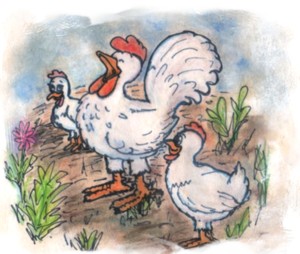
| "The world is no good!" he said. "Everything in it is so stupid." The weather-cock was puffed up, and that quality would have made him interesting in the eyes of the cucumber if it had known it, but it had eyes only for the yard cock, who was now in the yard with it. The wind had blown the planks, but the storm was over. "What do you think of that crowing?" said the yard cock to the hens and chickens. "It was a little rouge- it wanted elegance." And the hens and the chickens came up on the dung-hill, and the cock strutted about like a lord. "Garden plant!" he said to the cucumber, and in that one word his deep learning showed itself, and it forgot that he was pecking at her and eating it up. "A happy death!" The hens and the chickens came, for where one runs the others run too; they clucked, and chirped, and looked at the cock, and were proud that he was of their kind. "Cock- a-doodle-do !" he crowed, "the chickens will grow up into great hens at once, if I cry it out in the poultry-yard of the world!" And hens and chicks clucked and chirped, and the cock announced a great piece of news. "A cock can lay an egg! And do you know what's in the egg? A basilisk. No one can stand the sight of such a thing; people know that, and now you know it too- you know what is in me, and what a champion of cocks I am!" With that the yard cock flapped his wings, made his comb swell up, and crowed again; and they all shuddered, the hens and the little chicks- but they were proud that one of their number was such a champion of all cocks. They clucked and chirped till the weather-cock heard; he heard it; but he did not stir. |
| " Everything is so stupid," he said to himself. "The yard cock lays no eggs, and I am too lazy to do so; if I liked, I could lay a wind-egg. But the world is not worth even a wind-egg. Everything is so stupid! I don't want to sit here any longer." With that the weather-cock broke off; but he did not kill the yard cock, although the hens said that had been his intention. And what is the moral? " Better to crow than be puffed up and break off? |
| THE END. |

| Hans Christian Andersen. |