UNBELIEVABLE
Machu Picchu, Peru
Brazilian at Foz do Iguazu
IMPRESSIVE
MOMENTS
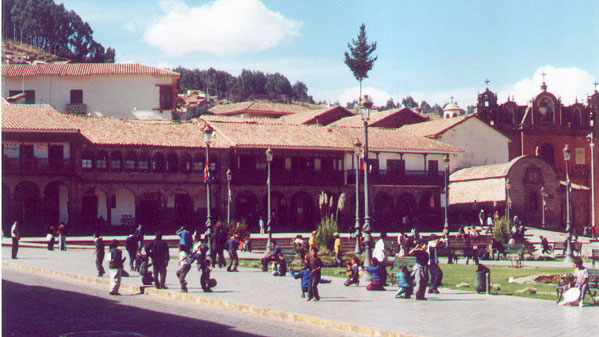
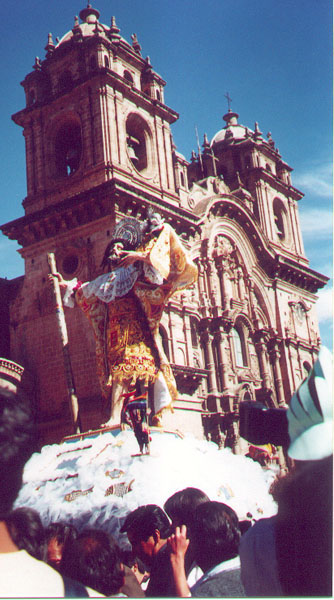
Cuzco, Peru (3300m above sea level)
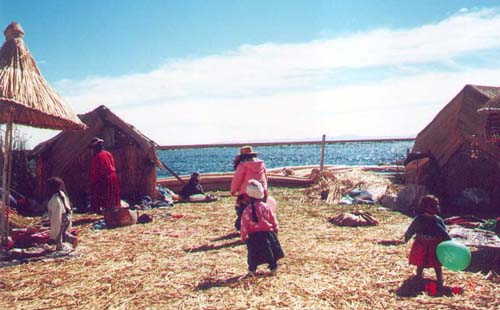
Lake Titicaca (3800m above sea level)
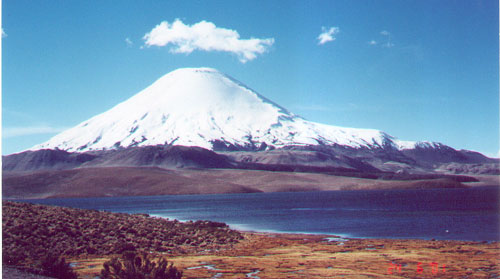
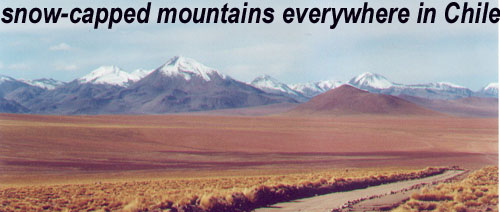
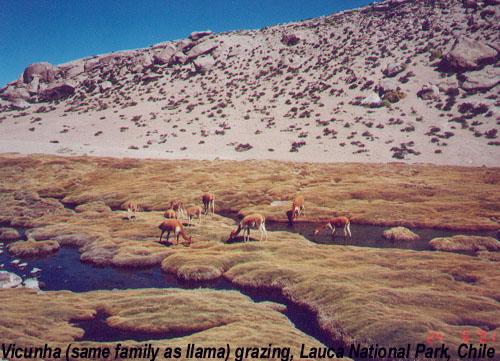
Lauca National Park, Arica, Chile
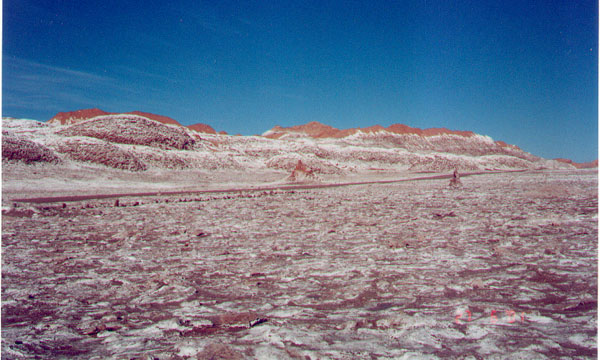
San Pedro de Atacama, Chile
Calama, Argentina
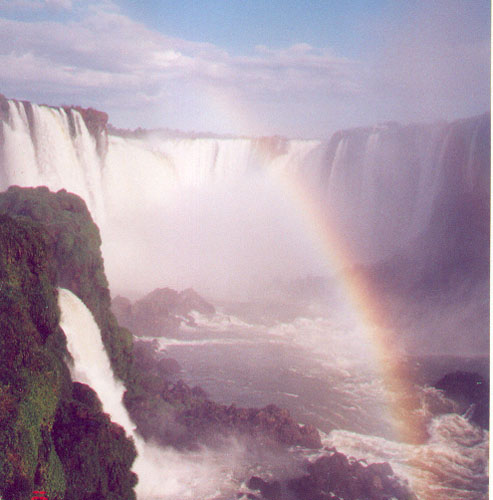
Iguazu Fall, Argentina / Brazil
Few HK people go to South America because it is
expensive, far and time-consuming. This time I hardly had time to make a careful
plan for the trip because before departure I was preparing and attending my
professional exam and I had to leave right after the exam.
In
this one-month-long trip, I stayed in totally 17 different hotels/guest houses,
took 5 domestic flights and countless long-distance and short-distance buses.
You could imagine how big is South America and how much money and time one needs
to spend on transportation while travelling in South America. Also, for this
reason, this trip was tiring to me, almost every day I needed to consider the
transportation problem and accommodation problem. You could say this is the
weakness of travelling alone, but I also experienced the caring and warmth from
the local people. Also, the places I went this time varied in temperature,
ranging from 25 to -12 degree Celsius, even though my body was not weak, I fell
sick several times during the trip.
In this trip, I only visited some major
historic sites and scenic sites in Peru, Chile and Argentina. I also stopped by
Foz do Iguazu in Brazil to see the Brazilian side of Iguazu Fall and stopped by
Asuncion in Paraguay to fly back to Hong Kong.
Life is full of surprises, especially while you are
travelling, some are created by yourself but some are not.
In Machu Picchu, Peru
In Machu Picchu, one accident happened to me. The email
I sent to my friends after the accident recorded the event.
In Arica, Chile
On 25 June 2001, there was a 7.9 magnitude
earthquake in Arequipa, a city in the south of Peru. It killed 47 people and
injured 550 people in Arequipa. At the time of the earthquake, I was in Arica,
the border city in Chile, adjacent to another border city of Tacna in the south
most Peru. Arica was also affected by this earthquake. The email
I sent to my friends from Arica recorded how I felt at that time.
In Foz de Iguazu, Brazil
I
stayed in Foz de Iguazu in Brazil for less than 24 hours, but what I saw already
made me escape this town as soon as I could. In the evening, while I was
awaiting a bus, at the bus stop, I heard one metal sound falling on the ground.
It was an about 15 inches long knife!!! sharp pointed and with zig zag edges on
the blade. A young man swiftly picked it up and put it into his trousers, closed
the buttons of his shirt and covered it up. Then he went to interfere with the
two women waiting at the bus stop. He later was questioned by some uniformed
people. What people told me about the crime in Brazil was sooo true. I
immediately gave up the idea of having dinner in a street restaurant. I headed
to the international bus terminal and had my dinner inside the terminal. It was
too dangerous to be in the streets in Brazil at night.
In Peru, Chile and Argentina, people speak Spanish,
very very few people can speak English. I don't know Spanish, not even a word.
More worse, in order not to increase the load of my luggage, I didn't even take
a mini Spanish dictionary with me. So...
However, sometimes you don't need language to convey
to the other your feelings, you caring for the other. I deeply felt so in this
trip.
In Arica, with a hotel hostess
In
Arica, Chile, I initially stayed in a hotel with a hostess who couldn't speak
any word of English. She was patient with me because the language barrier made
me take a lot more time to make her understand what I wanted from her. She also
helped me to call the bus company and book the taxi. After the earthquake in
Arica, I went to visit her again. When she opened the door for me, I couldn't
believe what I saw. Broken glasses on the corridor, dusts everywhere, broken
objects on the tables, cracks on walls, broken objects on the floor... it was a
ruin! I felt very sorry for her. She understood what I said (and my body
language) although I spoke in English. She showed me to every room in her hotel,
almost every room was damaged in some degrees, the office room and the kitchen
room were seriously damaged. She told me she would pull down the whole
hotel and rebuilt a new one. She seemed to be optimistic and was ready to accept
the fact before her. She even turned on the TV to watch the comedy with me and
laughed. However, I could feel deep in her heart she was sad. How could one not
be sad when she saw all of her home and business were destroyed in a minute. She
kept repeating my name which was the only English words she could speak...
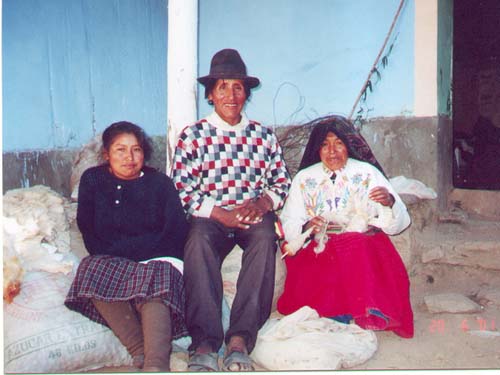
In Amantani Island, with a host family
In Amantani Island, an island in Lake Titicaca, in
Peru, I spent one day and one night living on this no water, no electricity
supply island. This is a poor and small island. The people there grow potatoes
and exchange products with neighbouring towns. My host
family was very nice. The whole family can't speak any word of English. The
head figure in a family in that island is the father. The father chatted with
me, asking me whether I felt cold, showed me the potatoes and the different
plants in her house. I told him I liked the tea they provided for me, he
immediately took off some fresh leaves from a plant and gave it to me to let me
take them back to Hong Kong. The son and his wife also taught me Spanish... I
could feel their hospitality without language.
For the great work made by the ancient people, we
always wonder how did they achieve it without using any machines.
Not only the ancient work, sometimes we also wonder
why some people living in our century could do something beyond our
understanding.
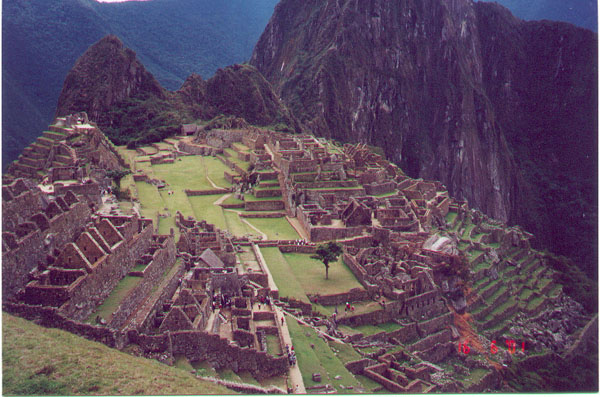
Machu Picchu, Peru('Lost City of the Incas')
An
Inca construction, built around the first half of the 15th century A.D. It
survived the Spanish destruction because it was buried under the thick
vegetation until it was discovered by an American Hiram Bingham in 1911.
Presently there is no conclusion for the purpose of
the city of Machu Picchu was built. There was no records on this because the
Incas had no written language. The evidence seems to indicate it was destined
for religious purposes, a great palace for the Virgins of the Sun - special
women chosen to dedicate their lives to religious services. This theory is based
on the fact that 75% of the human remains excavated there was female.
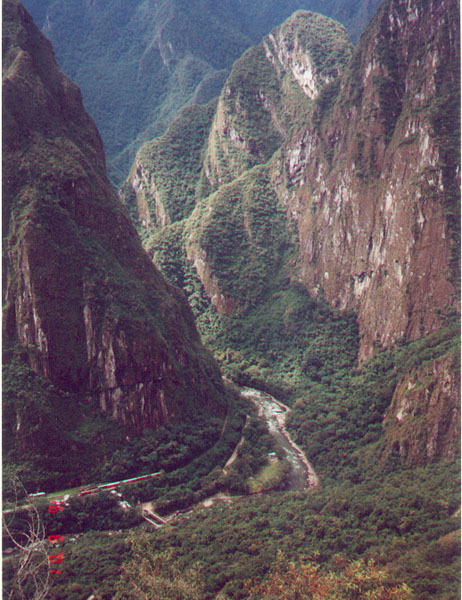
Machu
Picchu was built on a mountain top (2400m above sea level), around it were
mountain ranges and canyons.
The mystery was the rocks which were used to build the city came from the
surrounding mountains, not from the mountain on which it was built, but how did
the Incas move the big rocks from the surrounding mountains to Machu Picchu in
the 15th century?
Brazilian at Foz do Iguazu
I took a bus from Puerto Iguazu of Argentina to Foz
do Iguazu of Brazil. When everyone on the bus got down from the bus, I also got
down but I was not able to locate where I was, so I asked the people around. The
people there couldn't read, they couldn't even tell me the name of the street
where they were in. (One more difficulty was that the Brazilians speak
Portuguese but I can't speak Portuguese.) When I tried again on a third
passer-by on the street, a middle-aged woman who seemed to be a nice person, she
didn't know the street I was looking for, then after she knew I came from Hong
Kong, she somehow pulled me along and took me to cross a street. When I saw a
Chinese man in front of me, I then understood what she was doing. The [local]
Chinese man told me (in Chinese) the Brazilian woman needed to get 10 Real
(Brazilian currency, 1 Real equivalent to about US$0.4 at that time). I said I
was surprised she would ask me for money, and not only money, but 'huge' amount
of money!! The Chinese replied, 'They [the Brazilians] are very bad. It is not
safe here, a lot of thieves. You shouldn't come here.'
The
Chinese knew I didn't have any Brazilian Real but U.S. dollars only, so he took
out his purse and gave 10 Real to that woman. That woman said something to the
Chinese and the Chinese gave 2 more Reals to her. I immediately felt that woman
very detestable. So greedy!! But obviously the logics in her mind was sooo
different from mine. The Chinese told me the woman wanted to give me her
telephone number and that I could call her if I needed her help. [What a b/s!!]
She also wanted to see me to my hotel, I said I could take a taxi to my hotel by
myself. Before she left, she held out her hands to hug me and showed me how much
she would miss me. I don't know I should curse or laugh. She is crazy!! insane!!
She must have thought she deserved to be paid for what she has done for me and
she felt she had done a good job for me. I just find her unthinkable and
shameless. With the money she asked from me, I could already have taken a taxi
two times. I then understood what the Chinese man meant by 'they are very bad'.
By
contrast, the Chinese man gave me some local money to take a taxi (plus some for
emergency use), took me to a taxi, bargained the taxi fare with the taxi driver
for me, showed me the Brazilian and Paraguay border control across the street.
All the way, he was very friendly and didn't ask me for money, on the contrary,
when I gave him back money, he said that was a small amount only and he didn't
need it. I don't know what is Brazilian culture, but I am proud of Chinese
culture - the tradition of hospitality and the generosity of the Chinese!
[I wouldn't say all Brazilians are bad. The
Brazilian drivers and the ticket sellers on the bus helped me several times when
I took the local bus. They are the good Brazilians.]
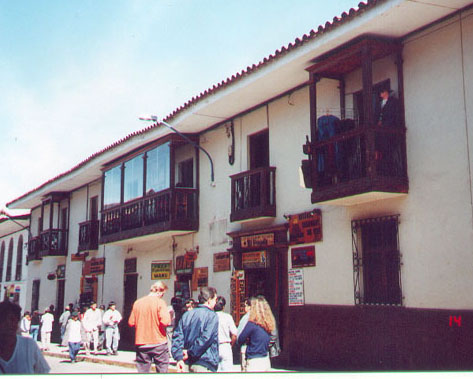
It
was once the capital of the Inca empire (15th - 16th Century A.D.), also the
base for visiting the famous Machu Picchu. I like the narrow stone-paved streets
with wood built balcony houses at two sides. Also like the central plaza,
balcony houses, cathedrals, spacious square...
I encountered a Catholic festival there, saw procession
carrying the religious figure statutes moving into the cathedral in plaza. Also,
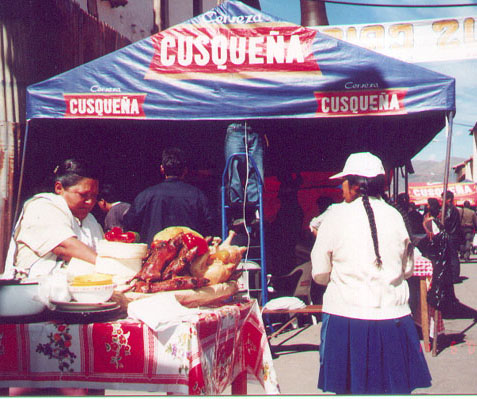
a banquet for the
festival and in the banquet, the typical food is a mixed plate of guinea pig,
cheese, pork, beans, algae, bread... I tried the famous guinea pig (one
mouthful), my comment is... please don't ask me to taste it again...
Lake Titicaca
(3800m above sea level)
It
is the highest navigable lake in the world, more than 170 km in length, the
largest lake in South America. The lake straddles the Peru-Bolivia border. Among
the islands in the Lake, are Floating Islands, Amantani Island and Taquile
Island.
In Floating
Islands of the Uros, everything on the island and the island itself is built
with reeds.
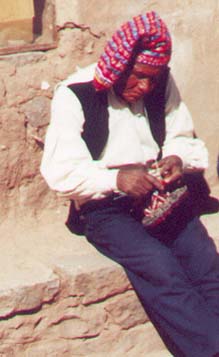
In Taquile Island, it is men,
not the women, who are responsible for weaving clothes.
Lauca National Park, Arica, Chile
Chungara
Lake (over 4500m above sea level), volcanoes at the back, in Lauca National
Park
San Pedro de Atacama, Chile
Salar
de Atacama (salt field), volcanoes at the back
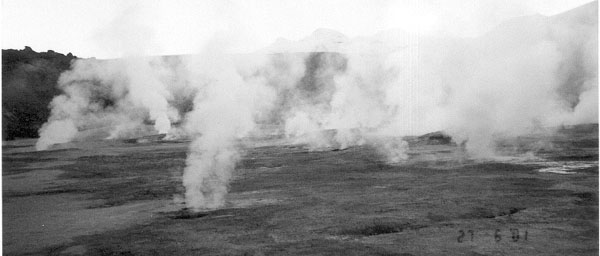
El Tatio Geyser
(4300m above sea level), the world's highest geyser field
 In
this one-month-long trip, I stayed in totally 17 different hotels/guest houses,
took 5 domestic flights and countless long-distance and short-distance buses.
You could imagine how big is South America and how much money and time one needs
to spend on transportation while travelling in South America. Also, for this
reason, this trip was tiring to me, almost every day I needed to consider the
transportation problem and accommodation problem. You could say this is the
weakness of travelling alone, but I also experienced the caring and warmth from
the local people. Also, the places I went this time varied in temperature,
ranging from 25 to -12 degree Celsius, even though my body was not weak, I fell
sick several times during the trip.
In
this one-month-long trip, I stayed in totally 17 different hotels/guest houses,
took 5 domestic flights and countless long-distance and short-distance buses.
You could imagine how big is South America and how much money and time one needs
to spend on transportation while travelling in South America. Also, for this
reason, this trip was tiring to me, almost every day I needed to consider the
transportation problem and accommodation problem. You could say this is the
weakness of travelling alone, but I also experienced the caring and warmth from
the local people. Also, the places I went this time varied in temperature,
ranging from 25 to -12 degree Celsius, even though my body was not weak, I fell
sick several times during the trip.
 I
stayed in Foz de Iguazu in Brazil for less than 24 hours, but what I saw already
made me escape this town as soon as I could. In the evening, while I was
awaiting a bus, at the bus stop, I heard one metal sound falling on the ground.
It was an about 15 inches long knife!!! sharp pointed and with zig zag edges on
the blade. A young man swiftly picked it up and put it into his trousers, closed
the buttons of his shirt and covered it up. Then he went to interfere with the
two women waiting at the bus stop. He later was questioned by some uniformed
people. What people told me about the crime in Brazil was sooo true. I
immediately gave up the idea of having dinner in a street restaurant. I headed
to the international bus terminal and had my dinner inside the terminal. It was
too dangerous to be in the streets in Brazil at night.
I
stayed in Foz de Iguazu in Brazil for less than 24 hours, but what I saw already
made me escape this town as soon as I could. In the evening, while I was
awaiting a bus, at the bus stop, I heard one metal sound falling on the ground.
It was an about 15 inches long knife!!! sharp pointed and with zig zag edges on
the blade. A young man swiftly picked it up and put it into his trousers, closed
the buttons of his shirt and covered it up. Then he went to interfere with the
two women waiting at the bus stop. He later was questioned by some uniformed
people. What people told me about the crime in Brazil was sooo true. I
immediately gave up the idea of having dinner in a street restaurant. I headed
to the international bus terminal and had my dinner inside the terminal. It was
too dangerous to be in the streets in Brazil at night.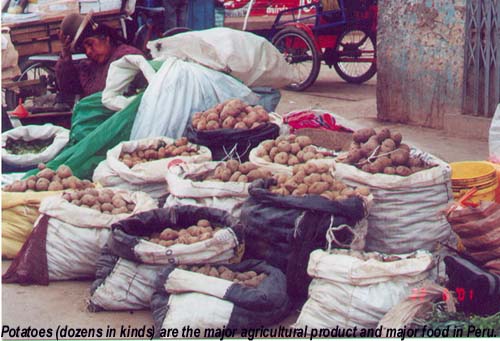 In
Arica, Chile, I initially stayed in a hotel with a hostess who couldn't speak
any word of English. She was patient with me because the language barrier made
me take a lot more time to make her understand what I wanted from her. She also
helped me to call the bus company and book the taxi. After the earthquake in
Arica, I went to visit her again. When she opened the door for me, I couldn't
believe what I saw. Broken glasses on the corridor, dusts everywhere, broken
objects on the tables, cracks on walls, broken objects on the floor... it was a
ruin! I felt very sorry for her. She understood what I said (and my body
language) although I spoke in English. She showed me to every room in her hotel,
almost every room was damaged in some degrees, the office room and the kitchen
room were seriously damaged. She told me she would pull down the whole
hotel and rebuilt a new one. She seemed to be optimistic and was ready to accept
the fact before her. She even turned on the TV to watch the comedy with me and
laughed. However, I could feel deep in her heart she was sad. How could one not
be sad when she saw all of her home and business were destroyed in a minute. She
kept repeating my name which was the only English words she could speak...
In
Arica, Chile, I initially stayed in a hotel with a hostess who couldn't speak
any word of English. She was patient with me because the language barrier made
me take a lot more time to make her understand what I wanted from her. She also
helped me to call the bus company and book the taxi. After the earthquake in
Arica, I went to visit her again. When she opened the door for me, I couldn't
believe what I saw. Broken glasses on the corridor, dusts everywhere, broken
objects on the tables, cracks on walls, broken objects on the floor... it was a
ruin! I felt very sorry for her. She understood what I said (and my body
language) although I spoke in English. She showed me to every room in her hotel,
almost every room was damaged in some degrees, the office room and the kitchen
room were seriously damaged. She told me she would pull down the whole
hotel and rebuilt a new one. She seemed to be optimistic and was ready to accept
the fact before her. She even turned on the TV to watch the comedy with me and
laughed. However, I could feel deep in her heart she was sad. How could one not
be sad when she saw all of her home and business were destroyed in a minute. She
kept repeating my name which was the only English words she could speak... An
Inca construction, built around the first half of the 15th century A.D. It
survived the Spanish destruction because it was buried under the thick
vegetation until it was discovered by an American Hiram Bingham in 1911.
An
Inca construction, built around the first half of the 15th century A.D. It
survived the Spanish destruction because it was buried under the thick
vegetation until it was discovered by an American Hiram Bingham in 1911.
 The
Chinese knew I didn't have any Brazilian Real but U.S. dollars only, so he took
out his purse and gave 10 Real to that woman. That woman said something to the
Chinese and the Chinese gave 2 more Reals to her. I immediately felt that woman
very detestable. So greedy!! But obviously the logics in her mind was sooo
different from mine. The Chinese told me the woman wanted to give me her
telephone number and that I could call her if I needed her help. [What a b/s!!]
She also wanted to see me to my hotel, I said I could take a taxi to my hotel by
myself. Before she left, she held out her hands to hug me and showed me how much
she would miss me. I don't know I should curse or laugh. She is crazy!! insane!!
She must have thought she deserved to be paid for what she has done for me and
she felt she had done a good job for me. I just find her unthinkable and
shameless. With the money she asked from me, I could already have taken a taxi
two times. I then understood what the Chinese man meant by 'they are very bad'.
The
Chinese knew I didn't have any Brazilian Real but U.S. dollars only, so he took
out his purse and gave 10 Real to that woman. That woman said something to the
Chinese and the Chinese gave 2 more Reals to her. I immediately felt that woman
very detestable. So greedy!! But obviously the logics in her mind was sooo
different from mine. The Chinese told me the woman wanted to give me her
telephone number and that I could call her if I needed her help. [What a b/s!!]
She also wanted to see me to my hotel, I said I could take a taxi to my hotel by
myself. Before she left, she held out her hands to hug me and showed me how much
she would miss me. I don't know I should curse or laugh. She is crazy!! insane!!
She must have thought she deserved to be paid for what she has done for me and
she felt she had done a good job for me. I just find her unthinkable and
shameless. With the money she asked from me, I could already have taken a taxi
two times. I then understood what the Chinese man meant by 'they are very bad'.
 By
contrast, the Chinese man gave me some local money to take a taxi (plus some for
emergency use), took me to a taxi, bargained the taxi fare with the taxi driver
for me, showed me the Brazilian and Paraguay border control across the street.
All the way, he was very friendly and didn't ask me for money, on the contrary,
when I gave him back money, he said that was a small amount only and he didn't
need it. I don't know what is Brazilian culture, but I am proud of Chinese
culture - the tradition of hospitality and the generosity of the Chinese!
By
contrast, the Chinese man gave me some local money to take a taxi (plus some for
emergency use), took me to a taxi, bargained the taxi fare with the taxi driver
for me, showed me the Brazilian and Paraguay border control across the street.
All the way, he was very friendly and didn't ask me for money, on the contrary,
when I gave him back money, he said that was a small amount only and he didn't
need it. I don't know what is Brazilian culture, but I am proud of Chinese
culture - the tradition of hospitality and the generosity of the Chinese!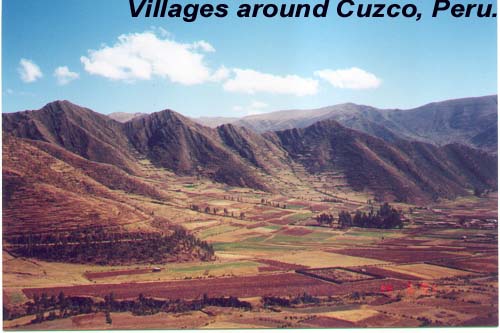 It
was once the capital of the Inca empire (15th - 16th Century A.D.), also the
base for visiting the famous Machu Picchu. I like the narrow stone-paved
It
was once the capital of the Inca empire (15th - 16th Century A.D.), also the
base for visiting the famous Machu Picchu. I like the narrow stone-paved 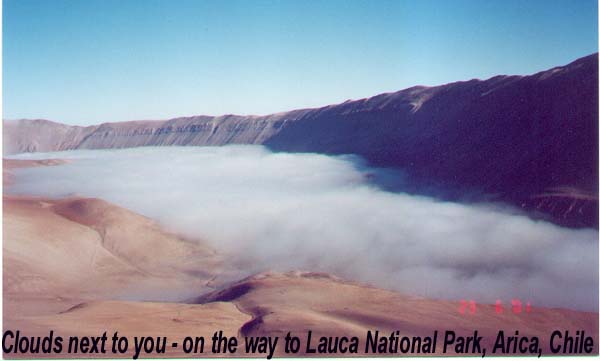 It
is the highest navigable lake in the world, more than 170 km in length, the
largest lake in South America. The lake straddles the Peru-Bolivia border. Among
the islands in the Lake, are Floating Islands, Amantani Island and Taquile
Island.
It
is the highest navigable lake in the world, more than 170 km in length, the
largest lake in South America. The lake straddles the Peru-Bolivia border. Among
the islands in the Lake, are Floating Islands, Amantani Island and Taquile
Island.