The
review of a journal in IEEE transaction on medical imaging,
vol.21, no.2, february 2002.
Title of Journal:
Computation of the Mid-Sagittal Plane
In 3-D Brain Images
By Sylvain Prima, Sébastien Ourselin, and Nicholas Ayache
Abstract
The paper, which
consists of 17 pages and devided into 5 chapters, offer a new method to
compute, reorient, and recenter the mid-sagittal plane in anatomical and
functional three-dimensional (3-D) brain images. The methods is an iterative
process and the computation process is mainly using two steps. First is
using a block matching procedure to
determine initial guess of mid-sagittal plane which performed and the second
one is using a least trimmed squares estimation to define the parameters
characterizing mid-sagittal plane. In order to get automatic computation the
estimated plane is aligned with the center of the image grid, and the whole
process is iterated until convergence.
The algorithms
explored in this paper is fast and accurate, even for strongly tilt heads and
even in presence of high accusition noise and bias field, as shown on a large
set of real magnetic resonance (MR) images.
Index Terms - Magnetic resonance imaging, symmetry,
mid-sagittal plane.
1. Introduction
As noted above the paper presents a new method to automatically compute, reorient, and recenter the mid-sagittal plane in anatomical and functional three-dimencional (3-D) brain images. The method is very interesting and useful for enriching our knowledge, especially in medical image visualization field which is discussed in lectures. The method can be implemented not only in magnetic resonance (MR) but also other modalities like computed tomography (CT), positron emission tomography (PET) and single photon emission computed tomography (SPECT).
The new technique oxplored in this paper is usefull to determine the mid-sagittal plane. This plane is used to split the tilt of the head into two roughly identical parts. And the knowledge about the plane can be a basis for further symmetry-analysis.
During the scanning process the information about anatomical or functional symmetries and unsymmetries is usually hidden by the tilt of the patient’s head. So, it makes visual inspection or analysis harder. The correction of this tilt is important for many tasks, allowing normal as well as abnormal departures from symmety to appear more clearly. This helps comparing the two sides of the brain by making manual or automatic measurements easiers.
Comparing the two sides of the brain is helpful for diagnosis in many casess fractures in CT images, lesions or bleedings in MR images, defaults of perfusion in SPECT images. And further it can be helpful for diagnosing some disease like the variant Creutzfeldt-Jakob disease and the Alzheimer’s disease.
2. Previous Work
and The Drawbacks
There are some previous papers which consider the problem computing the mid-sagittal plane in head. They can be devided into two mainly classes, which can be either (1) the plane best matching the cerebral interhemispheric fissure, or (2) the plane maximizing a symmetry criterion. The previous methods can be seen in the following table :
|
Methods (refer to the main article) |
Based on.. |
Application |
|
[16] |
Fissure |
MR |
|
[13] |
Fissure |
MR |
|
[17] |
Symmetry |
MR, PET |
|
[18] |
Symmetry |
MR, CT, PET, SPECT |
|
[19] |
Symmetry |
MR, CT |
|
[20],[21] |
Symmetry |
MR, CT |
|
[22] |
Symmetry |
PET, SPECT |
|
[23] |
Symmetry |
PET |
There are two severe drawbacks of previous symmetry-based methods, and the new methods offered in this paper deals with the drawbacks. First, the computation of local measures of symmetry and the use of a robust estimation technique allow to discriminate between symmetrical and asymmetrical parts of brain, the latter being naturally treated as outliers. Consequently, the computation of the mid-sagittal plane mainly relies on the underlying gross symmetry of the brain. Second, the regression step yields an analytical solution, computationally less expensive than maximization of the global similarity measures.
3. Description of the
Method
Mainly the computation composed of two steps. At first, given an initial guess of the mid-sagittal plane, the computation of local rather than global similarity measures between the two sides of the head allows to identify homologous anatomical structures or functional areas, using a block matching procedure. Subsequently define the mid-sagittal plase as the one best superposing the on one side and their counterparts on the other side by reflective symmetry. Practically the computation or the parameters characterizing the plane is performed by a least trimmed squares estimation.
The following explanation is about main principles of the methods. The details explanation can be seen in the paper pages 126-129.
Given
I, an MR image of the head, the mid-sagittal plane P is defined as the one best and superposing the
points {ai}and {Sp(bi)}, where ai is a head
voxel, bi its anatomical counterpart on the other side, and Sp the
symmetry with respect to the searched plane P. Practically, P is obtained by
minimization of the least squares (LS) criterion ∑i ║ ai - Sp(bi) ║2, where ║∙║is the Euclidian norm. In Appendix I (refer to the main paper) desribed
an analytical solution of the problem. The pairs {(ai,bi)} are
obtained as follows (see Figs. 1).
- The original image I is
flipped with respect to an arbitrary plane K, yielding the image Sk(I),
which Sk(I) is the symmetry with respect to K.
- The “demons” algorithm (refer to [28] in main article) finds the
anatomical counterpart bi’ in Sk(I)
of each point ai in I,
by way of a nonrigid registration between the two images.
- bi= {Sk(bi’)} is the anatomical
counterpart of ai on the other side of the head. For example,
in I , the point ai, located in the right temporal lobe
(radiological conventions) is matched with the point bi, located in the
left temporal lobe (see Fig. 1b.).
Experimentally, It is observed
that the quality of registration between I and Sk(I) is equivalent
for a large set of planes K , provided they are not “too far” from the search
mid-sagittal plane P; this means that the set of points {bi} is independent of
the chosen plane K. Practically, the most reasonable and simple choice for K is
the plane located at the center of the image lattice, which is likely to be
relatively close to P.
Once P is computed, the
transformation R = Sk o Sp is a rotation if P and K are not
parallel and a translation if P and K are parallel. The transformation R1/2,
when applied to the image I, automatically aligns the plane P with K, the
latter being considered as fixed to the image grid (see Appendix II in main
article).
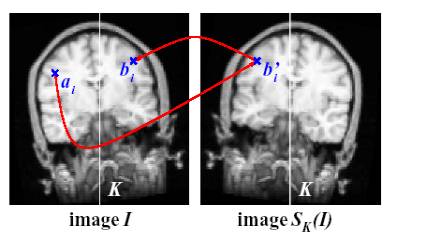
Figure 1a.
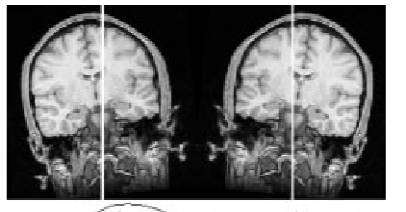
Figure 1b.
Fig. 1. The nonrigid
registration strategy :
Fig 1a.: coronal
slice of the original image I, with K, the central plane of the grid, drawn in white.
Fig 1b : Sk(I) is the same image as I, but flipped with
respect to K. The point ai in I is matched
with the point bi’ in Sk(I); bi = S (bi’ ) is a point of I, counterpart of ai on the other side of the head.
4. The related work that has been
published.
|
Author(s) |
Year |
Article |
Description |
The
relation to the paper |
|
M. E. Brummer |
1991 |
Hough tranform detection of the
longitudinal fissure in tomographic head images. |
It covers Hough tranform detection of the longitudinal fissure in tomographic head images based on fissure. The application is applied in MR. |
Other method to find mid-sagittal plane based on interhemispheric fissure of the brain . |
|
P.C. Marais , R. Guillemaud, M. Sakuma, A. Zisserman, M. Brady |
1996 |
Visualising cerebral asymmetry |
It explain th visualising cerebral asymmetry based on fissure. The fissure is segmented in MR images and extract it slice by slice snake. |
One of the some previous methods which based on the interhemispheric fissure of the brain . It can be seen on pp.411-416 in Lecture notes in computer science, Sept.1996, Hamburg, Germany. |
|
B.A. Ardekani, J. Kershaw, M.Braun and I. Kanno |
1997 |
Automatic detection of the mid-sagittal
plane in 3D brain images |
The papers show the method to detect automatically the mid-sagittal plane in 3D. The methods based on symmetry criterion. |
The method is based on symmetry criterion which has drawbacks. And the main article deals with the symmetry drawbacks. |
|
Y. liu , R.T. Collins, and W.E. Rothfus |
1997 |
Automatical bilateral
symmetry (midsagittal) plane extraction from pathological 3 D
neuroradiological images |
It explain the estimation a 2-D mid-sagittal axis for each coronal or axial slice and then reduce a 3-D plane from the set of these lines |
One of the previous methods which are used in the methods Based on a Symmetry Criterion. |
|
A.K Jain |
1981 |
Image data compression. |
Part of the paper explain the image data compression using block matching procedure. |
It is an initial technique which then be used in the main article to compute robust estimation technique. |
|
P.J. Rousseeuw and A.M Leroy |
1987 |
Robust Regression and Outlier Detection. |
|
It is the technique to gain the exact optimal value for h, the integer value in Least Trimmed Squares Estimation. |
6. Conclusion
The mid-sagittal plane of brain in head is important plane in medical imaging and visualisation world. The knowledge of the plane ca be a basis for further symmetry-analysis, which is usefull for some tasks like diagnosis in many casess fractures in CT images, lesions or bleedings in MR images, defaults of perfusion in SPECT images. And further it can be helpful for diagnosing some disease like the variant Creutzfeldt-Jakob disease and the Alzheimer’s disease.
So many methods made by researcher to find the mid-sagittal plane and the previous methods still have the drawbacks, and the main article deals with the drawback. The new methods offer in the main article consist of two step, as explained above, and the algorithms is fast and accurate.
References
[1]
Sylvain Prima, Sébastien
Ourselin, and Nicholas Ayache, “Computation
of the Mid-Sagittal Plane In 3-D Brain Images,” IEEE
transaction on medical imaging, vol.21, no.2, february 2002.
[2]