 |
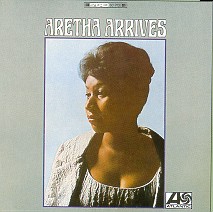
| Aretha Arrives-1967 |
| Track List: 1. Satisfaction 2. You Are My Sunshine 3. Never Let Me Go 4. 96 Tears 5. Prove It 6. Night Life 7. That's Life 8. I Wonder 9. Ain't Nobody (Gonna Turn Me Around) 10. Going Down Slow 11. Baby, I Love You |
| This album as the follow-up to "I Never Love A Man" which was a pretty tough act to follow. But Aretha pulled out some great cover songs on this one. The one I like is "96 Tears" and "That's Life." This album wasn't a big seller but it did have some good soul singing on it. "You Are My Sunshine" had Aretha's sister singing in the background. I think it's Erma. The other songs are pretty cool. "Satisfaction" is a real rocker. "Never Let Me Go," "Prove It," and "I Wonder" are pretty good ballads. The one that I think that stand out is the very bluesy "Going Down Slow" this song is a very good one to sit down and think about your life to. "Baby, I Love You" is the only song that was released commercially and was a Top Ten smash! |
| Original Liner Notes By Nat Hentoff I heard about Aretha Franklin before I heard her. Friends, wise in lore of gospel singers, told me that Reverend C.L. Franklin of Detroit had a daughter who could go tell it on the mountain and make other mountains shake. Eventually, I heard her as a soloist with the choir of the New Bethel Baptist Church, and marveled at the size of feeling in that voice. Later, Aretha began to explore the secular trails as a blues and ballad singer. In person, accompanying herself on piano as her voice soared through smoke, she was as stunningly powerful as in her gospel years, but on records something was missing. The form was there, but not the substance. I wondered when and if a machine could capture and hold all of the strength and glorious release of feeling she was capable of. And when she came to Atlantic with first the single, and then the album, called �I Never Loved A Man the Way I Love You.� It happened. Aretha, in the fullness of her power, had arrived. Further evidence was �Respect,� and insistently pulsating bit as a single and also part of that first album. With a foundation in her exultant gospel beginnings and the capacity to plunge into the marrow of the blues, Aretha Franklin has become, on record as in person, one of the magisterial musical presences of this decade. This second celebration of Aretha�s arrival consists in part of Ralph Burns� arrangements for strings, and sometimes for strings and horns, of such durably contemporary anthems of love, loss and renewal as �I Wonder,� �That�s Life,� and �Night Life.� The other part, without strings, is driven by horns and irresistibly blood-quickening rhythm section from Muscle Shoals, Alabama and Memphis. In �Baby, I Love You,� �Satisfaction,� and �Going Down Slow� among other tracks, Aretha reveals the depth and pride of her roots. A particularly mesmeric event is her moaning chase chorus with King Curtis on �Going Down Slow.� The horn parts on these tracks were written be Arif Mardin, and the designs of all the vocal backgrounds throughout the album are by Aretha. This is a woman of unremitting overwhelming vitality. For example, the session for this album were delayed because Aretha had shattered her elbow in an accident during a Southern tour. After her elbow had been in a cast for some time, she decided she could record, notwithstanding her doctor�s orders to the contrary. On the date, she still didn�t have complete mobility with her elbow but nonetheless in several of the slow numbers, she provided bedrock accompaniment on the piano. For the faster tracks, she couldn�t play with her right hand, but on �You Are My Sunshine,� undaunted she used only her left and the resultant rhythmic drive is a witness to the extent of spirit within her. This album continues to illustrate the scope as well as the emotional depth of Aretha. An incisive dramatist, a conjugator of soul, she gets inside lyrics and shapes them into extensions of herself. As Jerry Wexler, who produced these sessions, put it: �She�s an endless source of creativity. The experience of working with her is tremendously rewarding.� And in fact, there are few occasions when one comes anywhere near the elemental force and the truth-telling fervor of Aretha Franklin. |