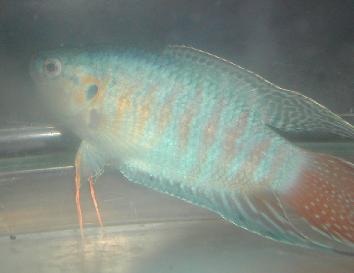
Paradise fish sci name=Macropodus opercularis
origin=China formosa etc.
Water conditions= prefers soft acidic water, but will happily live in any other water as long as its wet. :)
temp=40-85 degrees, prefers 70-77 degrees.
The paradise fish was discovered way back in the beggining of the aquarium hobby. It was the FIRST tropical fish that was kept in aquariums. Discovered by Linnaeus, this 3-4 inch pack of dynamite color quickly became popular. This fish encouraged more expeditions and turned up more newcomers. They included the betta and the chanchito cichlid. This fish is very intelligent, and the colors are very beatiful on good quality specimens. There is also M. concolor the black paradise fish, that is very rare in the hobby. Owing to all these unusual habits, M. opercularis definetly deserves a place in your aquarium. How about dedicating some space to the Grandaddy of tropical fishes, the fish that started it all?
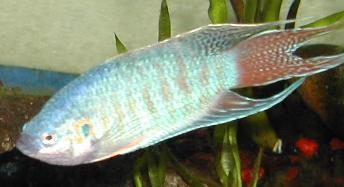
This fish is a denizen of slow moving or still bodies of water in the wild, so thats what it should get in a aquarium. Slightly turbulent water in my experience, lowers male aggresion by preventing bubblenests from popping up in the corner of the tank. These curious fish should have some rocks to explore, some plants to drift through, and maybe if you are want to create a even more natural habitat, some driftwood for them to look at. These fish are very active, and have a habit of pacing back and forth through the aquarium(inspecting everything that is new). They also like to glide thorugh the plants, inspecting all possible morsels of food. If a new fish is added, they may huddle around to view it, and maybe pick at it(and that will scare the living out of a shy fish). They should have at least a 20 gallon tank. Living in smaller tanks is not very fun for these fish, as they just sit listlessly in them and do nothing. These are not like the bettas, they like to move about. Plus they are much bigger than bettas. This is not saying bettas don't need room however.
These fish are greedy eaters and will eat whatever drops into the tank. Flake food is okay over the long term, and they may even breed on this diet. But the addtions of some frozen and live foods can only be described as beneficial. I've taught mine to jump up into the air and grab flakes and other morsels from my fingers. They also enjoy young fish of other species and of there own too! If you wish to introduce smaller fish, place them in carefully and in a unnoticeable spot. Then turn out the lights. In the morning, the paradise fish will come out and investigate everything, and if the fish isn't spooked and runs away, then he will accept it as a tankmate. Using this method, Hunter is living with a bunch of young kribs that were soon going to get to big for him to eat anyways.
Breeding of the paradise fish is quite simple. Nothing much is needed to get them to spawn. Males are characterized by there longer fins. Females in general have much shorter fins. The fish on these pages is a male, notice the long "streamers", which are not always present as they are often bitten off.They should be fed more than usual and given baby fish and other good foods in preparation to spawn. Put in the male on day one, and the female in on day two. Be sure the female is ready. She should be slightly plump from above. They will build a buibblenest and spawn in it. and hte male will guard the eggs. Remove the female at this point. The male wil tend the young for 3 days, after that remove him, lest his tastebuds overcome his parenting skills! The young thrive on infusoria mixtures and yeast suspensions and grow slowly. Then when they reach the age that they may eat brine shrimp, gorwth kicks high gear. My paradise fish young accepted frozen baby brine shrimp. They will grow to 1/2 of an inch in about 2-3 months, and will get about 1 inch in six months. This was my first spawn. In the future, I will release some into my pond and see if they grow faster there...just havta find out what to do after I catch them back.
 As you can see from this picture, newly hatched paradise fish are extremely small. Hunter was careless this time and allowed the bubble nest to disintengrate, and this left me with a clear shot of the babies.