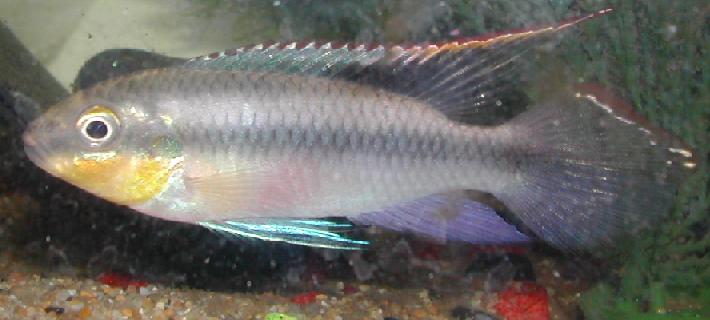
Kribensis sci name=pelvicachromis pulcher
Origin=West Africa. This is a river cichlid
water conditions=Very hardy and adaptable, can tolerate acidic waters to slightly brackish water. Sex ratios are even at neutral ph.
temp=70-82 degrees farenheit. To breed set at higher end of the range.
Introduced into the hobby in the 1950's the kribensis quickly became popular. Its beauty, size, and ease of care spread it through the hobby. The fish are very colorful, and body color ranges(wih mood) from a dark green in males, or white with 2 black stripes. When they are in darkness, they show checkerboard colouration. The male and the female are different, and some males sports ocelli on its tail. The females deep red belly and yellowish face make and attractive fish. If you haven't tried kribensis, you are missing out on quite a bit, and if you haven't tried cichlids, heres a place to get your toes wet. Even experienced hobbyists find these fish amusing to keep and raise and it often brings back old memories. If you don't have any tank space for a beginners fish, bear in mind that their are other species that are less common. To sum things up, this is a great fish.
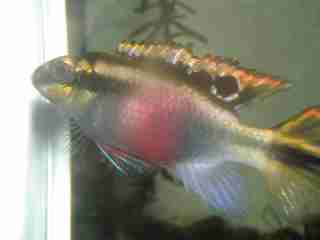 Female krib
The kribensis is a shy fish. Pairs can be kept in ten-20 gallons tanks alone. A 40 gallon community might be able to supp[ort a pair of kribs in it. Because of its shyness, there should be some plants to kide behind and more importantly a hiding spot for them to spawn(but they will try there best even without one). This may be flowerpot with a side chipped out, a coconut husk with a hole bored in it, or perhaps a cave of some sort. If not given one, these fish may attempt to dig one under something. This may cause it to colapse, killing the kribs inside. These kribs may do some digging, but they are still candidates for a planted tank.
These fish are slightly picky in my experience, and there shyness may keep them from eating at the surface. Shrimp tablets are good as flake food is too.But frozen and live are best. Kribensis seem to love mosquito larvae and blackworms are cherished as with almost all fish.
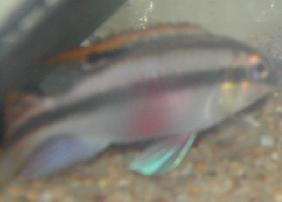
This is a female. The one at the top of the page is a male, notice the sharp pelvic fins on him and the rounded ones on her.

This is a picture of the kribs with there very first spawn(back in june of 2002). This spawn, however, dissapeared. It took thme 4 mistakes before they got things down. But the sixth time, the babies dissapeared again!hmmm...
The kribensis is a cave spawner. If the pair is compatible they may pair up, if not they will either ignore each other or fight. If you get a pair, they will usually settle down and spawn as soo nas they are comfortable. Young pairs(and old pairs that either lack parenting skills or are uncomfy) may eat the eggs. But after some time, they usually learn what to do. The eggs hatch, and hte young are usually moved to a pit one parent has dug. Some parents are morecaring than others ,some pairs show extreme parental care during the first week or so, others more or less so(my pair seems to be one of the less so pairs). The young, at free swimming stage will follow there mother like a shadow. During this time one should watch(especially in a ten gallon) for disagreements with the pair. If fighting is seen, remove the loser ASAP. Usually, it is the male that is expelled. As soon as you want to, you may remove the fry from there parents. Don't move them all at once otherwise the parents may fight as if they are blaming each other for the fry loss. The fry, when they reach freeswimming, will eat frozen and live things and well as crushed flake. Some of the new baby foods like Golden pearls coming to the market may be worth a shot. Baby brine shrimp(live or frozen)is also taken readily. They grew rather slow for me, but I attribute that to the lack of BBS in the diet. As soon as they grow up, you have only one problem-what to do with all of them!
Here are a few young kribs, approx 4-6 months old
 Baby kribensis
 A small one
 Lookie me!