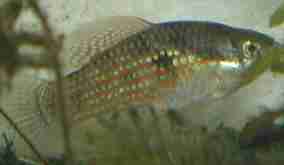
temp: 60-78 degrees, can stand a wide range of temps
Disliked by many aquarists because of its aggressive nature, it is really no different than the cichlids. Some have no idea that it and other North American fish are colorful and make good aquarium fish or don't even know they are around. It at least qualifies for living in the 5 gallon desktop tank that you don't know what to do with. Why not give them a try?
Tank conditions
This fish is a rather shy fish, and should be kept with plants in its tank. This fish is very adaptable, and can easily be kept in less than optimable conditions for this species. Temp should be around 60-78 degrees. But higher and lower temps are tolerated. Tankmates should be fast and hard to attack fish, no long finned fish as flagfish are well known for fin shredding. Anything that remotely resembles a flagfish in shape should best be avoided,as the flagfish may try to interact with them which would be annoying at the least and could cause fin damage at most. Pairs should be kept in a comunity tank. My pair in particular seem pretty shy, doing nothing but nipping algae and taking food as it drifts to the bottom.
Feeding
These flagfish have earned a reputation as algae eaters by many planted tank enthusiasts. It has also earned a reputation as a plant eater, but they haven't done noticeable damage to any of my plants. Shelled and crushed peas are eaten eagerly by them, as are spirulina based foods. Frozen and live foods should make up a good portion of the diet, but don't forget the plant matter. This fish is said to make excellent control for hair and some other kind of algae. Be sure to vary the diet.
Breeding
Breeding of this species requires a pair and some patience. Provide a spawniing mop or plants to lay the eggs on. They often engage in a elaborate courtship dance that is worth noting. The female leads the act of spawning, and the male follows the female to the site. The male wraps his fins around the female like many of the pupfishes do, his dorsal fin over her back, and his anal fin cupped over her vent. With some quivering the fish deposit an egg. When my pair spawned this way they were in a ten gallon tank with about 4 inches of water. They deposited the eggs in the roots of a dwarf umbrella palm plant that I stuck into the tank. The eggs should be removed along with the spawning site and placed in a shallow tank. Alternatively, a more labor intensive method would be to remove the eggs one by one gently with tweezers. Keep the water clean and change it at least once a day. Remove white or fungusing eggs. One way I found worked great for a pair of WC flagfish was to put them out on the patio in a saladbox(about the same size as one of the plastic animal carriers often sold) crammed with plants. Given live foods and peas they laid maybe a hundred eggs ever couple of days. I think part of it has to do with the temperature which was at least 80 degrees when the sun was up and almost hot to touch. Dropped to maybe 60 at night. After lots of eggs were seen the plants were moved to another salad box for incubation and hatching. Fry can be fed on microworms and baby brine shrimp. They can also be raised in tubs with greenwater and detritus on the bottom outside where they will feed on the microrganisms and grow rapidly. After several weeks the fry will develop a dorsal ocellus like that on the adult females. The males will lose this as they grow and begin to take on a more stocky shape then the females. Juveniles relish microworms too and will grub around on the bottom for them till they are stuffed. In my case sexing out took about 4 months but I suspect that it could take 2-3 during the summer with lots of food and space.
A female flagfish, notice the large spot at the rear of the dorsal fin(its quite hard to see it on this picture, but you may be able to see the lighter colored margin). Remember that males can also assume a checkered colouration, but there stripes will show through.
I am now(2005) keeping a trio of these guys(wild caught) in my 46 gallon bowfront tank. Tankmates include Xiphophorus montezumae and a lone Fp. sjoestedti. Lots of plants in this tank. They are doing well and have likely spawned in this tank. Since this time I removed a pair(smaller female dissapeared) and spawned them out on the patio as described above. I am currently raising at least 20 and have at least 2 pairs sexed out of F1 fish.
Home