Hedgehogs & Curses?: An Introduction To Gypsies
By Leslie McMurtry
The population of the camp in the 4th Kingdom was listed as twelve. But in our own 10th Kingdom, between five and ten million wander the world today. They are known to the Italians as Zingara, Gitanos to the Spanish. But who are these people we call "Gypsies"?
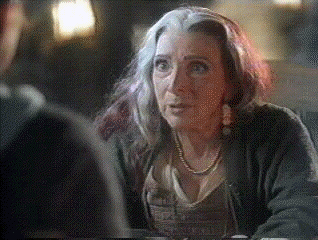
Myths and stereotypes have long clouded our view into the Gypsy people. Even Simon Moore in his script was probably an unconscious victim of the traditional stereotypes. One of these is a negative one. Gypsies are seen as lazy; they are viewed as practicing bad personal hygiene and being sexually and alcoholically promiscuous. They are charged with casting spells, practicing magic, cheating and stealing. Undoubtedly this is true of The 10th Kingdom when the Gypsy woman casts a spell on Virginia--and it works! Another myth is "the poet's view." Gypsies are seen as life-loving, passionate; a carefree, proud and independent people. Both views are equally untrue.
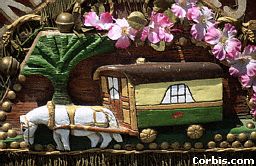
Gypsy Carving
© www.corbis.com/Dave G. Houser
It is hardly surprising, though, that these people should remain so nebulous when one considers how mysterious their origins have been. Few groups have ever had so many hypothesized origins. On one hand, they were said to have been descended from Noah--on the other, it was said Gypsy smiths made the nails for the crucifixion of Christ. They were called Babylonian, Abyssinian, Nubian, Euxian, or Sinitic. Their name comes from "Egyptian"--they were long said to have fled from Egypt. They were even thought to be descendants of Celtic druids or survivors of Atlantis. I myself have drawn connections between the Gypsies and the people of the Basque (the region between France and Spain), for both groups share a language like few others, with many "xs" which make "ch" sounds, and the Basques are a culture so unlike any other in Europe, they must be very ancient. Perhaps King Wendell would argue they are from the 4th Kingdom. It was not until 1763 that the true origins of the Gypsies were discovered by Stefan Valyi, a Hungarian theological student working at the University of Leiden in the Netherlands. Valyi met some Indian students on the Malabar Coast and was intrigued to find the students' language sounded very much like that of the Hungarian Gypsies. When he returned to Hungary, Valyi showed the Gypsies he knew some Indian words and the Gypsies understood almost all of them.
We are now certain Gypsies originated in India. They were descended from two groups, the Luri and Dom, tribes of wandering minstrels and nomads. Romany, the Gypsies' language, most closely resembles Sanskrit.
About 1000 A.D., the Gypsies left India. Their first stop was Afghanistan and Iran with some groups going down to Syria and Egypt. This group of Gypsies became the Lom, while those who went to Europe became the Rom. Rom is the name by which Gypsies prefer to be known. This group of Rom reached Greece in 1300, and then found temporary asylum in Romania. They reached Germany, France, and Switzerland in the early 1400s. By 1500, the Gypsies had arrived in England.
At first, the Rom, claiming to be good Christians, were welcomed warmly by the rulers of the lands they reached. But, as time went by, the Gypsies were seen as a threat to the indigenous peoples of Europe. Gypsies defied or simply ignored the basic values of non-Gypsies. Europeans determined three basic ways of getting rid of these pests: expulsion, repression, and assimilation.
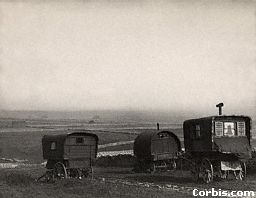
Three Parked Gypsy
Caravans
Three gypsy caravans park along a rural path.
Tideswell, Scotland, UK.
© www.corbis.com/E.O. Hoppé
In Sweden, Gypsies were expelled as soon as they entered the country; those who failed to do so were brutally attacked or hung. If Gypsies tried to escape to Finland they were driven back to Sweden. France enacted expulsion laws of their own in 1510. Any Gypsy caught in the country was flogged. Gypsy women who were captured had their heads shaved and were sent to workhouses. Men were put into chains in the galleys.
Many Romany people were sent to Barbados, Australia, and North America by the English. Signs dotted the English countryside telling the Gypsies to leave the country, but many could not read these signs. Nomadism and speaking of Romany (the language) was banned in Spain. If Spanish Gypsies did not obey this and other laws, they were enslaved. Switzerland allowed Gypsy hunts in the sixteenth century; so did Holland in the eighteenth. In Moravia, it was permissible to cut off the left ear of all Gypsy women, the right ear in Bohemia.
The brutality did not end there. By the end of the eighteenth century the rulers of Europe realized assimilation was the "solution" open to them and encouraged Gypsies to give up their way of life and become integrated, but this idea quickly fell apart. The concept of expulsion was twisted in genocide in World War II, when the Romany people's tragic fate mirrored that of the Jews. Gypsies were declared by the Hitler regime as "asocial," "subhuman," and "a lower race." Beginning in 1937, they were rounded up and put into concentration camps. According to the Nazis, being a Gypsy meant being diseased, so Gypsies were sterilized and forced to live and work in inhuman conditions. At one point, Auschwitz held sixteen thousand Gypsies. In August 1944, four thousand Gypsies were led to the gas chambers. Few people realize that at least a quarter of a million Gypsies were murdered during World War II. Since the original writing of this paper, I have learned that, as more evidence comes to light, this estimate is probably quite lower than the actual number of people who died. After centuries of ignorance, the lives of these people is finally coming to light. How did they survive all this persecution and remain a distinct culture? Perhaps some of the answer lies in their close-knit family organization. The Gypsy community that travels together is called a kumpania, which consists of 10 to 100 separate families. A familia consists of three or four generations and is led by the eldest member of the group, and a number of familia is contained by one kumpania. A vista is made up of a number of familia. All the people in one vista are descended from one ancestor.
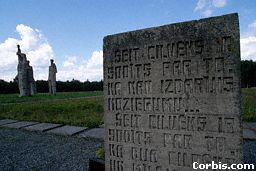
Salapils Concentration
Camp Memorial
A tablet stands at Salapils, commemorating the
site of the barracks where the Nazis and Latvian sympathizers
mudered 100,000 Jews, Gypsies, and prisoners-of-war between
1941 and 1944. The memorial of seven gigantic figures nearby
was built by the Soviets.
© www.corbis.com/Steve Raymer
Each community is ruled by a man (or woman, in some cases) who is chosen for their age, wisdom, and experience. S/he settles minor disputes. This "Rom Baro" settles minor disputes but is secondary to a kris, a Gypsy tribunal. The Rom do not use the death sentence, but the marime punishment, to a Gypsy, is worse than death. The Gypsy is banished from his or her community, and he or she cannot have any social contact with other members of the tribe. Not only is the offender, but usually his or her family as well, declared marime. The punishment can last for days or years.
The marime system is rigid and complex. It implies that a woman's body is divided into two parts. There is no shame in the upper body; women are allowed to expose their breasts and often use their bras as pocketbooks. The lower part of the body is an object of shame because it is connected with menstruation. Dishes cannot be rinsed in the same basin as personal clothing, and men and women's clothes cannot be washed together. A Gypsy informant of Marlene Sway's, author of Familiar Strangers: Gypsy Life in America, was appalled at the way non-Gypsies wash their clothes. "I've seen women at the laundromat, washing all kinds of clothes together," she said. "They don't think nothing of throwing men's and women's underwear in together with dishtowels and children's clothes. I think it's disgusting, but I guess they don't know no better."
In Gypsies by Howard Greenfeld, a new born child is also considered impure until he or she is baptized, in the Gypsy way of baptism. Before that, his or her name cannot be spoken, the child cannot be photographed, sometimes its face cannot be shown in public. The child has three names: the first is a secret one, its only purpose to confused demons which may harm the child; the second is informal and is not used out of the tribe; the third is a name to be used in dealing with non-Gypsies and has little meaning. In the matters of marriage, the fathers of the boy and girl involved obtain formal consent and settle on a bride-price. The money exchanged for the girl is though of as compensation for the loss of a daughter. The discussion of the bride-price is a long one. Sometimes it may be necessary to call in friends as witnesses to the bride's good qualities. Current bride-prices in the U.S. range from $5,000 to $30,000.
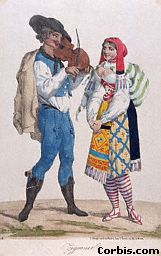
Gypsy Couple
A gypsy couple wearing their traditional
dress.
© www.corbis.com/Austrian Archives
The wedding is largely symbolic and has no religious significance. The wedding festivities can go on for days. Simon Moore's writing on the subject of hedgehogs proved correct. At festivals like the wedding, enormous quantities of food are consumed, and a favorite dish is, you guessed it, roasted hedgehog. When the celebration ends, the bride's family unbraids her hair. Before the groom can take her home there is a feigned abduction of the bride. Her unmarried friends make a wall around her to keep the groom out, but happily, he always breaks through. The bride's mother-in-law helps her knot her handkerchief, which she is never again without in public. After she is married, the bride leaves her family and lives with her husband's family. Not until their first child is born will the couple be able to move into their own home.
Funeral arrangements still take into account the marime system. The deceased is washed and dressed in their finest clothes immediately. Until the burial there is no washing or shaving or combing of the hair, no food is prepared; only coffee and brandy can be drunk; mirrors must be covered and vessels containing water must be emptied. Things that will be useful to the deceased during their journey to the afterlife will be gathered to be placed in the coffin. All ties with the deceased must be destroyed. Things are burned, smashed, and mutilated, or sold to non-Gypsies. Traditional Gypsy religion is not Christianity, though many have taken to it in recent times (I once found a Gypsy homepage celebrating Mother Teresa, claiming she was an Albanian Gypsy). The Gypsy religion has some striking similarities to Judaism. Gypsies are monotheistic, believing in one male deity called Del. They do not make graven images of their god, do practice circumcision, do adhere to strict anti-cruelty laws, and do practice numerology. Good luck charms, amulets, and talismans are common among Gypsies, and one of their most unshakeable and fundamental beliefs is that vampires, spirits, and ghosts exist.
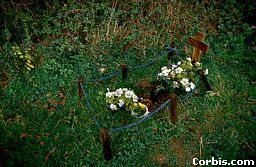
Gypsy's Grave, England
The regularly tended grave of a gypsy near
Newmarket, England, ca. 1960-1994. The inscription on the
cross reads 'Joseph the Unknown Gypsy Boy'.
© www.corbis.com/Robert Estall
Gypsy women are most known for their fortune-telling skills. There are three main reasons fortune-telling has appealed to them: it's a relatively simple way of earning money; it gives them an aura of mystery; and fortune-tellers ca learn social, political, and economical facts that other Gypsies, unless marime, would not have access to. The authors of Gypsies of the World met a group of fortune-tellers in Milan. One of the women, Nusrija, explained to them, "I only ever speak of good news, never of bad, as there is no fixed price for fortune-telling and people pay only as much as they want to. No one gives money for bad news."
Gypsy soloists and orchestras entertain non-Gypsies. The Flamenco, a dance from Spain that is now world-famous, is largely associated with Gypsies. Some of the best Flamenco dancers have certainly been Gypsies. But one should note that Flamenco is traditionally Spanish and not Gypsy. A more modern way of money making is welfare benefits. The welfare benefits reaped by children and old people can provide from $600 to $1400 a month.
While I cannot, at present, report on the condition of Gypsies in the 9 Kingdoms, I can say a little about the situations of Gypsies throughout our world. There are about thirty-five million Gypsies left in India. In the vicinity of the Kokrila Tanda village, women do seasonal work at a sugar refinery. Their working day can last fifteen hours and they are paid five rupees, about forty cents in the U.S.
At feasts and festivals, Turkish Gypsies are much in demand for their musical services. In Istanbul, several thousand Gypsies earn a living by shining shoes. In an Istanbulan night club, the authors of Gypsies of the World watched belly-dancing Gypsy girls. There are about 50,000 Gypsies in Turkey.
There are about 250,000 Rom in what was once the Soviet Union. Russian Gypsy music has been popularized in recent years by film-makers. Russian authorities, however, have virtually put a stop to the Gypsies' wandering by assigning them regular jobs. The old romantic wooden caravan (vardos) is becoming rare.
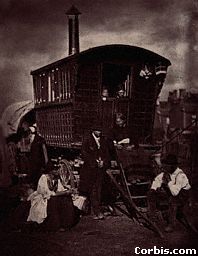
Gypsy Caravan
Gypsies assembled around their wooden caravan
which serves as both transport and home.
© www.corbis.com/Hulton-Deutsch Collection
Ismeta Radjaj, who was a Bosnian Gypsy, told this to the authors of Gypsies of the World: "Let the whole world see from your book how we Gypsies live. Like we weren't people at all. There's no work and no home for us like there is for others." Indeed, in Karaburma, the poorest settlement in Belgrade, there is no electricity or running water for Yugoslavian Gypsies.
Every year on May 24, Gypsies from all around the world make a pilgrimage to the south of France, to the village of Saintes Maries-de-la Mer. They come to honor their "patron saint," St. Sara. This celebration is connected with an event purported to have taken place in A.D. 42 when St. Mary Jacobe and St. Mary Salome are said to have landed in this part of the Mediterranean coast, having drifted from the Holy Land in a tiny boat without oars or sail. With them was a swarthy "Egyptian" serving girl, Sara. The Gypsies pay respect to a wooden statue of Sara by touching or rubbing cloth garments which they believe will bring them good luck. The estimated numbers of gypsies in other European countries are: 40,000 in Austria, 80,000 in West Germany; 35,000 in the Netherlands; 50,000 in the United Kingdom; and 20,000 in Ireland.
Throughout
their existence, Gypsies have been a mysterious people.
They have been seen as evil and possessors of magic or as
carefree lovers of life. Hopefully, you, the reader now
come away with a viewpoint removed from these
stereotypes. Perhaps with education on the Romany
people will understanding and diplomacy begin, in all the Ten
Kingdoms.
Bibliography
Cohn, Werner, The Gypsies, New York: Addison-Wesley
Publishing Co., 1973.
"God Help the Gypsies," Stephen Rebello, The Art of
the Hunchback of NotreDame, New York: Hyperion, 1996.
Greenfeld, Howard, Gypsies, New York: Brown Publishers, 1977.
Sway, Marlene, Familiar Strangers: Gypsy Life in America,
Illinois: University of Illinois Press, 1988.
Tomasevic, Nebojsa, and Rajko Djuric, Gypsies of the World,
Boston: Henry Holt and Co., 1988.

