What is it? | The Butterfly Effect | Fractals | Uncertainty | Links What is Chaos Theory? Plain english?
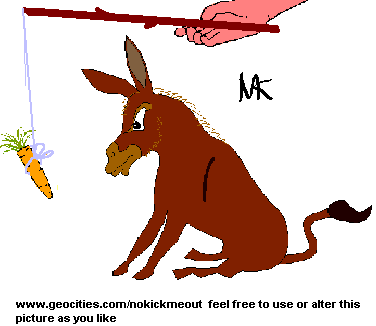
Basically, the chaos theory is based on the idea that the universe is too detailed for us to ever be able to measure it EXACTLY. There will always be error. The simplest way to think of it is like a carrot dangling from a stick in front of a donkey. No matter how fast or far the donkey runs the carrot is still in front. No human is smart enought to account for every little factor that may affect a situation. Nor can we measure things that are infintisemally (sp??) small or large.
For that reason, weather predictions are so unreliable. Meterologists may be able to monitor cloud types, pressure systems, hot & cold fronts, but they may not consider or know about the small rainstorm over a village on the outskirts of Vladivostok. As weird as it seems, something so random like that may prevent accurate prediction for rain in Melbourne that week (except that there's rain in Melbourne just about every week).
It's crazy. Me typing these words now is possibly preventing a typhoon in the Phillipines. Or I could be causing an electrical storm in Iceland (the power! ^_^)
Scientists often talk about fractals when they go on about Chaos Theory. They are geometric representations of the kind of infinite complexity that Chaos Theory is all about. But if they're too scary for you, the Butterfly Effect might illustrate the principle better. For more authoritative sources which can be used for assignments and whatnot, check out my links.This may seem a little irrelevant but for those who already do a bit of science, I have Formulae for calculating errors which is useful when you lose your textbook and need to look it up.
Top of page | Contents page |
Sign My Guestbook
Sensitive dependence on initial conditions
Huh?
Well, this guy Lorenz had a major part in developing this theory - he's kind of the Charles Darwin of Chaos Theory - and originally he mentioned a metereologist's comment that according to this theory 'one flap of a seagull's wings would be enough to alter the course of the weather forever.' Another, similar way of demonstrating his point came later when he explained that a small air current could be generated from the flap of a butterfly's wings which would contribute to worldwide wind systems which could result in a hurricane near Jamaica.
The places often change: one minute the butterfly is in China causing storms in the Carribean, the next he's in Brazil causing tornadoes in Texas. But the point is that such a small occurrence can snowball into much more significant consequences. Think how small a wind is made by a butterfly flapping its wings, halve it, halve it again, halve twenty more times and you still aren't thinking small enough. The universe consists of sub-atomic particles and forces we can't understand let alone measure quantitatively. In fact you can never think small enough to comprehend the scale of the Chaos theory, which is the whole point: you can't predict anything, it's chaos.
If you have trouble thinking small, the fractals might help. Calculating uncertainty helps scientists be prepared for their own inaccuracy. More examples can be found through my links.
Top of page | Contents page |
Sign My Guestbook
These are fractals.
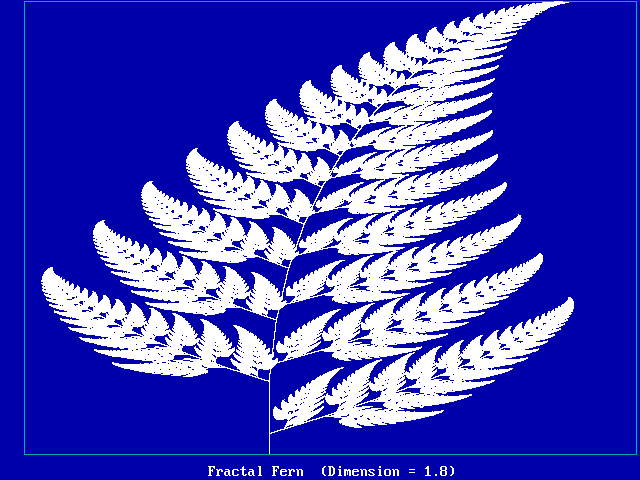
So what are fractals? They are geometric shapes. However, while they are in that way related to squares and triangles, fractals are unique. No matter how much you zoom in on them, the parts that make them up look the same. You never get to a point where the shape becomes simple and you can see exactly what its made of.
It looks like a fern. Nature is abundant with fractals. If you are studying fractals it is a good idea to look up other examples of fractals in nature - such as through my links.
Top of page | Contents page | Sign My Guestbook
Like I've said about a trillion times already, with humans and measuring the universe, there will always be inaccuracy. We can never be certain of the length of a coastline, the mass of gold bullion or even if the marks on your ruler truly represent exact centimetres.
We call that uncertainty.
We can, however, give a value to the extent of that inaccuracy, often called a margin of error. You may have seen some kind of measurement, eg: 5 cm, with ±0.01 next to it. This means that the value of 5 cm can be off by up to 0.01 of a centimetre. The reason there is a + & a - is because the measurement could be too much or too little. And it does not mean the inaccuracy is exactly 0.01 - thats just a limit to it. The true value could be 0.005 less than 5 cm (4.995 cm) or 0.002 more (5.002 cm).
So how do we know the inaccuracy of our readings?
The basic way to do it is to test your measurements. When taking a reading of say, the height a ball bounces when dropped from a fixed height, we won't just settle for the first value we obtain - it could be way out of whack. We take many readings. We look at the range of those readings and then divide them by the number of values recorded. It's a lot like averages/means but NOT THE SAME!
uncertainty = range of values ÷ total number of values
D x = X max - X min
Just to clarify, I should explain means. A mean is basically an averages. You add up each value, rather than just take highest & lowest, and then divide it by the total number of values. It is shown as an x with a line above it.
mean = sum of values ÷ total number of values
x = S x
Uncertainty may depend on the calibration of an instrument, how many decimal points a value is rounded to or obtained (some kitchen scales can't do much less than 1 g) or just simple human error. If a correct standard has not been carefully used in creating rulers, thermometers and weights then you may be reading exactly what your instruments are showing but they are themselves inaccurate.
Top of page | Contents page | Sign My Guestbook
The universe is far too complex for the finite mind of man to comprehend its infinite intricacies.
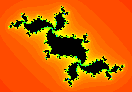 .these are from Fantastic Fractals www.techlar.com/fractals.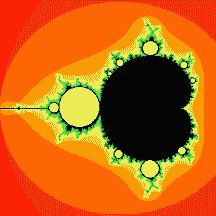
Don't get what I mean? Try this: draw a equilateral triangle (all sides equal). On each on the sides of the triangle draw another equilateral triangle only a third of the size of the bigger one and in the middle of that side. Then do the same to all these triangles, and again and again and again.... Even though you can't go forever, a real fractal of this kind would.
Here's what I got:_____________________
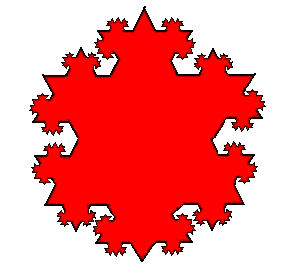
Okay, it's pretty dodgy but at least I didn't nick from someone else. Notice how it looks like a snowflake?
Well have a look at this other fractal:
n
n