 |
BLUETOOTH |
 |
|
What is Bluetooth ? We all know Bluetooth is a new buzz name in mobile to mobile communication. This page will tell you what is inside this technology why we allways prefer Bluetooth over infrared?? Why?? For this why read on. BLUETOOTH A wire free connection that
enables devices to exchange information.
Bluetooth is a technical industry standard that facilitates communication between wireless devices such as mobile phones, PDAs (personal digital assistants) and handheld computers, and wireless enabled laptop or desktop computers and peripherals. A single Bluetooth-enabled wireless device is capable of making phone calls, synchronizing data with desktop computers, sending and receiving faxes, and printing documents. For example, an individual can use a Bluetooth connection to print a document from his PDA. Bluetooth devices use a microchip transceiver that operates on the 2.45GHz frequency and have a range of up to 10 meters (approximately 33 feet)..
How does it works?? Bluetooth devices operate at 2.4 GHz in the license-free, globally available ISM (Industrial, Scientific, and Medical) radio band. The advantage of operating in this band is worldwide availability and compatibility. A potential disadvantage is that Bluetooth devices must share this band with many other RF emitters. These include automobile security systems, other wireless communications standards (such as 802.11), and ordinary noise sources (such as microwave ovens). To overcome this challenge, Bluetooth employs a fast frequency-hopping scheme and uses shorter packets than other standards in the ISM band. This scheme makes Bluetooth communication more robust and more secure. Frequency Hopping Frequency hopping is literally jumping from frequency to frequency within the ISM band. After a Bluetooth device sends or receives a packet, it and the Bluetooth device or devices it is communicating with �hop� to another frequency before the next packet is sent. This scheme has three advantages:
Of course, the connected devices must agree upon the next frequency to use. The Bluetooth specification ensures this in two ways. First, it defines a master-slave relationship between Bluetooth devices. Second, it specifies an algorithm that uses device-specific information to calculate frequency-hop sequences. A Bluetooth device operating in master mode can communicate with up to seven slave devices. To each of its slaves, the master Bluetooth device sends its own unique device address (similar to an ethernet address) and the value of its internal clock. This information is used to calculate the frequency-hop sequence. Because the master device and all its slaves use the same algorithm with the same initial input, the connected devices always arrive together at the next frequency. Power Consumption As a cable-replacement technology, it�s not surprising that Bluetooth devices are usually battery-powered devices, such as wireless mice and mobile phones. To conserve power, most Bluetooth devices operate as low-power, 1 mW radios (Class 3 radio power). This gives Bluetooth devices a range of about 5�10 meters. This range is far enough for comfortable wireless peripheral communication but close enough to avoid drawing too much power from the device�s power source. Security Security is a challenge faced by every communications standard. Wireless communications present special security challenges. Bluetooth builds security into its model on several different levels, beginning with the security inherent in its frequency-hopping scheme. At the lowest levels of the protocol stack, Bluetooth uses the publicly available cipher algorithm known as SAFER+ to authenticate a device�s identity. The generic-access profile depends on this authentication for its device-pairing process. This process involves creating a special link to create and exchange a link key. Once verified, the link key is used to negotiate an encryption mode the devices will use for their communication.
Bluetooth Architecture Bluetooth is both a hardware-based radio system and a software stack that specifies the linkages between layers. This supports flexibility in implementation across different devices and platforms. It also provides robust guidelines for maximum interoperability and compatibility.
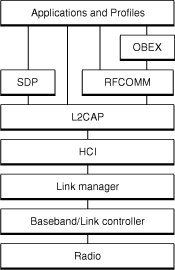
The Bluetooth Protocol StackThe heart of the Bluetooth specification is the Bluetooth protocol stack. By providing well-defined layers of functionality, the Bluetooth specification ensures interoperability of Bluetooth devices and encourages adoption of Bluetooth technology. As you can see in Figure , these layers range from the low-level radio link to the profiles. The Bluetooth protocol stack
Lower LayersAt the base of the Bluetooth protocol stack is the radio layer. The radio module in a Bluetooth device is responsible for the modulation and demodulation of data into RF signals for transmission in the air. The radio layer describes the physical characteristics a Bluetooth device�s receiver-transmitter component must have. These include modulation characteristics, radio frequency tolerance, and sensitivity level. Above the radio layer is the baseband and link controller layer. The Bluetooth specification doesn�t establish a clear distinction between the responsibilities of the baseband and those of the link controller. The best way to think about it is that the baseband portion of the layer is responsible for properly formatting data for transmission to and from the radio layer. In addition, it handles the synchronization of links. The link controller portion of this layer is responsible for carrying out the link manager�s commands and establishing and maintaining the link stipulated by the link manager. The link manager itself translates the host controller interface (HCI) commands it receives into baseband-level operations. It is responsible for establishing and configuring links and managing power-change requests, among other tasks. You�ve noticed links mentioned numerous times in the preceding paragraphs. The Bluetooth specification defines two types of links between Bluetooth devices:
Each link type is associated with a specific packet type. A SCO link provides reserved channel bandwidth for communication between a master and a slave, and supports regular, periodic exchange of data with no retransmission of SCO packets. An ACL link exists between a master and a slave the moment a connection is established. The data packets Bluetooth uses for ACL links all have 142 bits of encoding information in addition to a payload that can be as large as 2712 bits. The extra amount of data encoding heightens transmission security. It also helps to maintain a robust communication link in an environment filled with other devices and common noise. The HCI (host controller interface) layer acts as a boundary between the lower layers of the Bluetooth protocol stack and the upper layers. The Bluetooth specification defines a standard HCI to support Bluetooth systems that are implemented across two separate processors. For example, a Bluetooth system on a computer might use a Bluetooth module�s processor to implement the lower layers of the stack (radio, baseband, link controller, and link manager). It might then use its own processor to implement the upper layers (L2CAP, RFCOMM, OBEX, and selected profiles). In this scheme, the lower portion is known as the Bluetooth module and the upper portion as the Bluetooth host. Of course, it�s not required to partition the Bluetooth stack in this way. Bluetooth headsets, for example, combine the module and host portions of the stack on one processor because they need to be small and self-contained. In such devices, the HCI may not be implemented at all unless device testing is required. Because the Bluetooth HCI is well defined, you can write drivers that handle different Bluetooth modules from different manufacturers. Apple provides an HCI controller object that supports a USB implementation of the HCI layer. Upper Layers Above the HCI layer are the upper layers of the protocol stack. The first of these is the L2CAP (logical link control and adaptation protocol) layer. The L2CAP is primarily responsible for:
The L2CAP employs the concept of channels to keep track of where data packets come from and where they should go. You can think of a channel as a logical representation of the data flow between the L2CAP layers in remote devices. Because it plays such a central role in the communication between the upper and lower layers of the Bluetooth protocol stack, the L2CAP layer is a required part of every Bluetooth system. Above the L2CAP layer, the remaining layers of the Bluetooth protocol stack aren�t quite so linearly ordered. However, it makes sense to discuss the service discovery protocol next, because it exists independently of other higher-level protocol layers. In addition, it is common to every Bluetooth device. The SDP (service discovery protocol) defines actions for both servers and clients of Bluetooth services. The specification defines a service as any feature that is usable by another (remote) Bluetooth device. A single Bluetooth device can be both a server and a client of services. An SDP client communicates with an SDP server using a reserved channel on an L2CAP link to find out what services are available. When the client finds the desired service, it requests a separate connection to use the service. The reserved channel is dedicated to SDP communication so that a device always knows how to connect to the SDP service on any other device. An SDP server maintains its own SDP database, which is a set of service records that describe the services the server offers. Along with information describing how a client can connect to the service, the service record contains the service�s UUID, or universally unique identifier. Also above the L2CAP layer in Figure is the RFCOMM layer. The RFCOMM protocol emulates the serial cable line settings and status of an RS-232 serial port. RFCOMM connects to the lower layers of the Bluetooth protocol stack through the L2CAP layer. By providing serial-port emulation, RFCOMM supports legacy serial-port applications. It also supports the OBEX protocol (discussed next) and several of the Bluetooth profiles. OBEX (object exchange) is a transfer protocol that defines data objects and a communication protocol two devices can use to easily exchange those objects. Bluetooth adopted OBEX from the IrDA IrOBEX specification because the lower layers of the IrOBEX protocol are very similar to the lower layers of the Bluetooth protocol stack. In addition, the IrOBEX protocol is already widely accepted and therefore a good choice for the Bluetooth SIG, which strives to promote adoption by using existing technologies. A Bluetooth device wanting to set up an OBEX communication session with another device is considered to be the client device.
|
||