Pressure Point Therapies
Massage Therapy
Reflexology

Pressure Point Therapies
Massage Therapy
Reflexology
Pressure point therapies use finger pressure on specific points--usually related to the oriental meridian points, but also other neurological release points--to reduce pain and treat various dis-ease states. There are antecedents in Europe, Asia, and the USA. Adamus and A'tatis described a pressure system in 1582, and the sculptor Cellini (1500-71) wrote of using pressure points to relieve pain. It seems America is the last to know anything. What is wrong with that picture? Is our capitalistic government controlling knowledge? In 1770 the Jesuit Amiat contributed to European understanding with an article on Chinese pressure point massage. This article influenced the Swedish therapeutic massage pioneer Ling. In turn, Swedish therapeutic massage influenced traditional Japanese folk massage in the early 20th century, and this cross-fertilization became known as "shiatsu". About 1913, Fitzgerald had been influenced by Bressler in Europe. The use of pressure points has evolved under several systems, some of which are discussed below.Reflexology--Fitzgerald's work with hand reflex points was developed and promoted by Ingram in the US and Marquardt in Europe. Because in this system specific zones on the feet are related to specific organs, the system is often called zone therapy. There is a related system of hand zone therapy as well. The results reported for this process include relief of pain; release of kidney stones; and recovery from the effects of stroke, sinusitis, sciatica, and menstrual and other disorders (Marquardt, 19830.
Traditional Chinese massage--Remedial massage methods were described in the texts of the Han period (202 B.C. to circa 220 A.D.). By the Tang Dyansty (618-907 A.D.), these systems were taught in special institutes. Both tonification (energizing) and sedation techniques are used to treat and relieve many medical conditions. Major techniques in use are
These techniques are usually used in combinations. Two prominent groups of techniques are known as an-mo and tui-na. Varying illnesses and conditions are treated with Chinese massage, including the common cold, sleeplessness, leg cramps, painful menses, whooping cough, diarrhea, abdominal pains, headache, asthma, rheumatic pains, stiff neck, colic, bed-wetting, nasal bleeding, lumbago, and throat pains.ma, rubbing with palm or finger tips; pai, tapping with palm or finger tips; tao, strong pinching with thumb and fingertips; an, rapid and rhythmical pressing with thumb, palm, or back of the clenched hand; nie, twisting, with both thumbs and tips of the index fingers grasping and twisting the area being treated. ning, pinching and lifting in a stationary position; na, moving while performing ning; and tui, pushing, often with slight vibratory effect. Acupressure systems--four systems in which the fingers manipulate the oriental meridian system are in widespread use in the US. In all these systems, pressure is applied to meridian points to stimulate or sedate them. Amounts of pressure and length of application vary according to the system, the ailment, and the intent. All of these systems; shiatsu, tsubo, jin shin, jyutsu, and jin shin do, rely on traditional oriental medical theory, although their treatment methods vary considerably.
Shiatsu and Tsubo rely largely on sequenced applications of pressure applied from one end of each meridian to the other.
Massage Therapy--is one of the oldest methods in the gallery of health care practices. After all, who doesn't like a good massage. References to massage are found in Chinese medical texts 4,000 years old. Massage has been advocated in Western health care practices in an almost unbroken line since the time of Hippocrates, the "father of medicine." In the 4th century B.C., Hippocrates wrote, "The physician must be acquainted with many things and assuredly with rubbing"(the ancient Greek and Roman term for massage).
Modern, scientific massage therapy was introduced in the U.S. in the 1850's by two New York physicians, who had studied in Sweden (again America is the last to know everything). As the health care system in the U.S. became more influenced by biomedicine and technology in the early 1900s, physicians began assigning massage duties to assistants, nurses, and physical therapists. In turn, in the 1930s and 1940s, nurses and physical therapists lost interest in massage therapy, virtually abandoning it. However, a small number of massage therapists carried on until 1970s, when a new surge of interest in massage therapy revitalized the field, albeit in the realm of alternative health care.
Touch is the fundamental medium of massage therapy. While massage methods can be described in terms of a series of techniques to be performed, it is important to understand that touch is not used solely in a mechanistic way in massage therapy; there is also an artistic component. Because massage usually involves applying touch with some degree of pressure, the massage therapist must use touch with sensitivity to determine the optimal amount of pressure appropriate for each person (muscle tension, soft-tissue problems). The therapist must learn pressure points as in every other hands on pressure technique that activate the energy flow and to release blockages, which correspond to many different areas of the body.
Some 80 different methods may be classified as massage therapy, and approximately 60 of them are less than 20 years old. If regulatory, insurance payment, and research barriers are not removed, they will inhibit progress regarding massage therapy, along with the other forms of alternative health care.
The link below I found most interesting.
Interesting charts on specific spots. BioPulser
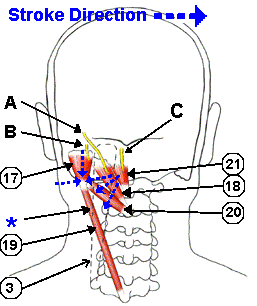
The Greater Occipital Nerve influences the fluid output of the Sphenoid Lining (see suboccipital page.) Pressure or irritation on this nerve can cause Histamine to be released in the Sphenoid Sinus (3). Histamine irritates the sphenoid lining causing it to
overproduce fluid. The swollen membranes around the sinus opening then swell shut and pressure builds up inside the sinus. The sphenoid sinus become blocked. Air can no longer circulate and carry away body heat. The Hypothalamus (1) and Pituitary (2) glands warm to full body temperature and may begin to dysfunction. The swollen sinus can also press against bone that then presses against these glands. One way or the other they begin to lose their ability to effectively regulate the complex body chemistry. Many kinds of inflammations, from cold symptoms to herpes outbreaks, can also be tied in to excess histamine release caused by an irritated or stopped-up sinus.The suboccipital muscles at the base of the skull are far more important for the nerve reflexes they cause than for the orthopedic pain in the neck they may produce. This particular
organ reflex is so important that it is given it’s own chapter.