Oscar Romero: Person of Faith
by Noah Mitchell
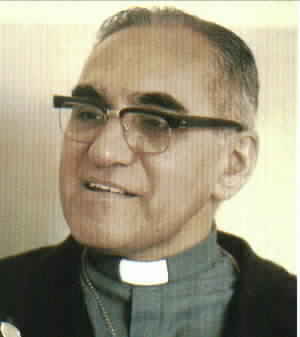
Oscar Romero was born in Ciudad Barrios, El Salvador. Even as a boy, he felt a calling to the priesthood; at only 14, he left home to pursue his vocation. Once ordained, he was not yet a spokesman for the end of Salvadoran oppression. In fact, early in his life as a priest, he held on to an ideal of rigid Church command over the masses to keep peace while the aristocracy exploited them and the military enforced the exploitation. Even as editor for the archdiocesan magazine, he avoided issues of social injustice. He was known to be orthodox, pious, and critical of liberation theology.
However, in 1975, the national guard attacked a village in the diocese-- The soldiers used machetes to hack people to pieces, supposedly searching for weapons. As oppression of preists increased, Romero was promoted to archbishop. His first jobs were burying murdered protestors. The crucial turning point in Romero's life occurred when Romero's good friend (a priest), Rutilio Grande, was ambushed and killed along with an old man and a teenage boy. Grande was critic of the ruling class' incredible wealth and oppression against the farmers, whose rights had been stripped away.
Now, in the midst of leaflets urging, "Be a Patriot: Kill a priest," Romero excommunicated his friend's assassins. He boldly took the place of Rutilio as a shepherd willing to lay down his life for the sheep. He preached a new message of liberation theology: "God needs the people themselves to save the world . . . The world of the poor teaches us that liberation will arrive only when the poor are not simply on the receiving end of hand-outs from governments or from the churches, but when they themselves are the masters and protagonists of their own struggle for liberation."
Yet, Romero could not stop the violence; 75,00 Salvadorans would be killed, one million would flee the country, another million would be left homeless in the years to follow. He was not a man of power, but a humble man with a purpose. He even chastised American President Carter: "You say that you are Christian. If you are really Christian, please stop sending military aid to the military here, because they use it only to kill my people." At the same time, he was certainly not purely a political figure; he criticized leration theology without the gospel and denounced peasants' violence as a liberating tactic.
"The church would betray its own love for God and its fidelity to the gospel if it stopped being . . . a defender of the rights of the poor . . . a humanizer of every legitimate struggle to achieve a more just society . . . that prepares the way for the true reign of God in history."
On March 23, 1980, his boldness summitted as he challenged an army of peasants over a broadcast sermon heard throughout the country: "Brothers, you are from the same people; you kill your fellow peasant . . . No soldier is obliged to obey an order that is contrary to the will of God . . . In the name of God then, in the name of this suffering people I ask you, I beg you, I command you in the name of God: stop the repression!" He had risked his life before with his messages, and now he knew he had sacrificed it. He said days before his death, "You can tell the people that if they succeed in killing me, that I forgive and bless those who do it. Hopefully, they will realize they are wasting their time. A bishop will die, but the church of God, which is the people, will never perish."
On March 24, he was assassinated while conducting mass at a funeral.
There is no doubt he was a man of the greatest level of faith. He had chosen the highest risk of all for God. He was certain in his resolve, no matter the cost.
Sources:
Shepherd, Victor. "Oscar Romero." copyright June 23, 1998. date accessed: 10/27/06.
Creighton University. "Remembering the Assassination of Archbishop Oscar Romero." date accessed: 10/27/06
Golden, Renny. "Oscar Romero: Bishop of the Poor." date accessed: 10/27/06