Challenges to Faith Journal
by Noah Mitchell
Summary:
Atheisn, Science, and the power of dehumanization often challenge the extent or existence of one's Faith. Atheists, whether positive (who consider their atheism an essential part of who they are) or practical (whose lives do not reflect any kind of real relationship with God), set examples for us to deny God's work through words or actions. Friedrich Nietzsche, a German philosopher, denied reason's power to discover truth and adopted a belief of relative morality, in which what is wrong for some people is not necessarily wrong for certain other people. According to Nietsche, there are no objective values. He also put a very high emphasis on power and ambition (will to power), stressing the importance of the Superman, certain men who have a tremendous will to power, something the masses lack. Thomas Hobbes, a "practical" atheist, emphasized materialism is the belief that there is nothing beyond physical matter. He denied that freewill exists amond men. He, too, believed in relative values. These two atheists are quite different than the philosophy of St. Ignatius Loyola, who argues that we are "created to praise, revere and serve God." Ignatius' idea of "Ignatian indifference" means that we don't care what happens to us as long as it is God's will; we should do all things for the greater glory of God.
Science sometimes presents a barrier between us and religion. Religion does not follow the scientific method, per se. We cannot observe it in a natural phenomenon and test it. Through the ages, the relationship between religion and science has gone through stages: From 500 BC to 1500 AD, science was explored for to discover more about God's creation. There was no apparent disunity. THis stage could be called "unreflective unity." During the REnaissance and Enlightenment, however, their relationship went through a "reflective disunity." Europeans were starting to think and question independently of Church restrictions. Galileo Galilei and Francis Bacon began to challenge Church authority. Lastly, a period of "reflective unity," arguably beginning around 1900 to the present, reflects society's movement toward reconciliation between religion and science. There are limits to science's power. Science presupposes the uniformity of nature, emphasizes empiracle knowledge, and does not give us certitude.
Also, the media in general constantly presents us with images, phrases, and ideas that dehumanize humanity and the human body. The media replaces people and love with sexual toys and obsession with products.
Three Ideas:
1. There should really not be much of a difference in one's worldview depending on whether he/she believes in objective morality rather than relative morality. If the former, then one feels an obligation from God to act rightly. If one believes in relative morality, one can and should feel that the same guidelines guide his/her life. There is an obligation for the benefit of humanity, rather than from God.
2. The analogy of the Church's relationship with Science is comparable to that of a parent and a child: first there is unreflective unity, then reflective disunity during adolescence, and eventually (hopefully) a reflective unity once the child reaches a more mature age.
3. (from "A History of Doubt") The Greek philosophers, and most philosophers through history, do not disrespect religion, but revere it as an answer to doubt, even if they reject it as truth. Many history-making doubters also were part of the Church, arguably even Jesus Himself.
Images of Key Ideas:
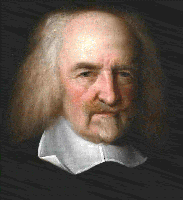

A Question
The book lists atheism, science, and the media as "challenges" to faith. Can a challenge strengthen Faith?
Of course! All these challenges, if considered or even followed, can reveal their weaknesses that one may find Faith to lack. In this way, an individual can find that Faith is stronger than its challenges. This is even a necessary part of maturing spiritually.