Journal #1
"The unexamined life is not worth living."
Just as Socrates, Plato, Buddha, Fr. Hagan, Dion Sanders, and Eric Clapton all convey in different ways, it is vital to question ourselves, our lives, and our environment. How do we live? How should we live? Why do we live? Such questions are essential to our self-awareness, and answers to these questions can only be glimpsed through reasoning, the action of thinking through a subject critically to arrive upon an answer. Socrates exhorted such reasoning. When examining one's life, however, there are some lessons one must eventually come to realize: that we make decisions all of the time that determine who we are, that we hold certain biases, that our happiness rest on our value judgements, that changes in our beliefs must modify and change our lives, and that,oftentimes, the most important decisions are ones of faith (trust and belief). With these things in mind, we can examine our lives, seeking truth, as Plato and Fr. Hagan commanded, and we can approach the truth with an open mind, following Buddha's advice. Sometimes, our examination reveals internal emptiness and despair, such as in the cases of Dion Sanders and Eric Clapton. These cases especially, but in all cases to some degree, a chance metanoia emerges. In our metanoia, whether earth-shattering or seemingly insignificant, we turn away from illusion towards truth in a radical and ultimately life-altering change of mind and heart.
Three Important Ideas of the Section:
1. According to Buddha, mankind is born terribly narrow-minded. They can hold on to their definite beliefs so hard that they choose to criticize others' view of things. This teaching, a stem of dukkha, can be compared to the Christian teaching of original sin, an inherited evil nature. These people are like blind men who each touch part of an elephant and think that an elephant has the texture only of the body part they touched. These men would argue over what sort of thing an elephant is. Buddha explained:
"For, quarreling, each to his view they cling.
Such folk see only one side of a thing."
Often, in my opinion, it is not an inherent narrow-mindedness, but a learned characteristic of adhering to conformities for an illusion of confort in partial ignorance.
2. According to Aristotle, there are two types of people: boats with rudders and boats without rudders. The majority of society seems to be rudderless. They have no direction in their life, no purpose to fulfill. The wind blows them about and they do nothing about it. They are easily sent into storms and have trouble coming out. However, some people have rudders; they hold faith in a purpose and a direction. They can steer away from storms or enter straight into them by their will. These two types of people compose society.
3. A predominating trait of most teenagers and much of society in general is hubris. Hubris is the mindset or attitude that "it's not going to happen to me." The attitude could be related to overarching and foolish pride. Hubris, however, is not a trait of only modern times, however. Thousands of men in ancient Greek and Roman culture are notorious for their exaggerated trust and belief (faith) in themselves. Many believed that although thousands before them failed or died in particular excursions, they would certainly not meet the same fate as their predecessors. A notable example of hubris today is teenagers' attitude towards driving. Most often, teens make poor decisions driving with the preconception that nothing will happen to THEM and that accidents and tragedies only happen to others.
Images of Key Ideas:
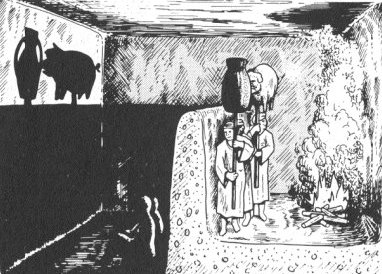

One good question to ponder:
In Matthew 19, Jesus tells the rich young man that "if you would enter life, keep the commandments" (ESV). The man replies that he has kept them. Could it be possible that this man has kept the commandments? To what degree must one honor one's father and mother or love their neighbor to "get full credit?"
My thoughts: Though Jesus does demand, "be perfect as your heavenly father is perfect," no human could ever live up to this standard. There is no way that any person, including the young man in the story, could keep the commandments in their fullest. This story also leads me to note that the Jews of the time had a more limited view of the Christian God, with only the experiences recorded in the Old Testament from which to learn. All humans' view of God is different from experience or lack thereof, and here this man's idea of "keeping the commandments" may be much different than mine or anyone else's.
Concerning the follow-up question, it is silly and insignificant to attempt finding petty boundaries of God's love. This question only arises out of concern for ourselves, when we should not try rationalizing our standing before God, but rather look ahead to how we are planning to live the rest of our lives.