 |
| HERALDRY |
| Heraldry comes from the German words Heer, meaning a host or army, and Held, meaning champion. It is the art and science of creating and describing a coat-of-arms (also known as 'armorial bearings' or 'arms'). A herald is a peson whose job is to create and regulate coats-of-arms. Some work private of the government, while some work for the state, depending on the country in which they work. Heraldry originated in medieval times, in order to distinguish between combatants in battles and jousts. In the late middle ages and the renaissance, heraldry became a highly-developed discipline, regulated by the heralds. In most countries, it is just a hobby; but in some nations it is illegal to assume someone else's arms. |
 |
| TYPES OF SHIELDS |
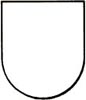
| Over the years and throughout the nations in which heraldry has developed, different shields (also known as fields or escutcheons. Most take their designs from the in-vogue shields used in combat at the time. Shown her are a few examples |
| Halbrundschild This shield with a distinct semi-circular base, is common in Austria and Switzerland. |
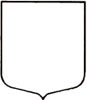 |
| French This shield originated in France (obviously) and is an almost square shield with a tapering bottom. This is useful because one can fit more information on the field without being distorted. |
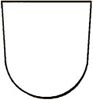 |
| German Similar to the Halbrundschild, this shield has a semi-circular base and tapering sides. |
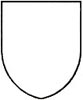 |
| Heater The most common type of shield. It has precise proportions: 3 units along the top, 1 unit straight down,3 units at 45 degrees. Then use a compass to round from the bottom of the straight to the bottom of the shield. |
 |
 |
| COLOURS |
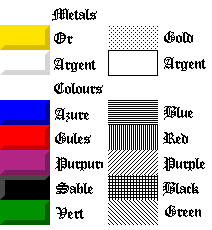
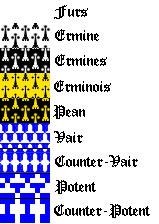
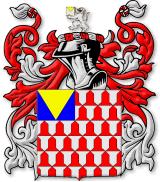
| The table on the left shows the colours used in heraldry, with their names in English, and how they are described in heraldry. It also gives the black-and white equivalents.The most important rule of heraldry is 'the rule of tincture'- a colour cannot be placed on a colour, nor a metal on a metal. Tis is both for the sake of contrast and also because it was difficult to do in the Middle Ages. The exception to this rule is the shield of Godfrey of Bouillon, King of Jerusalem. Upon his coronation on July 22, 1099, he created a shield featuring five gold stars on a silver field (Argent,five crosses potent Or). He may have adopted the Arab technique of Damascus steel and may have been a mistake on the part of heralds in later years, wherby the stars were originally black steel, but rusted and so were mistaken for gold. The table on the right shows the most common furs used in heraldry. The ermine family is derived from the fur of stoats, while the vair/potent family is that of squirrels. The colour schemes shown are most common but can be varied as shown on the Beech coat-of arms on the left. |
 |
 |
| The arms of Godfrey of Bouillon, King of Jerusalem. |