Asteroids are large chunks of rock that come from the asteroid belt between Mars and Jupiter or the Edgeworth-Kuiper Belt beyond Neptune, on the outskirts of the solar system.
Comets are asteroid-like, small bodies covered with water ice, dust, carbon-like and silicon-like substances.
They have highly elliptical orbits around the sun.
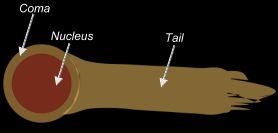
As the comet approaches the sun, the heat and the intense solar wind sublimates the solid nucleus to gas and dust producing the distinct coma and tail of a comet. (Sublimate means to convert solid to gas, bypassing the liquid stage.)
Comets can have one of two types of tails, depending on the ingredients of the nucleus:
Gas-Ion - ionisation occurs when sunlight rips electrons from the gas in the coma, producing straight and narrow tails.
Dust - dust particles are swept away by solar wind and are deposited further away from the nucleus producing diffuse and curved tails.
There are two types of comets:
Short Period - originate in the Edgeworth-Kuiper Belt, these comets return frequently to our solar-system (like Halley's comet)
Long Period - originate in the Oort cloud beyond Neptune and Pluto (cloud of frozen bodies which orbits the Sun); perturbations may eject a body to begin its orbit as a long-period comet.
In 1705 Edmond Halley predicted, using Newton's new laws of motion, that the comet seen in 1531, 1607, and 1682 would return in 1758. The comet did return as he predicted and was later named in his honor. The average period of Halley's orbit is 76 years, effected by gravitational forces of planets that it nears. Its orbit is highly eccentric, retrograde and inclined 18�. Halley is unique among comets in that it is both large and active and has a well defined, regular orbit. It will return to the inner solar system in 2061.
Comet Shoemaker-Levy 9 was discovered by Eugene and Carolyn Shoemaker and David Levy in 1993. Shortly after its discovery it was determined to be on a collision course with Jupiter. As it passed close to Jupiter, it was broken into at least 21 fragments which were dispersed millions of kilometers along its orbit. Between 16 July 1994 and 22 July 1994 the fragments impacted the upper atmosphere of Jupiter. The after-effects of the impacts were visible on Jupiter for nearly a year after the event.