Ngorongoro Crater
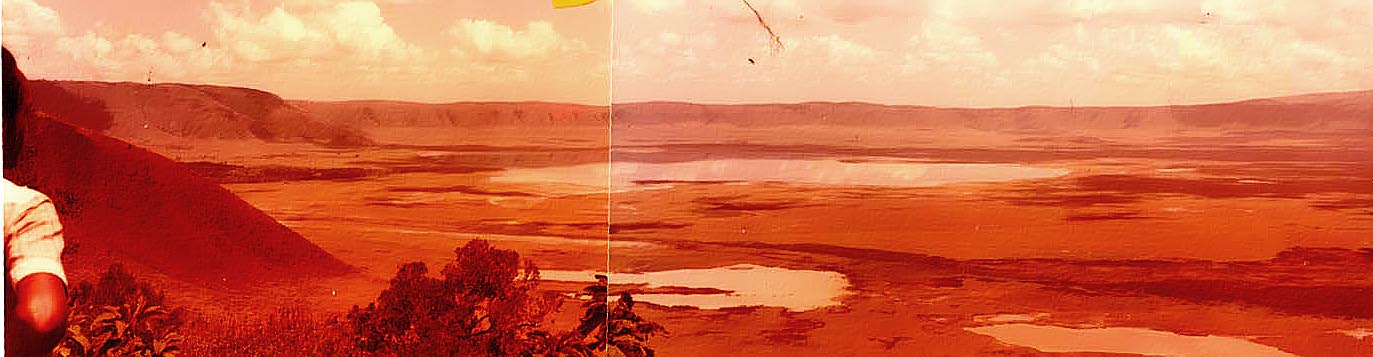
Ngorongoro Crater - Crater Floor
Author with Tanzanian Research Students

Go TopI stayed in Tanzania from December, 1979 to February, 1990. I travelled extensively to the remote corners of the country often with students of Geology of the University of Dar es Salaam. I met expatriates of different profession and from different countries of the world besides the people of the country itself. On our arrival in Tanzania, we were faced with a country which was feeling the after-effects of the Ugandan War: prices of essential commodities were escalating by leaps and bounds; corrupt officials of Government and Public Sector Companies were having a field day . State takeover of foodgrains distribution put the people in utter distress. I stayed in the University hotel called the Silversands Hotel for the first three months and then in the main campus of the University that was situated on a small hill. The University buildings together with the multistoried Students' hostels and the teachers' houses and the vegetation around presented a picturesque surrounding. I have tried here to present whatever I had seen and experienced during my stay for the period .
Tanzania is a country situated on the East Coast of Africa south of Kenya and north of Zambia and Mozambique. On the west, the country has a natural boundary represented by Lake Tanganyika. Lake Victoria occupies the vast area on its northwestern border. Though the country has an area of nearly one-third that of India, it has a population that is one-thirtieth that of India. During the early period of our stay, there was only one University but later, the Morogoro Campus was separated from the main University of Dar es Salaam into a full-fledged University of Agriculture. Christians and Muslims form nearly 80% of the population, the rest still practise traditional indigenous beliefs, especially the Masai tribes. The Masai tribes are very different from other African tribes in that they had some features similar to Indians. Even the name of the hills present Indian affinity as exemplified by names of hills such as "Oldoinyo Lengai" or "Oldoinyo Sambhu". The country was colonized by the Arabs and the slave trade began in the 8th Century AD. The trace of the inhuman treated meted out to the slaves are still vivid in the relics found at Bagamayo near Dar es Salaam. Tanzania formed the major part of the German East Africa in 1885 and in 1946, Tanganyika was a UN Trust Territory under U.K. Tanganyika and Zanzibar merged to form the United Republic of Tanzania of today. President Julius Nyerere was the first President of the Country after independence in 1961. He was popularly known as "Mwalimu" or "Teacher" as he began his life as teacher. Geographically, the country is fortunate in having a natural boundary except in a few stretches. In the north, the highlands constitute the relics of ancient volcanism, Kilimanjaro forming the highest peak in Africa. The area around Mbeya in the southwest also form highlands consisting of rocks of volcanic origin and the volcanic activity continued till the 18th Century. Eastern coast and the undulating topography on the west along the shore of Lake Tanganyika present features very s similar to the Eastern Ghats of India. Rift valley Systems, which is very spectacular in Africa, form the western boundary of Tanzania. The valley may be imagined as a trough formed on land as the result of adjustments which occurred as a consequence of the Ocean Floor Spreading that caused the separation of the continents of India, Africa and America. Lake Tanganyika, Lake Nyasa occupies the rift valley known as the East African Rift Valley. The first railway line was constructed during the German rule. These connect Dare es Salaam with the west and Arusha in the north. Communist China constructed the Dar es Salaam - Zambia railway line and this forms the lifeline between Dar es Salaam and Mbeya and between the seaport of Dar es Salaam and land-locked Zambia.
Go TopI had the opportunity to stay with a Tanzanian family in a village in Nothern Tanzania. Three brothers and their families were having separate establishments but used to celebrate customary local functions together. One of the brothers was a muslim but that did not have any influence in their daily life and they lived together. Actually, religion - both Islam and Christianism came much later to Tanzania and the traditional beliefs are still embedded in their daily life as in the many tribes in India who embraced christianity but still practise traditional customs as prevailed earlier. There are more than 100 different tribes and their different languages or dialects and that makes a difference in the people. Mwalimu was actually instrumental in bringing together these diverse tribes with the Common language 'Kiswahili' or 'Swahili' spoken across the country and making it as the National Language of Tanzania. He established "Institute of Kswahili Research" at the University of Dar es Salaam to promote, enrich and popularise the use of the language. One advantage of popularising the Swahili language was that Swahili was not a regional language or mother tongue of any particular tribe as Hindi in India to cause any tension due to discrimination. The language was actually the common language spoken by both Kenya and Tanzania and was well understood in Uganda.
Go TopMwalimu was instrumental in introducing "Ujaamma" - a process of bringing people scattered in an area into village blocks where all the development activities were concentrated. The idea was to reach facilities such as education,health,food near to the people. Single party rule helped him to put into effect his ideas to practice. However, farmers were separated from the land they tilled. Moreover, in his zeal to do good to the people, he did not impart any responsiblities to the officials implementing the program. So production of foodgrains sufferred. So long as food aid was forthcoming, the country could distribute them. Indiscriminate nationalization of the distribution process itself put a brake on the development of healthy market system and so indigenous production of foodgrains suffered. (Even the surplus houses were nationalised. Many of them converted the houses into hotels to save them from the takeover.) Before our arrival, I learnt from the students that a procession was arranged by the students opposing the one-party system but that agitation was ruthlessly suppressed. Supply of beer through the public distribution system to the students' hostels at a cheap rate helped to keep the political activity practically non-existent. The State party C.C.M.(Chama Cha Mapinduzi - Party of Revolutionaries) was supreme and no dessent was permitted. I learnt that even some party members were recruited as students attending classes to spy on the students and teaching community.
Go TopThough financially Tanzania was not strong, the country started several welfare measures. Education was free for the Tanzanians upto the highest level and that included free hostel stay, food, books and stationaries, medical facilities and allowance for other expenses. Thanks to the high per capita aid, the University got many costly equipments which many of the Indian Universities did not have or even proposed to seek them. However, in view of the Government providing the facilities to the people without any cost, people got into the habit of too much dependency on the Government help. I used to observe the people in the remotest villages drinking beer right from the morning and doing no work. Once I saw fire was destroying crops in the field but nobody from the village took the lead to put out the fire since they were assured of rations through Government if they have the right connection.
Go TopUniversity students were the most fortunate ones since their position in the Government service and their expenses during their study were guaranteed subject to their performance. At the time, most of the students selected were supposed to have done national service for two years after 'A' Level Examination nearly equivalent to Class XII Higher Secondary Examination in India. Many of them were, therefore, above 20 years of age when they entered the University. As employment were assured, students were very serious and sincere in their studies than those in India. As the Government paid for their stay ( both boarding and lodging),books, fees, travel, and other necessities, there was no problem in pursuing studies if one wished to and had the capability. The students were paid allowances which they spent on beer or whatever they could lay hands on. Some of them often got married during their studies. The assessment of results are completely internal except the Final Examination when External Examiners would come and scrutinise the scripts and review the results. However internal assessment had a 30% weightage even in the Final Examination. The Teacher teaching the subject was supreme in the internal assessment process. In India, there is a tendency of some of the teachers to award high marks to gain popularity among the students; Once this was tried by one teacher from India who did not properly cover the syllabus. It boomeranged on him as the students, who got 'A' grade, complained against him since they felt that they did not learn anything and were poorer in the subject compared to the next batch of students taught by another teacher. However, I must mention that on an average students were good and some were quite intelligent and picked up their subject very quickly. Many of them followed their studies abroad; few of them were retained by the Universities in the advanced countries.
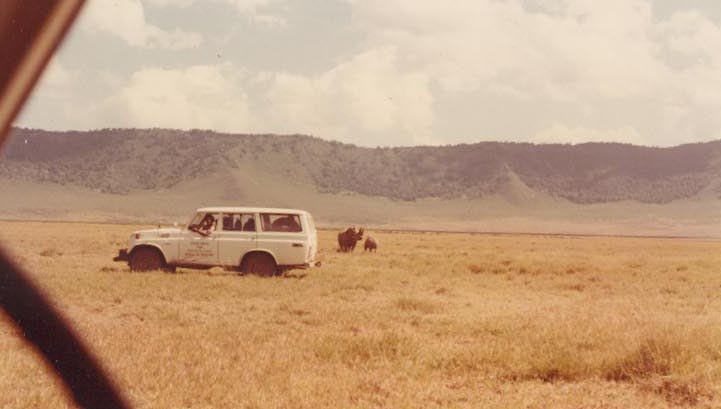
Go TopNgorongoro Caldera - situated in the northern Tanzania - is a great tourist attraction not only for the multitude of animal life but also for the scenic beauty of the landscape of an unbroken caldera which could be easily approached by fore-wheel drive vehicles from the crater rim down to the base of the caldera about 600 m below. The area which is 180 Km from Arusha town and could be approached from Arusha about 700 Km from Dar es Salaam. As an unbroken, inactive caldera, Ngorongoro is the largest of its kind in the world. With a diameter of 18 Km, the average height of the rim is about 2300 m whereas the floor of the caldera stands at 1700 m giving an average depth of about 600 m. Animals included hyena, rhinoceros (double horned) etc. except giraffe which is conspicuous by their absence.
Go TopWe drove to Mbozi from Mbeya town. The Mbozi Meteorite is a large chunk of metallic rectangular block which had come down to earth from space. The mere size (if we could draw a inscribed sphere within it, it would be nearly 5m in diameter)indicates how large it was originally. I saw several machine saw marks on it at several locations on it. May be some researchers had taken out samples to study the composition. Meteorites indicate what our own earth consists of since they are remnants of some heavenly bodies disintegrated in space.
Go TopLakes are an asset of the countries bordering it. Besides, fish species that exists and the water it holds , the scenic beauty of the lakes surrounded by the green forests would be appreciated by all. Standing on the shore of the Lake Vicoria or Lake Tanganyika, the water front appears to be open sea rather than a fresh water lake. On the side of Lake Tanganyika, hills could be seen on the other side but the water of Lake Victoria seems to be never-ending. A variety of Bhetki was relished by us at Dar es Salaam with high fat content. I learnt that it came from Lake Victoria.
Go TopMwalimu had a vision: He wanted to bring benefits
of health and educational developments to the masses. That is why
education and health care was free for all citizens. What he
blundered was the unnecessary nationalisation of all forms of
economic activity including residential houses. As a country with
abundant national resources, instead of nationalising existing
economic activity, there was enough scope to develop agriculture
and agriculture-based industries. Inept handling of economic
affairs and corruption in the public sector firms broke the
backbone of the country. In one instance I heard that many people
drew advance and never repaid them and since there was no proper
audit in proper time corrupt officials made fortunes.
Go Top