FUCHSIA
|
FUCHSIA |
|
 uchsias are grown primarily for their ornamental value because they are long flowering plants. They produce masses of flowers from Spring to Autumn. "Taste", is what the word Fuchsia means to us. There are more than one hundred species of fuchsia, comprised mainly of perennial trees and shrubs. These plants are all members of the plant family Onagraceae; the evening primrose family. Fuchsia are known as long-day (LD) plants. The length of the dark period controls flower initiation. Flowering can be done effectively by exposing the plants to "short-night" periods.
The special healing properties of the Fuchsia is that it uplifts the soul, elevating it to new levels of consciousness. It clears up any psychological imbalances from early childhood.
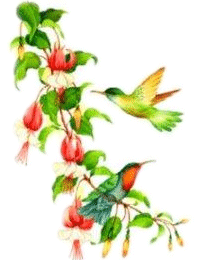
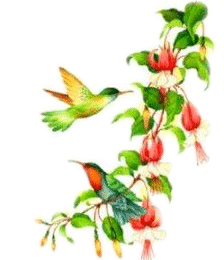
FUCHSIA IS A GOOD SOURCE FOR INVITING HUMMING BIRDS INTO YOUR GARDEN

CARE FOR FUCHSIA

 WATERING the plant is an important factor. During the active growing period, plants should be kept moist, but not over-watered. Water the plant when the soil feels dry. Potted plants cen be watered, until the water flows freely out of the drainage holes. Plants in shade can be sprayed with water. When plants are open to direct sunlight, do not water overhead, so as to avoid the foliage damage. If your plant wilts from lack of moisture place it in a larger container full of water until it stops bubbling. Let the fuchsia sit in the water container for a few moments then lift out of the water bath and set on a bench or hang the fuchsia until it stops dripping. Be sure to keep them moist, not wet, during the winter months. Plants can be lost by drying out. During hot, dry days, move the plant to a cooler place, if possible, and give it a shower.It's the dry air that fuchsias don't like. If the drainage is good and the soil not too compact you can't drown a fuchsia. You might have to - and you can - water fully rooted plants several times a day if drainage and soil are correct.

PRUNING, REPOTTING AND PINCHING are some of the other important factors. Prune your plant 1/3 of its size. This will result in the formation of a full, compact plant when growth resumes. When this happens, increase moisture and return it to the growing conditions the plant prefers &endash; increased light and warmer temperatures. When new growth starts, it will often produce single stem branches. If left to continue, this would result in a sparse, leggy plant. Pruning is done at the start of the growth cycle in late January. Prune back severely, since fuchsias bloom on new wood. If the nodes on the old wood are showing leaf buds, prune back to the second true node on the old wood. Root pruning is as important as cutting back. It will give the plants, the space they need for those new roots. Fuchsias can stand, severe pruning.
REPOTTING, is generally done at the same time as pruning. Cut away one inch of old soil around the outside of the root ball and replace it with new potting soil. It is recommended that you transplant them carefully into a larger pot right away, preferrably a 4" or 5" size pot with good potting soil and let them grow and establish there roots before the final transplant into a larger container or into the ground with the ground always being the better choice. Black plastic pots are dangerous! When the sun hits the pot it heats instantly to scorching temperatures and kills the roots in a short time. Beware! Clay pots are always the best. Overwatering the plant after repotting may cause the plant to die since the soil isn't yet filled with roots.
PINCHING is required to create a well formed and a well balanced plant. It encourages bushy growth and more blossoms. When new growth is about three inches long or has two sets of leaves, pinch out the center tip.
Two new branches will form from this pinch. Continue pinching all the tip growth in this manner until the desired size and shape is formed. It will take 6 to 8 weeks for blossoms to mature after the last pinching.
EXPOSING the potted Fuchsia to the sun for a long time is not good for the plant. If the plant is accustomed to the sun from the start and as an UNrestricted root run they do quite well in the sun, but ususllay colours get blurred. Always remember that fuchsias grow best under cool and humid conditions (+10-+20 C / +50-+70F) and they thrive when it's raining...Place potted fuchsias in mostly shade & free-planted perennial fuchsias in full sun. Fuchsias will not tolerate severe frost or subtropical coastal areas.Place potted fuchsias in mostly shade & free-planted perennial fuchsias in full sun. Fuchsias don't like indoor climate at all. A balcony is a good place but out in the open is always the best, exposed to drizzle, fog and cool air. Fuchsias are surprisingly resistable to windy weather. Branches rarely break from wind alone but it's very common that the whole pot topples over and branches break. So anchoring the pots is advisable. Fuchsias are not tender plants. They love cool but not below freezing point, both in summer and winter.
FERTILIZE fuchsias by putting some SLOW-release fertilizer on top of the pot soil. Just mulch it into the surface of the soil, so the plant will be fed every time you water it. It doesn't matter what kind of fertilizer you use as long as it is balanced. During dormancy fuchsias should not be fertilized.
PEST CONTROLcan be done by cutting of the affected areas.A mixture of 1 liter of water, 50 mls of denatured alcohol and approx. 30 drops of ordinary detergent for dish-washing, are sure to avoid pests.