Thousands of years ago, the whole world was trying to think of ways to inform people of the news. In Rome, Julius Caesar created the Acta Diurna, a series of public announcements. He posted it daily so that people had a chance to read about the current events. Manuscript newssheets were passed out in many German cities in the fifteenth century amd later began to appear more frequently in the rest of Europe ("Newspapers Today").
Although they could not really be called newspapers, handwritten newsletters were sent out by ancient Roman scribes to businessmen and politicians in distant cities to keep them posted on the happenings in Rome. This custom, originating in about 1000 B.C.E., was continued until the 1700's, when printing papers became both common and popular (Waters 4).
Some people think that the first newspaper originated in Britain. But it actually started in Peking, China in the early 500's. It was called the Tsing Pao, a court journal produced from carving blocks. The Tsing Pao lasted until 1935 (Shimada Interview).
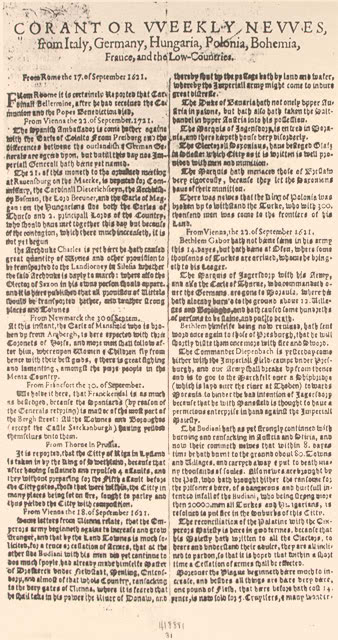
In 1620, the first regular news-book, made of folded newssheets, was published in English. It was called the Weekly Newes from Italy, Germaine, Hungary, translated from a Dutch original. The idea appealed to the public and other news-books soon followed. They were called courants or corantos (Waters 4).
The first American newspaper came out in 1690. It was called Publick Occurences, both Foreign and Domestic by Benjamin Harris. Sadly, the newspaper lived and died in the first and only issue. After that unsuccessful attempt, no one tried to launch a newspaper in America until 1702 when John Campbell published the Boston News-Letter ("Tracing the Story").
1702 also marked the the beginning of the first daily newspaper in another part of the world. England had created The Daily Courant. At first, it was printed on the backside of one small sheet of paper but soon expanded to foursheets. And although The Daily Courant was successful, it closed down in 1735, having only lived for 33 years (Mogel 4).
Before newsapers, news had to find other ways to get around. One way was by word-of-mouth. That was was not (and still is not) very reliable because of many reasons. First, people tend to twist things around a little bit when they hear a bit of news. Another reason word-of-mouth was not very reliable was because it took a long time for news to travel. It could take weeks, or ever months. By the time a piece of news reached someone's ears, it could be a month old and not at all current ror important ("Newspapers Today").
And yet another way news got around was by horse. People would write a note on a piece of parchment, send it with a news carrier on horse, and the news carrier would ride from town to town until they found the person. During the trip, the riders would trade off to avoid drowsiness ("Newspapers Today").