Nimish Gautam
Legendary Ladakh


In line with my Tibetan Buddhism trail I, after my visit to Dharamsala, headed for my next destination - Ladakh for a 15 day trip. While Tibet still remains a dream destination, Ladakh was a reality in the summers of 2004. As always my co-traveler was my friend Charles Samuel who shares my interest of treading on off the beaten path.

Ladakh is an all out attack on the senses and is far from a comfortable holiday destination. Most Indian vacationers prefer to travel and holiday in style and luxury; consequently Ladakh is not a favorite. It is, however, a backpackers and adventure seekers paradise and is very popular in the trekkers' circuit. The fact that it is part of the state of Jammu and Kashmir and close to India's disputed international borders, wards off many. Ladakh, however, is probably safer than the other safest parts of India.

We took the more arduous route to Ladakh - road from Manali. The more comfortable way is to directly fly into Leh from Delhi. Yet another option (and equally exhausting as our choice) is to take the road from Srinagar. Road from Manali is more popular with the backpackers since the hill station of Manali is a perfect place to unwind from the stress that one carries from Delhi and get prepared for the onward Ladakh adventure.

Manali is a beautiful town in the state of Himachal Pradesh and is a very popular family holiday destination among North Indians. We took the Himachal Pradesh Tourist Development Corporation (HPTDC) bus to Manali. It's an overnight trip from Delhi and we checked in an HPTDC hotel on the banks of the Beas river. Manali and the surrounding region is a complete holiday destination in itself but since we had bigger fish to fry, we stayed for just one day. We went to the ancient Hidimba Temple and some interesting forest walks.

There are numerous travel options to Leh - bus, taxi, mountain bike, motor bicycle and of course the famous Manali - Leh trek. We took a bus to Leh that left Manali early in the morning via
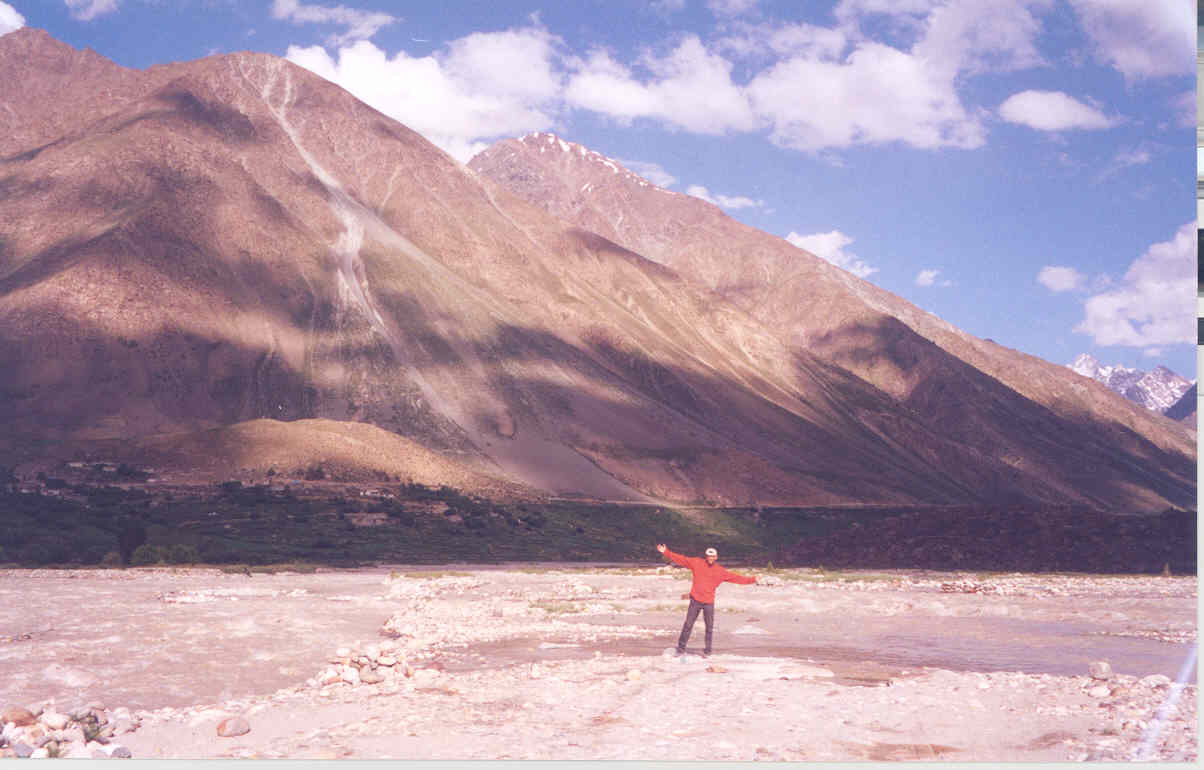
Rohtang La Pass, first in the series of the many passes in and around Ladakh. One of the most striking things about this journey is dramatic changes in the topography when one leaves the green mountains of Manali and drives into the landscape dotted with loose stones and grass of the most remote region of Himachal - Lahaul and Spiti about which Rudyard Kipling said, "Surely the gods live here; this is no place for men". Beyond that the topography changes once more when one approaches Ladakh; it now turns into absolutely barren obdurate mountains that are packaged by nature in shades of brown, grey, maroon, purple, red, yellow, blue, black!!! Phew...did I leave any?

This road ride is probably one of the most thrilling in the world. The bus was at the edge of the cliffs and I was at the edge of my seat. This one's not for the faint hearted. This 475 km journey takes one and a half day and that is if all goes well. As luck would have it our bus had a flat tyre twice and we couldn't reach our night halt at the campsite of Sarchu in time. As travelling at night is close to committing suicide, we stopped in a tent at a place called Bharatpur. I could (so did most of the other passengers) hardly sleep for most of the night and had a severe headache when I got up in the morning; my first signs of high altitude sickness. Despite that we fared pretty well; there was a group of girls from Korea who puked a lot. Thanks to the wonder drug Diamox that we took every day since our arrival in Manali; it helped in reducing the effects of high altitude sickness that is caused by low atmospheric oxygen. Since we had done our bit of research beforehand we had enough stock of Diamox, Paracetamol and sunscreen with a high SPF. Temperatures in Ladakh tend to have sudden variations. Since the sun is extremely relentless it becomes very hot but can be get pretty cold as soon as clouds appear or in shade.

It was late afternoon by the time our bus reached Leh. We checked in our hotel which was close to the city centre set amidst a wonderful garden of apricot trees and view of the Leh Palace.
Leh is the capital of Ladakh and is the starting and ending point of onward excursions into the vastness of Ladakh. Leh has plenty of accommodation options to suit every budget mostly family run and are referred to as 'guesthouses'. Most backpackers hang around the numerous German bakeries meeting other tourists and sharing travel experiences and forming groups for onward travel or treks. Just as the rule book says, we took complete rest that day so as to acclimatize to the low oxygen level; there was forthcoming hectic travel.
Hosted by www.Geocities.ws


As soon as you reach Leh it is best to visit as many travel agents as possible at the earliest opportunity and join a group for your onward excursion. If you want to limit your travel expenditure, it's a good idea to join one of the groups and a share a taxi with them for further travel in Ladakh. We also got our permits from the commissioner's office. Permits are required to visit restricted areas of Pangong Lake, Nubra Valley and Tsomoriri Lake. You can get a single permit for all these places and keep enough photo-copies of the permits.

Hosted by www.Geocities.ws


Hosted by www.Geocities.ws


The next day we hired a scooter (you could hire a motor cycle or a taxi) and went to the village of Nimoo to see the wondrous spectacle of the meeting of the Indus and Zanskar rivers. The rivers are distinctly coloured and the exact meeting point of the two rivers is very conspicuous. Though we came back to Leh but few tourists go beyond to Alchi and fewer still to Dha-Hanu. On your way to Nimoo or on your return you can stop and see the Sputik gompa near the Leh airport.

Hosted by www.Geocities.ws


Hosted by www.Geocities.ws


To the west of Leh (in almost a single line) are the Indus River front , the gompas (monasteries) and palaces of Stok, Shey, Thiksey, Stakna and Hemis. All are worth a visit and can be combined in a single day trip by a taxi or a motorcycle. Those that deserves a special mention are the photogenic
Thiksey and Hemis; the latter is the biggest gompa in Ladakh housing 500 monks and incredible thanga paintings and frescos. Stok Palace is well preserved and houses a small museum while Shey Palace is slightly dilapidated but has a nice gompa. Stakna gompa is a small detour from the highway and is perched on a hilltop.

Hosted by www.Geocities.ws


The next day was a big one since we headed for the fabled
Pangong Lake. Passing through Chang La (5289m) the third highest motorable road in the world it is a 150 km drive. Except a few unpaved patches the road is in good condition and some tourists, like us, go on a two-wheeler. On the way you would pass through some of the most amazing landscape in the world and at many points freshly melted snow results in streams that simply cross your path over the road. At one point a bridge was washed away by the river and the army personnel were busy constructing a new one. We had to take help from the construction workers who put up wooden planks for us to cross over the river!

Hosted by www.Geocities.ws


Hosted by www.Geocities.ws


Hosted by www.Geocities.ws


The first sight of the Pangong Lake was truly magical; the water was so unbelievingly blue and stretched to the horizon. The lake is a massive 130 km long and extends into China (my dream destination of Tibet - so close yet so far). Around one third of the lake is under Chinese control and the only humans visible are army personnel and some construction workers. There is a small lodge (with dining facilities) on the banks of the lake run by the local people; it's a very basic accommodation but it's location makes it priceless. We stayed there for the night. We were the only tourists at the lake that day and were lucky to get a ride in one of the army boats. There are no boating facilities at the lake and the army boats are for surveillance purposes but if you have luck on your side they may take you on the boat.


Hosted by www.Geocities.ws


Pangong Lake was like a dream and I distinctly recall my evening walk at the lakeside. Immensity of the lake's blue waters surrounded by brown rolling hills and not a human in sight; too good to be true that's why I call it a dream.

Next day it was back in Leh and to check out some local sites.
Shanti Stupa looms high over Leh and offers great views of not just the town but the entire valley. It is also known as the Japanese Stupa since the Japanese built it. If you have time you may wish to pay more than one visit to the stupa. Our first visit was at sunset and the second was on an afternoon.


Hosted by www.Geocities.ws


Nubra valley
120 km north of Leh was the next destination. Though we went by a taxi, it is possible to go there by bus. Khardung La, the road to Nubra valley, is the highest in the world (5602m). It also has the world's highest temple and golf course (natural grassy glade at North Pullu). It was very cold at Khardung La and it even snowed. Snow right in the middle of summers in the Northern Hemisphere was a nice surprise. Thereafter it is a downhill drive into Nubra Valley which has the most wholesome climate in Ladakh which is evident in the immense green villages and apricot and berry plantations.


Hosted by www.Geocities.ws


Hosted by www.Geocities.ws


Nubra Valley is quite an amazing place. Probably this is one of the few, if not the only, places in the world where you click a photo of snow, mountains, sand dunes, rivers and lush greenery in a single frame! Our taxi dropped us at the main town of
Diskit after which we trekked 7 km in the desert to the village of Hunder. This trek was very interesting but difficult since the sun tends to be very hot and you have to wind your way among the sand dunes. The easier option is to take a taxi or a bus or even a lift in an army truck (we even did that) or simply walk on the road. I had a good roll down the sand dunes! Surely you would come across double humped camels which proves that Ladakh is after all a high altitude desert. You can also enjoy a camel safari in the desert.

Hosted by www.Geocities.ws


After that tiring trek in the desert we reached the village of
Hunder where we had planned to stay for the night. What a village it was! Running into kilometers and not a soul in sight; no one to give any directions. One tends to over look the beauty of the place after the long walk in the desert and simply needs a place to rest. We walked and walked in the numerous lanes amidst trees and still found no one. I remember walking in a courtyard of an open house; water was dripping from clothes that were left out on a line for drying but still not a human in site! We knocked at doors walked into open farms but found no one. The whole place now looked haunted. The only audible sounds were that of chirping birds and gushing water streams. After wandering in the green labyrinth for over an hour we finally spotted a few construction workers who directed us to the hotel. I was never as thrilled as then to see a human being; they sure are endangered species here!

Our hotel in Hunder offered good accommodation but the best part was the huge garden that had a camping site and its very own private mountain streams! The vegetables for the dinner came from the hotel�s own kitchen garden. In the evening we went for a walk in the village and were invited by a Ladakhi family for tea. It was a nice cheerful house set amidst apricot and apple plantation. They served us the famous Ladakhi butter tea which actually tasted more like soup than tea. Now that we had sense of direction we explored the village, which is made up of an amazing maze of hundreds of gushing streams and narrow tree lined lanes. Later we went to the gompa above the village. There is another dilapidated gompa further up; we didn�t go there but it supposedly has good views. The word that best describes the place is �beautiful� in all its contexts � ravishing, attractive, gorgeous, pretty, exquisite�

The following day we took a bus to Leh. We reached the entry point of Khardung La at noon and had to wait for four hours for the traffic convey to form. One way traffic is allowed across the road; it was the turn of the incoming traffic at that time. We met a few army officials there one of whom was acclimatizing before joining this troops at the highest battlefield in the world at Siachen. A major invited us to his bunker for tea and packed us provisions for our trip.

Hosted by www.Geocities.ws


Back in Leh it was a day of rest and some remaining sightseeing. The skyline of Leh is dominated by the nine story high Leh Palace which is in ruins though undergoing restoration. There is nothing to see at the palace except view of old Leh. The palace was the inspiration behind the more flamboyant Potala Palace of Lhasa in Tibet. It fell into neglect after the king of Kashmir captured Leh and banished the Ladakhi king to Stok. Above the Leh Palace is the Tsemo gompa and castle which houses an amazing three storied high statue of Buddha. On our way back we stopped at the Polo Ground to watch a match in progress. Polo and archery are very popular in Leh.

An interesting countryside walk leads you to the Sankar gompa which houses some remarkable statues of Buddha. One such statues has 10,000 faces and 10 million eyes; now if your arithmetic doesn�t quite add up � the eyes are not just on the faces but also on the hands. Right in the heart of the town is the modern Soma gompa and the old Jama Mosque. Moravian Church is also close by, it is supposedly more than 100 years old but the exteriors seem to be recently done and have destroyed any historic character that it might have had. Beyond that are the lanes of Changspa the retreat of backpackers.

We had saved the best for last. The legendary Tsomoriri Lake is some 250 km from Leh; the journey is very rough and takes 6 to 7 hours. The last 60 km is an absolutely rugged drive. We took tents and sleeping bags from Leh and pitched our own tent right at the banks of the lake close to a small mountain river. It was great fun staying in the tent close to the lake with no electricity! We had to find our way to the restaurant at night with the help of flashlights. It doesn�t rain much in Ladakh but since we had pitched our own tent so it had to rain; and it did in the night. Thankfully the tent was waterproof and of good quality; not a drop of water came in.

Hosted by www.Geocities.ws


Tsomoriri Lake is 28 km long with 7 to 8 km at its widest; the region is a wild life sanctuary. One can spot cranes, wild ducks, some other small birds and marmots. The rodent like marmot (though they are as big as cats) population outnumber humans by 50 to 1. There is a small village in the vicinity so lodging and food in not a problem in the summers; people of sane mind don�t come here in the winters. Since Charles has had enough after the rough ride he decided it was better to stay in the tent while I thought to explore the lake on my own. If you are lucky (though I thought otherwise at the time) you can bump into a gypsy (I think they are popularly known was the Chinese cowboys). While I was climbing a hill to get a good shot of the lake a gypsy came from nowhere on his horse and accosted (so I thought) me. He got off the horse and walked to me speaking is his language (which I didn�t understand). I must admit he looked pretty intimidating. I tried to prepare myself to fight back in case he meant harm. He then grabbed my hands, kissed them, took them to his forehead and bowed. I breathed a sigh of relief when he jumped on his horse and galloped into the horizon. Only when he was far enough I zoomed my camera and got a shot.

Hosted by www.Geocities.ws


As if one surprise was not enough another one loomed ahead. A storm started to build up over a portion of the lake and clouds started �falling� like candyfloss over the lake. I started to rush back to my tent and closer to humanity. Almost mid way I just turned back to take a look at the storm and what I say was an amazing spectacle of nature. The storm concentrated over half the lake which was very dark with low menacing clouds and high turbulent waves. The other half of the lake was the antithesis of the first. The water in this half was calm with no clouds, lot of sunshine and the water as placid as it could be. The border point between these two extremities was marked with a rainbow. I knew Charles wouldn�t believe me so I clicked some pictures and shot a video to prove that fairytales do come true in Ladakh.

Hosted by www.Geocities.ws


We were off to another lake - Tso Kar which is also a haven for wild life. For most of the time the road is non-existent but our experienced driver (though he dozed off twice while driving!) managed. A word of caution here � don�t go to Tso Kar on your own. This is not a place for bikers; there are no roads, no humans to give you directions and no signposts that you could tally with your map. Our four-wheeled drive meandered through the sand among the galloping wild horses and it felt like driving to nowhere until all of a sudden we hit the highway. Then it was again on the same second highest road (in the world) that we took when coming from Manali reaching its highest point at Tanglang La (5360 m). Most people consider skipping Tso Kar altogether because the rough ride.

Hosted by www.Geocities.ws


The next morning we caught our flight back to Delhi. The Leh airport is among the most secure in the country (as it has strategic military significance) so be prepared for thorough frisking and security checks. It was an extraordinary flight right over the snow covered mountain peaks and glaciers as I bid adios to Legendary Ladakh.

My Dharamsala trip

My Dalhousie trip

More Ladakh photos

Please email your comments and feedback to [email protected]
1