 |
Aerobiologia
1992; 8(2):237-244
Allergy against chironomids (non
biting midges) in adult atopic patients.
Nils
E Eriksson and Carsten Schou,
Summary
The aim of this investigation was to evaluate the prevalence of atopic
sensitization to chironomids (CHI) in patients with asthma and/or rhinitis
(A/R), and to study concomitant sensitization to CHI and other allergens. Skin
prick tests were performed with 3
different CHI extracts as well as with common inhalant allergens in 600
consecutive patients, 495 of which had A/R. Allergen specific IgE antibodies in
the sera against CHI, shell fish and cockroach were analyzed with Magic Lite.
59 (12%) of the patients with A/R had a positive skin test with CHI.
Positive skin tests with house dust mites and a storage mite were more common in
CHI allergic patients than in other atopic patients. Nasal or conjunctival
provocation tests, performed on 23 of the patients with positive skin test with
CHI, were clearly positive in 7 cases (30%), questionable in 8 (35%) and
negative in 8 cases (35%).
Magic Lite, performed on sera from 50 of the patients with positive skin
test against CHI, was positive with CHI in 39 cases (78%), with crayfish in 33
(66%), shrimp 20 (40%), cockroach 21 (40%) and with crab in 3 cases (6%).
It is concluded that sensitization against CHI is common in patients with
A/R. The clinical relevance of the positive test results is, however, unknown.
Concomitant sensitization with CHI, crustaceans and cockroach is common.
Key words: Allergy, Chironomids, Crustaceans, IgE antibodies, Insects, Skin prick
test
Name and postal address of the authors:
Nils
E Eriksson, Lung- and Allergy Clinic, Dept of Medicine, Länssjukhuset, S- 30185
Halmstad, Sweden
Carsten
Schou, Allergologisk Laboratorium, Postbox 408, DK-2970 Hörsholm, Denmark
Introduction
Chironomid larvae (CHI), non-biting midges, are used as aquarium fish
food, called "red mosquito larvae" (RML). Allergy to CHI is found,
however, not only among patients handling fish food. Widespread allergy against
CHI (adults as well as larvae) has been reported from Sudan (Gad El Rab et
al., 1988) and from Japan (Kino et al., 1987). According to an
earlier study, 14% of our atopic patients have an unquestionably positive
(>2+) skin prick test (SPT) with an extract produced from chironomid larvae
(Eriksson et al., 1989). Another study indicated that the sensitization
rate with CHI was higher among farmers than among our urban patients (Eriksson et
al., 1991). The clinical relevance of these positive test results is
unknown.
The aim of the present study was to estimate the prevalence of CHI
allergy in adult patients with asthma and rhinitis and to study concomitant
sensitization to CHI and other allergens, especially arthropods.
Patients and Methods.
a) Evaluation of CHI extracts with SPT on CHI sensitized patients
20 adult individuals (mean age 34 years) with a previously known allergy
against CHI were skin prick tested in duplicate with the following allergen
extracts:
1)
Chironomus thummi thummi larvae (CTT) extract from Allergologisk
Laboratorium Köbenhavn (ALK), in the following named CTT-ALK, employing 3
concentrations: 0.02, 0.2 and 2 g/l,
2)
Our earlier used extract from CHI larvae (fish food, "red mosquito
larvae", RML-LB) produced by Dr Lars Belin, Göteborg, with a concentration
of 1/100 (w/v) (Eriksson et al., 1989).
3)
a crude CHI larvae extract received from Dr X Baur, München, Germany (RML-XB),
with a concentration of 1 g/l (w/v) (Baur et al. 1982)
4)
a purified Chironomus thummi hemoglobin extract
(Chi t I), received from dr X Baur,
with a concentration of 0.1 g/l (w/v) (Baur et al. 1982).
As controls, twenty healthy persons were tested with the same extracts.
b) Studies on 600 consecutive patients
SPTs
were performed on 600 consecutive adult patients (mean age 37, range 11 - 80
years) at the Lung- and Allergy Clinic, with three CHI extracts (CTT-ALK 2 g/l,
RML-LB 1/100 and Chi t I 0.1 g/l) in addition to 11 common inhalant allergens
(see Table III!).
Allergen
specific IgE antibodies against CTT,
crustaceans (crab, crayfish and shrimp) and cockroach were determined with Magic
Lite (ML) on the sera of patients with positive SPT against CHI. Furthermore,
Radio Allergo Sorbent Test (RAST) was performed on selected sera.with CTT-ALK
and with two of the CHI species known to cause allergy in Japan, Chironomus
yoshimatsui and Tokunagayusurika akamusi.
In vivo methods
SPT was
performed as described earlier (Eriksson et al., 1989). A wheal reaction
of the same size as that of a positive histamine reference (histamine HCl 10
g/l) was recorded as three plus (3+).
Nasal or conjunctival provocation tests (PTs)
were performed with CTT-ALK 0.2 g/l or 2 g/l on those CHI-SPT positive patients
in the second part of the study, who
volunteered for the provocation test. The
tests were performed as described elsewhere (Eriksson et al., 1989).
The patients were asked to send in a written report of
symptoms appearing 2, 8 and 24 hours after the testing.
In
vitro methods
Magic Lite.
Specific IgE to CTT, crustaceans and German cockroach was tested by Magic Lite
chemiluminescence test (ML) essentially as described elsewhere (Sturgess et
al. 1986, Woodhead et al.
1989, Weeks et al. 1983). Results were expressed as Allergy Classes (AC)
0 - 5.
RAST.
Cyanogen bromide-activated paper discs were coupled at 1 mg CTT extract per ml
(40 ul/ disc). For each disc, 50 ul of serum was used. IgE binding was revealed
with iodinated anti-IgE (18.000 cpm/disc; Pharmacia, Sweden). Results were
expressed as percentages of total binding, a procedure regarded to be acceptable
for the limited purposes of this study.
The RAST discs with Chironomus yoshimatsui and Tokunagayusurika
akamusi were kindly provided by prof. S G O Johansson, Stockholm, Sweden.
Allergen
extracts.
The CTT-ALK extract was produced as follows: 90 g of larvae from Chironomus
thummi thummi were crushed in a mortar and stirred over night in 0,125 M
ammonium bicarbonate. The material was centrifuged 40 min. at 15.000 x G and
filtered through Whatman #1 filter paper. The extract was dialysed 3 x 12 hours
against 100 volumes 0,125 M ammonium bicarbonate. After freezedrying the extract
was redissolved and the dialyzing steps were repeated. By a final freezedrying
the yield was 1.11 g. For SPT the extract was redissolved in Coca's solution and
sterilized through 0.22 um filter. Fifty per cent sterile glycerol was added and
the extract was ampouled under sterile conditions. For provocation the extract
was redissolved in sterile water and filtered through 0.22 um before
freezedrying in sterile ampoules. All operations were performed at 5 C. The
extract was reconstituted with sterile saline immediately before use.
The RML-LB, RML-XB and Chi t I extracts are described under section a)
above. The crab, crayfish, shrimp and German cockroach extracts used in ML were
the commercially available ML extracts (ALK, Hörsholm, Denmark) and the common
inhalant allergens used in the SPT were the commercially available Soluprick
extracts from the same manufacturer. See Table III!
Statistics.
Differences between groups were tested with Fischer's exact test. In the tables
*, ** and *** denote p<0.05, p<0.01 and p<0.001 respectively. NS = not
significant.
Results
a) Evaluation of CHI extracts with SPT
SPT performed with CHI extracts on 20 healthy individuals was negative in
all except one person. ML showed that his serum contained IgE antibodies in low
concentration against CTT-ALK (AC 1). On the 20 CHI sensitized patients, the RML-LB
extract gave the strongest SPT reactions, on an average a 3+ reaction. The mean
diameters and mean number of pluses with the test extracts are shown in table I.
The CTT-ALK extract with a concentration of 2 g/l was chosen for use in the
second part of the study.
c) Studies on 600 consecutive patients
SPT results Of
the 600 consecutive patients, 280 (47%) had one or more positive (>0) SPT,
266 (44%) with common inhalant allergens and 61 (10%) with CHI extracts. Of the
496 consecutive patients who had A/R, 254 (51%) had positive SPT with one or
more allergens, 240 (48%) with common inhalant allergens and 59 (12%) positive
SPT with one or more of the CHI extracts. Of the 59 patients having positive SPT
with CHI extracts, 14 had isolated positive SPT with CHI and 45 positive SPT
with common inhalant allergens as well. Of the 254 atopic patients (i.e.
patients with positive SPT results), 23% had positive SPT with CHI- extracts.
The quantitative SPT results with the different CHI- allergen extracts are shown
in table II.
Comparison between CHI- sensitized and other atopic patients with asthma/rhinitis.
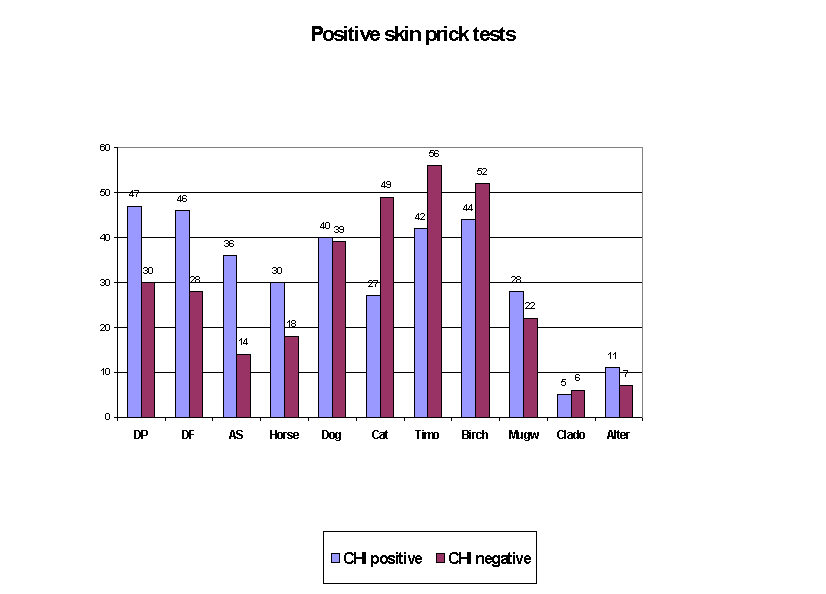
Positive SPT with the mite allergens were more common in CHI- sensitized
patients than in patients not sensitized to CHI, whereas the opposite result was
found with cat allergen (Table III). Asthma was more common (39%) in the CHI
sensitized group than in other atopics (20%)(p<0.05). The ages of patients
with CHI sensitivity (mean 34 years) did not significantly differ from that of
atopic patients without CHI sensitivity (mean 32 years). Fourteen per cent of
the patients in both groups had an aquarium in their home.
The proportion of urban/rural residences did not differ between the
groups.
Provocation tests were performed on 23 patients (12 nasal and 11 conjunctival provocation
tests). Of these 7 (30%) were clearly positive, giving moderate or severe
symptoms, whereas in 8 cases (35%) only slight symptoms, of doubtful clinical
relevance, were elicited with CTT-ALK 2 g/l. Eight provocation tests (35%) were
negative. Three of the patients reported moderate symptoms and 9 patients
reported slight symptoms 8 hours after the visit at the clinic. No isolated late
reaction was reported. Some anamnestic data as well as test results of the
patients subjected to provocation tests are seen in table IV. Only two patients
reported that they earlier had noticed symptoms when exposed to "red
mosquito larvae" used as aquarium fish food.
Specific IgE antibodies in serum. ML, performed on sera from 50 consecutive patients
having positive SPT with CHI, was positive in 72% with CHI, in 62%
with crayfish, in 42% with cockroach, in 36% with shrimp and in 8% with crab.
The ML classes of 70 sera (CHI sensitized patients from part a and part b of the
study grouped together) are seen in Table V.
Of the 14 patients who had isolated positive SPT with CHI, 12 had CHI-specifik
IgE antibodies in their sera, according to ML. One of the two patients with
negative CHI-ML had a positive ML result with crayfish.
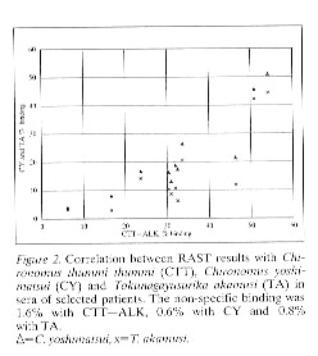
A good correlation was found between RAST determinations of specific IgE
against CCT, Chironomus yoshimatsui and Tokunagayusurika akamusi
(Table VI).
Correlations between in-vivo and in-vitro results.
When the SPT results and ML results with CTT-ALK were compared, a fairly good
correlation was seen, although individuals with a positive SPT and negative ML
as well as a few patients with the opposite result were seen (Table VII). Of
patients with a positive SPT with CHI, 73% had a positive (> AC 0) ML result.
Discussion
The
finding that 12% of our adult patients with A/R (corresponding to 23% of atopic
patients with A/R) have positive SPT with CHI allergens, are in agreement with
an earlier study from the same clinic (Eriksson et al., 1989). Allergen
specific IgE antibodies against CTT, determined with ML, was found in 72% of
patients having positive SPT with CHI. This shows that at least the majority of
the positive SPT results are due to real IgE sensitization. Some of the patients
have been sensitized to CHI when exposed to RML used as fish food, and the
sensitization of other patients might be explained by their allergy to
crustaceans, cross-reacting with CHI (Eriksson et al., 1989). For the
majority of CHI sensitizations, however, other explanations have to be searched
for. A reasonable guess is, that the patients have been sensitized when exposed
to adult CHI in their environment.
The results of the provocation tests, giving only 8 clearly positive
reactions out of 23 tests, suggest that the CHI sensitization is of limited
clinical importance.
Baur et al.(1982) have identified sensitization to CHI hemoglobin,
and have localized antigenic determinants to certain polypeptide sequences of
the hemoglobins. Only 17% of our CHI sensitized patients had positive SPT with
the purified hemoglobin (Chi t I) allergen. This finding could indicate that the
sensitization of our patients more often is directed against other CHI
allergens. It could also mean, however, that we used the Chi t I extract with a
too low concentration, giving falsely negative SPT.
IgE antibodies against crustaceans and cockroach were found in many of
the sera from CHI- sensitized patients. Inhibition studies, performed on the
sera from some of our patients and reported elsewhere (Schou et al, 1991)
have shown that true IgE cross-reactivity occurs between CHI, crustaceans and
cockroach, thus corroborating some of the results of an earlier study (Eriksson et
al., 1989).
We have no explanation to the finding that positive SPT with mites (DP,
DF and Acarus siro) were more common in the CHI sensitized
patients than in other atopics. In another study, in which 50 CHI-sensitized
patients were compared with 50 CHI-negative patients with an allergy against
animal and/or house dust mite, SPT results with DP. did not differ
between CHI-positive and CHI-negative individuals. The only significant
differences found were, that 17/50 CHI-sensitized but only 1/50 of the
CHI-negative patients had an aquarium in their home,
and that 16/50 CHI-positive but only 7/50 H-negative patients reported
symptoms elicited by shellfish (Eriksson, 1991).
Future evaluations should focus on the relationship between exposure and
sensitization and on the possibility of cross-reactions between CHI and mites.
References
Baur
X., Dewair M., Fruhmann M., Aschauer H., Pfletschiner J., Braunitzer G..
(1982)
- Hypersensitivity to chironomids (non-biting midges): localization of the
antigenic determinants within certain polypeptide sequences of hemoglobins (erythrocruorins)
of Chironomus thummi thummi (Diptera). J Allergy Clin Immunol. 69: 66-76.
Eriksson
N. E., (1991) - Allergy to chironomids. (Abstract).
Schweiz. med. Wschr.
121: Suppl. 40/II: 53.
Eriksson
N. E., Jonsson P., Ryden B., (1989) - Hypersensitivity
to larvae of chironomids (non biting midges). Cross sensitization with
crustaceans. Allergy 44: 305-313.
Eriksson
N. E., Pettersson I., Vedal S., Högstedt B., Belin L., Johansson SGO., (1991)
- Asthma and rhinitis among
farmers. Results of testing with common allergens and allergens of chironomids
and storage mite. Biolleten (Novosibirsk, USSR) In press, 1991
Gad
El Rab M. O., Kay A. B., (1980) - Widespread immunoglobin E-mediated
hypersensitivity in the Sudan to the "green nimitti" midge,
Cladotanytarsus lewisi (Diptera: Chironomidae).
J Allergy Clin Immunol. 66: 190-197
Kino
T., Chihara J., Fukuda K., Sasaki Y., Shogaki Y., Oshima S.,
(1987) - Allergy to insects in Japan III. High frequency of IgE antibody
responses to insect (moth, butterfly, caddis fly and chironomid) in patients
with bronchial asthma, and immunochemical quantitation of the insect-related
airborne particles smaller than 10 um in diameter. J Allergy Clin Immunol.
79: 857-866.
Schou
C., Eriksson N. E., Löwenstein H., (1991) - IgE-binding
of chironomid-allergic patients. (Abstr.)
Proceedings of the XIVth International Congress of Allergology and Clinical
Immunology, Kyoto, Japan.
Sturgess
M L., Weeks I., Mpoko CN., Laing I., Woodhead J S.,(1986).
Chemiluminescent labelled antibody assay for thyroxin in serum, with magnetic
separation of the solid phase. Clin Chem 32:532-5.
Weeks
I., Beheshti I., McCapra F.,
Campbell A K., Woodhead J S. (1983)
- Acridinium esters as heigh-specific-activity labels in immunoassay.
Clin Chem 29:1474-9.
Woodhead
J S., Weeks I.,(1989) - Magic Lite design and development. J
Biolumin Chemilumin 4:611-14.
Acknowledgement. The study was supported by grants from The
Swedish National Association against Asthma and Allergy, The Swedish National
Association against Heart- and Lung Diseases and Glaxo Pharmaceutical Corp.,
Sweden.
Table I. Skin prick test results with different allergen extracts in 20
patients with a known allergy against chironomids. (Mean diameters and number of
pluses, standard deviations in brackets)
Allergen
Diameter
No of
(mm)
pluses
CTT-ALK
0.02 g/l
2.4 (2.2)
1.0 (1.0)
CTT-ALK 0.2 g/l
3.7 (2.9)
1.5 (1.3)
CTT-ALK 2 g/l
5.2 (3.5)
2.1 (1.5)
RML-LB
7.4 (2.9)
3.0 (1.2)
RML-XB
1.4 (1.9)
0.6 (0.9)
Chi t I
0.6 (1.2)
0.3 (0.7)
Histamine
10 g/l
7.1 (0.8)
3+ (definition)
Table
II. SPT results with CHI allergens in 59 patients having positive SPT to one or
more of the CHI allergens.
Allergen
Number of plusses
Positive
Neg
1+
2+
3+
>3+
No
% of all
tested
atopic
patients
(n=254)
CTT-ALK
10
13
22
11
3
49
19%
RML-LB
4
14
25
12
4
55
23%
Chi t I
49
2
3
5
0
10
4%
Table
III. Comparison between SPT-results of CHI-allergic (CHI+) and other atopic
patients (CHI-) with A/R.
Allergen
1)
SPT CHI+
SPT CHI-
(n=59)
(n=196)
positive
positive
No.
%
No.
%
Significance
DP
28
47
58
30
*
DF
27
46
54
28
*
Acarus siro
21
36
27
14
***
Horse
18
30
35
18
NS
Dog
24
40
77
39
NS
Cat
16
27
96
49
**
Timothy
24
42
110
56
NS
Mugwort
16
28
43
22
NS
Birch
25
44
102
52
NS
Cladosporium
3
5
11
6
NS
Alternaria
6
11
13
7
NS
Histamine,
diameter
Mean
6.8
6.6
Standard deviation
1.3
1.2
1) Soluprick 10 HEP extracts with
Dermatophagoides pteronyssinus (DP), Dermatophagoides farinae (DF),
dog, horse, cat, timothy, mugwort, birch, Soluprick 1/20 w/v extracts with
Alternaria and Cladosporium, Soluprick "Diephuis" 1000
NE/ml with Acarus siro.
Table
IV. Some anamnestic data and test results of patients subjected to provocation
tests
Age
Aquarium 1) at
Known
Symptoms Test
results
and
home
friends'
contact
elicited
with CTT-ALK
initials
homes
with RML
by crus-
SPT
ML
PT 2)
taceans
36
ob
++
-
+ 3)
-
6
5
3 4)
21 pt
++
+ 3)
-
4
nd
3
13 mk
+
++
+
?
3
3
3
23 cs
+
-
+
-
2
1
3
30 kc
+
-
+
-
3
nd
2
26 ka
-
-
-
-
3
2
2
28 ae
+
-
-
-
2
1
2
19 tt
+
-
+
+
3
2
1
21 ah
+
-
+
+
2
2
1
55 rs
-
++
-
+
2
1
1
36 loe
-
-
-
+
2
2
1
36 ys
-
-
-
-
2
1
1
51 bs
-
-
-
-
1
0
1
48 ls
-
++
+
+
1
0
1
33 aa
+
-
-
-
0
0
1
33 pb
-
-
-
-
2
1
0
24 ssp
-
+
-
+
2
1
0
53 oe
+
-
-
-
2
0
0
44 lk
+
-
-
+
2
1
0
29 lb
+
-
+
-
1
nd
0
17 fa
+
-
-
-
0
1
0
66 oa
-
-
-
-
0
1
0
68 rj
-
-
-
-
0
0
0
1)
+ = have had contact with aquarium earlier; ++ = have contact with aquarium
presently
2)
0 = no symptoms, 1 = slight symptoms, 2 =
moderate symptoms, 3 = severe symptoms.
3)
have noticed symptoms on exposure to red mosquito larvae
4)
PT positive with CTT-ALK 0.2 g/l
nd
= not determined
Table V. Results of determination of IgE antibodies with Magic Lite (ML)
against CTT-ALK, crustaceans and cockroach in sera from 70 patients (from part a
and part b of the study) with positive SPT with CHI
Allergen
ML (Allergy class)
positive ML
0
1
2
3
4
5
No
%
CTT-ALK
17 31
17
4
0
1
53
76
crab
57
4
6
2
1
0
13
19
crayfish
28 13
20
7
2
0
42
60
shrimp
40
6
17
6
1
0
30
43
cockroach
41 17
9
3
0
0
29
41
Table VI. Results of RAST with Chironomus thummi thummi (CTT),
Chironomus yoshimatsui (CY) and Tokunagayusurika akamusi (TA) in sera
of selected patients.
Patient,
RAST results (% of total binding)
age and
initials
CTT
CY
TA
36
OB
54.2
50.9
44.3
60
RN
50.9
45.5
42.1
42
GE
46.4
21.4
11.8
37
JS
33.7
26.3
20.5
21
CS
32.5
17.4
6.1
22
LRL
32.0
18.7
10.7
22
HN
23.8
16.6
14.1
21
AH
30.4
16.2
10.2
25
TA
31.0
13.0
8.6
40
LG
16.7
8.0
2.8
26
KM
6.2
3.9
3.0
Non-specific
binding
0.6
0.8
Table VII. The quantitative connection between SPT and Magic Lite (ML)
analyses with CTT-ALK in 73 patients.
ML
SPT result (number of pluses)
(Allergy
Positive
class)
0
1
2
3
>3
SPT, %
>3
1
100
3
2
1
100
2
2
10
5
3
90
1
5
4
13
5
1
82
0
4
10
4
3
81
Positive
ML,
%
73
29
85
80
100
Legend to Figure
1. Comparison between SPT results of 59 CHI-sensitized (CHI positive) and 196
other atopic patients (CHI negative) with A/R. Soluprick 10 HEP extracts were
used with Dermatophagoides pteronyssinus (DP), Dermatophagoides farinae (DF),
dog, horse, cat timothy (Tirno), mugwort (Mugw)
and birch, Soluprick 1/20 w/v extracts with Alternaria (Alter) and Cladosporium
(Clado) and Soluprick (Diephuis) 1000 NE/ nil with Acarus siro (AS). The
differences between the two groups are statistically significant with AS
(P<0.001), DP (P<0.05), DF (P<0.05) and cat (P<0.01, in the opposite
direction).
Figure 1
Figure 2