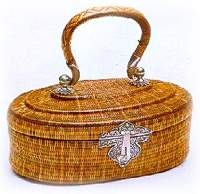
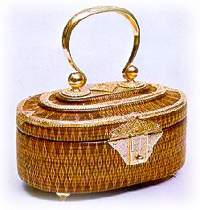
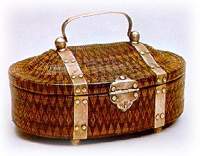
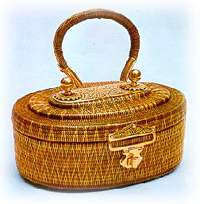
Though the Nakhon Sri Thammarat penitentiary authorities are encouraging the prisoners to practise the craft, marketing their finished work, yan lipao wares are still not widely used due to their very high price. Ladies' handbage with gold niello or nak ornamentation normally cost from one to two thousand baht. The reason for this is the time factor - a medium sized vessel takes at least ten to twenty laborious days to complete. It is small wonder that very few people have the inclination to persus such a tedious occupation. Outstanding amongst these few is Nai Kimchuang Srithammathon, a seventy-three years old man who learnt the craft from an uncle fifty-four years ago. In 1942,by the order of General Pibulsongkram, a greand lipao hat-making contest was held in Nakhon Sri Thammarat drawing thousands of hopeful entries. Nai Kimchuag's nine children entered a total of nine hats with the amazing result that all nine won top prizes in different categories. In 1970, Nai Kimchuang proudly presented Their Majesties the King and Queen with products of his workmanship.
The extreme toughness of yan lipao is testified by this popular folk rhyme :
Yan Lipao Basketry Yan lipao is selected for weaving by the length and colour which should be dark brown or golden on the innerside. After cutting and deleafing, the outer part is stripped from the pith which is discarded. This must be done while the vine is still very fresh, great care being taken not to break the fibre at the joints. The strips are then hung up to dry in the shade. Prior to weaving, the lipao strips, which should be uniform in size for the same piece of work, are drawn through a sharp hole in a tin plate to somoothen them in a process called chak liad The size of the hole depends on the requirements of individual weavers, the greater degree of finess and pliability achieved in this process the more refined the finished work. Prior to weaving, the strips are dipped in water to toughen. The most difficult and time-consuming part of lipao basketry is said to be the beginning of each work. Interwoven light-dark designs are achived by using the two natural colours of the lipao's outer skin,the underside being much lighter. On completion, a wood oil is applied to the finished work to enhance the colour and protect the fibre. Tools essential to the craft are : a knife made from discarded steel saw, drilled tin plates (often the top of a milk tin), a heavy knife for hammering, and a steel needle for drilling holes.
|
|