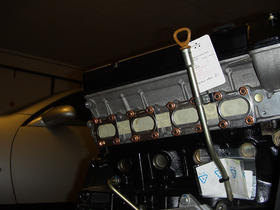
| Compare to a stock 190 E 2.5-16, the EVO engine has a special short strock engine that was build with shorter and lighter pistons. The piston size is now 97.3 mm and the strock is 82.8 mm. (compare to 95.5 and 80.25 mm for the 190 E) Different con-rods with pistons pin lubrification were used. They were also stronger and lighter than the ones used on the 16v engine. |
| The fly wheel was lightened, the clutch was modified and re-inforced. The underfloor catalytic convertors were designed as a steel monolith, two flute pipe with increased cross section, matched to larger silencer and pipes for increased engine output. The fly wheel was also lighteneg and the rear axle ratio was now 3.46:1 in order to have a better acceleration. The gear-box also had shorter gears for the same purpose, better acceleration. The KE and EZL control units were replaced in order to suit this engine. Their was also a new gear-driven high pressure oil pump installed for the first time. Although it is logical, I still have to mention that a larger radiator was fitted in order to cool the engine more efficiently. |
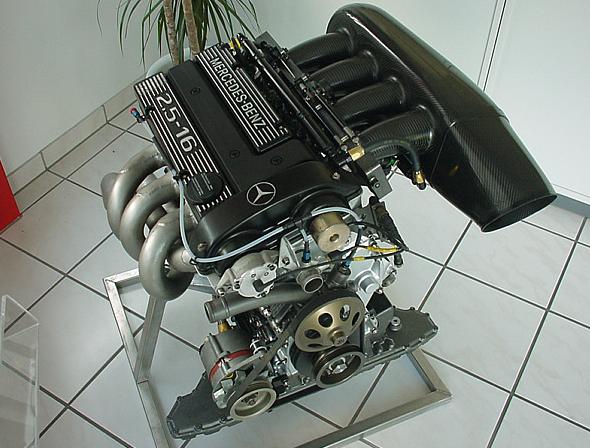 |
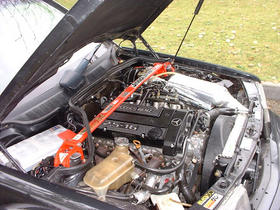
| Mercedes-Benz engine that was on the Evolution II AMG race car. (~390hp) |
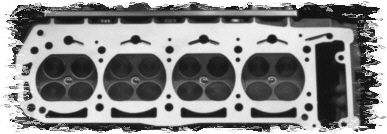
| Cylinder heads were different and the crankshaft now only had four counter weights instead of 8. This was done in order to obtain a reduction in weight. The intake camshaft was changed and a single timing chain was used to drive the camshaft and gears. The intake manifold, the throttle valve assembly were flow-obtimized and the compression ratio was now 10.5:1. |
 |
| The Mercedes-Benz Evolution engine was, in 1990, the biggest 4 cylinder engine that you could find on the market with the BMW and Porsche engine. This powerful 4 cylinder was build "in house" by Mercedes-Benz themeselves, without the help of any tuners. (Only the DTM engine was modified by AMG) This Mercedes-Benz engine is a 2463cc with 16 valves producing 235hp @ 7200rpm. The most impressive fact is that, this motor is a N/A one which means it produces 235 hp without the help of any turbochargers or "kompressor". |
| Acceleration figures 0 to 80 km/h: 4.9s 0 to 100 km/h: 6.7s 0 to 120 km/h: 9.0s 0 to 140 km/h: 12.1s 0 to 160 km/h: 15.2s 0 to 180 km/h: 22.4s 0 to 200 km/h: 28.3s 0 to 400m = 14.6s 0 to 1000m= 27.1s |
| Build by Mercedes and AMG in order to compete in the DTM championship against BMW, Alfa Romeo Opel and Ford. -The AMG version weights only 980kg -2.5-16v engine produces ~ 390hp. 0 to 100 km/h = 4.3s (According to Mercedes AMG) |
| Please note: The acceleration figures are the "best ones" I found from various magazine reviews. The fastest 0 to 100 km/h time is 6.7s, the slowest recorded in a review was 7.3s. |
| Mercedes Evo II ////AMG (Race car): |
 |
 |
 |
 |
| - Engine block modified to use a chain-driven oil pump for increased flow capacity. - Lightened crank (4 of the original 8 counterweights were eliminated) - Stronger lifter... - All ports undergo careful machining and gas-flowing. _ Compression ratio reverts back to 10.5:1 of the original 2.3-16. - New cams with increased lift and duration. - Reprogrammed fuel injection?engine management system. - Larger throttle body. - All steel, free-flowing cat. - Final drive ratio shortened from 3.27 to 3.46. - Fully progressive, electronic, limited slip differential. (Locking ratio varies from completely open to completely lock) Final HP figures= 235hp @ 7200 rpm and 181 lbs. ft. between 5000 and 6000rpm. Thank to Yen-Hsen for his help |
| Here are all the differences between a 2.5-16 stock engine and the EVOII engine....... |
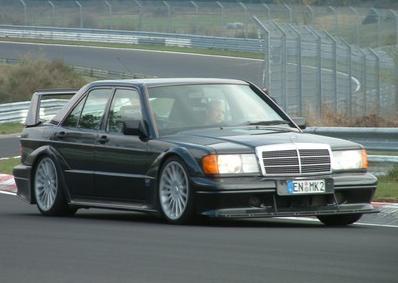
| Mercedes Benz 190 E 2.5-16 Evolution II Base price: $70'000 (estimated) Nowadays, you might be able to find one for ~30'000 USD. Powertrain: 16 valve, 4 inline 152cu in (2463cc) Power: 235 hp @ 7200 rpm Torque: 181 lb-ft @ 5500 rpm 250 Nm @ 5500 rpm |
| Main competitors: BMW Sport Evolution III Ford Sierra Cosworth Lancia Delta Integrale 16v Opel Omega EVO 500 |
| Most of the EVO's went to Germany. Around 60 EVOII's made it to Switzerland. As for the EVOI, around 50 of them were delivered. |
 |