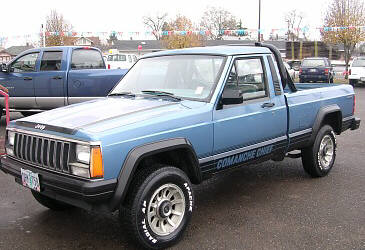
| Jeep Comanche |
| Definitly in the sought after category of the Jeep line, this very utilitarian vehicle was discontinued after slow sales and pressure from Chrystler with it possibly impacting its Dodge Dakota line. During its time, the Comanche reigned surpreme. Not only did its 6cyl get comperable gas mileage with the Dodge dakota, it also was significantly faster than the 6cyl variant from dodge and though I don't have numbers, I would be willing to bet it would give the 318 (V8) equiped dakota a run for its money or even beat it in the performance catagory (also, notwithstanding the Jeep got better mpg). With its limited run and very user friendly nature, this jeep makes the top list of wanted vehicles, perhaps only eclipsed by the (also before its time) CJ8/Scrambler. By far the most favorable application of either the XJ or MJ is the 5 speed, 4.0L (and dana 44 when applicable). This is a strong combo which by vertue of power to weight ratio and a very smooth torque curve make a extremely quick vehicle. Of its class it will out run just about anything (minus V8 engines of late, and vehicles specifically designed for go-fast pursuits). Upon its first entry, 1992, it had only 10 less hp than the chevy 350, ford 351 V8s, and comperable HP to late 80s model V8 (not big block engines). During this time, the jeep could surprise many a pickup owner and even sedan from time to time. |
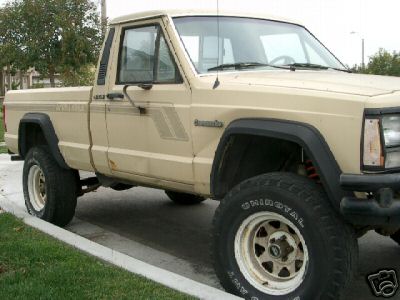
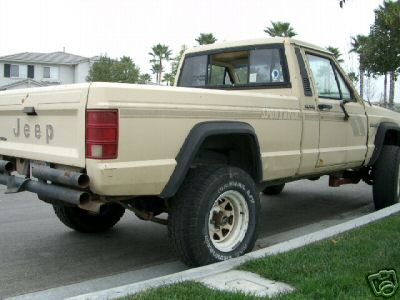
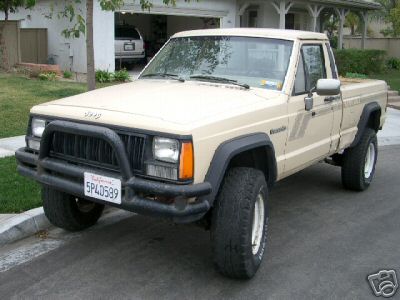
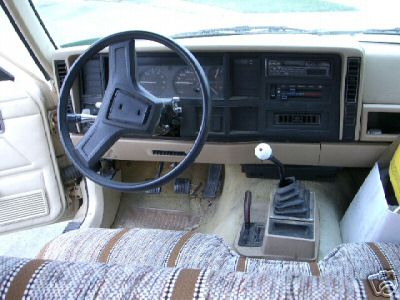
| Suspension Lifting a comanche (or cherokee). The basics: The XJ/YJ platform share the same front suspensions and have similar rear suspensions. The sucess of this design (front) lead to the Grand cherokee incorperating a similar front and rear suspension, whose further sucess inspired the TJ/ Wrangler (style 2). The front suspension: two arms, solid axle, two coil springs, and a locating arm (keeps axle straight, also prevents axle wrap, which is less of a concern on the front of a vehicle; therefore, acts mostly to locate the axle in the proper orientation as dictated by the design engineers of the early 80s who worked on this chassi). Rear suspension: leaf springs, shackels. (point of order: the XJ has "spring over", while the MJ has the more favorable "spring under" orientation). to lift the cherokee/comanche there are a variety of options. One is to lift it using a conventional lift kit or system. (kit usually includes mounting hardware, full front suspension setup, and a cheaper rear suspension - add a leaf, or a block. The system usually has a full set of rear leafs). If I were to purchase one of these, I would get a skyjacker. They seem to be the best mix of economy and lift, actually letting you clear 31s with fender clearance. Most lifts for this platform can fit 31 inch tires; however, they are often stuffed fairly well into the fenders. The skyjacker on the other hand, gives more clearance with the 31s. I hear they ride nicely on and off-road, but that is to be determined. Other options include superlift (who tends to be stiffly sprung), rough country, black diamond (yes they are back), and a variety of other brands (and knock offs). I would look for a good front suspension, as the rear can easily be lifted (even for cherokees). Look to spend about $300 for this "kit" which may or maynot include shocks (note: rancho 5000s usually go for about $40 a piece). The home-brew, home-made, cheaper route, Louisiana Engineered version... < note: Use at Own Risk! This is a guide and not guarnteed to work, nor does it carry any warrenty > Front suspension: Coil spacers - 2" longer coils (1-2") cost: $100 Rear suspension: $25 leaf sprirngs Find a set of rear 1/2 ton truck springs the same width of your stock XJ/MJ springs (not HD, or 3/4 ton springs, these will end up being quite stiff for a truck that is 1- 2000 pounds lighter than what these were intended for). Lift your jeep (use jackstands, be VERY careful). Disconnect necessary equipment (be careful) Take leaf spring pack off (both sides or one at a time). Disassemble pack (note: you may have to use brute force, a prybar or screwdriver, and lots of banging. Try not to harm the spring and DO NOT take a torch to it). Keep the top leaf (with eyelets), place the others aside. CHOICE: you can intermengle your stock (jeep) springs with the 1/2 ton truck springs, or use just the latter. That is your choice. I am not sure what the former would do, but it is an option Choice 2 you can use either just the leaf springs beneth the 1/2 ton main leaf, or cut its eyelet off and use it as well. Take the top sprirng (the one with the eyelets) and place the other springs (whichever choice you decided) beneth it. I would get a new spring bolt (about 75 cents a piece). Put springs back under jeep. Reconnect everything. See how high it is now. Note: the new springs should have either more arch OR simply be stiffer, which should provide the lift. Also note: On spring over models (converted MJ or stock XJ), more springs will provide more lift by means of added stiffness and simply adding height of the spring itself (its thickness). You may have to use a few of the steps to fine tune your suspension both for height and ride with various spring combinations. I got this idea from a guy who built a cherokee lift from coil spacers and dropping the spring bucket (if I remember correctly) and (what I definitely remembered) using a 7-9 leaf pack from a dodge pickup. |
| Engine / drivetrain The inital V6 engine option was one of the form of a 2.8L GM 60d V6. Though a great engine in a chevy S10, the heavier cherokee and comanche didn't fair as well. Also note: it could have also followed suit with iginitions of the age, that jeep, AMC, in order to save money did purchase mass quanities of less prestine ford products (2nds). This engine does last a while for some people, but was underpowered and lacked the torque of the 258 6cyl (ava. in Fullsize cherokees, J series trucks, and most popularly the CJ series -- also ava. in other AMC vehicles of time too). Designed from the venerable 4.2L stock, the 4.0 took a different approach to the 6cyl. Instead of being undersquare (bore is less than stroke), this new design was oversquare (bore greater than stroke), employed a new (to Jeep) fuel injection (Renix) and a new - higher flow - cylinder head. These changes lead to better emmisions and a 65 horsepower increase, with similar torque rating. There are two forms of the 4.0L engine during this span, the inital design, which was much improved over the 258 and the HO (high output) version introduced in late 91. This version upped horsepower by about 10 horsepower and provided an even more favorable MPI (multi port fuel injection system). These engines are most sought after because of their greater power, further improved cylinder head, and better drivetrains that back them. Transmission: the Peugot transmissions of the early cherokee years did handle the stock engines, but addition of tires, hauling, extra weight, etc did often tax them beyond their designed limits. If one is swapping a transmission, this one is probably not the best choice when strength is a concern. With the improved engine came an improved transmission, the Aisin AX-15. This two piece trasmission is a medium duty transmission that replaced the light duty peugot. This new change also was brought into the wranglers (drivetrain) of the era. In two double O (2000), jeep switched from the AX-15 to the NV 3550 (new venture gear). This transmission shares the T5s (of the cj, Full size jeep) gear ratios, but is stronger its mimiced counterpart. This transmission is a single case and is thought to be that extra step above the ax-15, though a small one. It too is a medium duty transmission rated for 300 lb-ft of torque. The axles of choice here is limited to two: the 35c (most prevelant) chrystler 8.75 or the Dana 44 The 44 was ava with towing packaged automatic transmissioned cherokees and "metric tonne" MJs. Gear ratios for these variants ranged from 3.07, 3.55, 3.73, 4.11 depending on engine and options (note: first two = 6yl stock, optional; and the latter 4cyl stock, optioinal). |
| Engine Upgrades The Most pricy, yet most power one can get is from a "stroker kit" from various places (or handcrafted). This is essentially the crankshaft and rods from a AMC 258 (the inspiration for the 4.0L) with modified pistons placed into the stock 4.0L block. Some notching is required, though it is minimal. This increase in displacement, accompanied by larger injectors, cam, and computer tuning produce an extra 70 horsepower. This is comperable to what you can expect from a supercharger, espically one with low boost. I'm not sure on the lifespan of these, but I don't see why they would be any less. Also, many people decrease their redline with this combo (because it becomes square). This is probably not necessary if the proper headwork is done (roller rockers, high performance valve springs, locks, retainers, pushrods). In fact the redline can be increased with the previously listed headwork. That is simply a side note. (another sidenote: the amc 258, undersquare, can have a higher redline given the proper equipment listed above as well). K&N or similar filters extend life and decrease solid waste (paper filter disposal) and do shift around the power band a little (take a little from the bottom, put it on top). Note: remember bigger is not always better... the more flow the engine has in, the more gas it will let in, thus it will run a little richer down low... thus reducing torque and some hp. Headers and a new exhaust system will cost you about $600 to complete and will yield about 10- 15 hp. |
| wheels/ tires Jeep wheels based on the 5 on 4.5" bolt patten tend to have a good amount of wheel backspacing. Be aware of this when purchasing new wheels. Also the look will be different (a 15x8 will look like a 15x7 with traditional backspacing), if you are interested in creating a "look" for your vehicles. I'm partial to the Mickey T classic II wheels as they are light weight and affordable. |
 |
 |