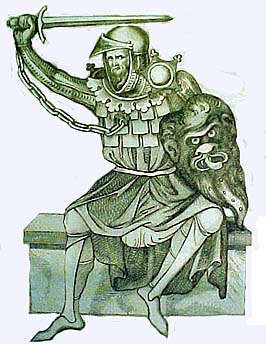
John of Gaunt, Duke
of Lancaster
Plantagenet
Born: MAR 1340, St Bavon's Abbey, Ghent, Flanders Died: 3 FEB 1399, Leicester Castle, St.Paul's Cathedral, London, England Married: 19 MAY 1359, Reading Abbey, Berkshire to Plantagent, Blanche of Lancaster, Countess of Derby Child 1: Philippa of Lancaster Married: 21 SEP 1371, Roquefort, Guienne to Constanza of
Castile, Queen of Castile Married: 13 JAN 1396, Lincoln
Cathedral to Roet, Catherine Swynford The fourth born (and second surviving) son of Edward III, King of England, and Phillipa of Hainault. He was the most powerful man in England, his wealth and influence surpassed that of his father, as of his elder brother, Edward, the Black Prince. He was born in Ghent (on one of his mother's travels with Edward's army), thus the popular name 'of Gaunt'. Lancaster was a tall, spare, but well built man who was somewhat conservative in his politics, somewhat radical in his religion (as shown by his support of the all-but heretic, John Wycliff.) In his infancy, he was created Earl of Richmond and, by that title, admitted into the Order of the Garter upon the death of Thomas Holland, Earl of Kent, one of the original knights. In 1359, at Reading Abbey (Berks), he married Blanche, the younger of the two daughters and co-heirs of Henry, Duke of Lancaster, and upon the death of his father-in-law, in 1361, he was advanced to that Dukedom. He held also, in right of his wife, the Earldoms of Derby, Lincoln and Leicester, and the high office of Steward of England. Blanche, dying in 1369, the ambition of the Duke - who had taken an active part in the war carried on by the his brother, Black Prince, for the restoration of Peter, King of Castile & Leon - induced him to direct his views towards Constance, the elder of the two daughters of that monarch, then lately slain by his illegitimate brother, Henry of Transtamare, his successor under the title of Henry II. In 1372, the Duke married this princess and thus assumed the regal style of those kingdoms. These titular honours were ascribed to him in the writs of summons to Parliament from that year until 1386, when, by an arrangement with King John I of Castile & Leon, the son and successor of Henry, Catherine, the only daughter of the Duke of Lancaster by Constance, was betrothed to Henry, Prince of Asturias, his heir-apparent, and the crown settled upon the issue of that alliance. Although John of Gaunt had been engaged in warlike enterprises from his earliest years, yet his martial achievements did not increase the lustre of British glory or secure for himself the character of a great commander. In three expeditions into France, in 1369, 1370 and 1373, he gained no laurels and the peculiar misfortunes which attended the last, when a considerable number of his followers perished amongst the mountains of Auvergne, rendered him very unpopular on his return to England in July 1374. All Guienne and Gascony, with the exception of the towns of Bordeaux and Bayonne, had fallen from their allegiance and a suspension of hostilities was negotiated at Bruges, by the Duke and others, with the Duke of Anjou, before the expiration of that year. After the death of the Black Prince, in 1376, the Duke of Lancaster acquired a marked ascendency in the councils of the infirm monarch, his father. His administration of public affairs is said, furthermore, to have been stained by several acts of violence. On the 16th June 1386, "at the palace of John of Gaunt, King of Castile & Leon, in the convent of the Friars Carmelites, at Plymouth" (where he was then sojourning prior to his embarkation for Spain), he gave his remarkable testimony in favour of the right of Sir Richard Scrope to the arms borne by him in the celebrated controversy between Scrope and Sir Robert Grosvenor. John continued to govern the Kingdom during the minority of his nephew, Richard II, by whom, in 1389, he was created Duke of Aquitaine. His power increasing, he proffered, in open parliament, a claim to the succession for his son, Henry Bolingbroke (later King Henry IV), as son to Blanche, great-grandaughter of Edmund Crouchback, Earl of Lancaster, whom, he pretended, had been elder brother to King Edward I, but set aside on account of his deformity. The weakness of this pretension, which, if established, would have been fatal to the reigning monarch, was opposed, without difficulty, by Roger Mortimer, Earl of March, who, as son and heir of Philippa, the daughter and heir of his elder brother, Lionel, Duke of Clarence, had, by the laws of the empire, an indisputably prior right and was, accordingly, declared the presumptive heir to the crown. The Duchess Constance dying in 1394, John espoused, in 1396, Catherine, daughter of Sir Paine Roet, Guienne King of Arms, and widow of Sir Hugh Swynford, a knight of Lincolnshire. This lady had been of the household of the Duchess Blanche and charged with the education of the ladies Philippa and Elizabeth during their minority. On the 3rd February 1399, John of Gaunt, Duke of Lancaster, died at the Bishop of Ely's Palace in Holborn. Conforming to his will, dated 3rd February 1398, his body was interred before the high altar of Old St. Paul's Cathedral, near the remains of Blanche, his first consort. By his first consort, Blanche of Lancaster, he had issue: 1. Henry, Duke of Hereford &
Lancaster and Earl of Derby, afterwards King Henry IV. By his second consort, Constance of Castile, John of Gaunt had an only daughter, Catherine, wife of Henry, Prince of Asturias, afterwards Henry III, King of Castile & Leon. The descendants of this alliance were on the throne of Spain until King Charles II, who died in 1700. His issue, before his marriage to his third consort, Catherine Swynford, were legitimated by Act of Parliament, 9th February 1397. They were all surnamed "De Beaufort," having been born at Beaufort Castle in France, which had devolved to the Huse of Lancaster by the marriage of Blanche of Artois with Edmund, Earl of Lancaster. They were: Lancaster had many residences and estates, but his principal residences include the Savoy Palace in London, and the lands and castle of Kenilwoth in Warwickshire. Lancaster particularly loved Kenilworth, transforming what was once a cold and heartless fortress into a welcoming and warm home (that remains, nevertheless, impregnable). The image depicts John of Gaunt in his prime. Image taken from Joseph Strutt, A Complete View of the Dress and Habits of the People of England (London, 1796), vol. 1. Image ©Sara Douglass Enterprises 2001.
|