
|
Departments
[ Agriculture ] [ Tea, Coffee & Rubber Cultivations ] [ Horticulture ] [ Irrigation ] [ Live Stocks ] [ Pisciculture ] [ Forest Resources ] [ Mineral Resources ] [ Industry ] [ Textile & Handicrafts ] [ Transport & Communication ] [ Community Information Centres ] [ Power ] [ Cooperation ] [ Banking ] [ Public Distribution ] [ Medical ] [ Education ] [ Employment ] [ Water Supply ] [ Rural Development & Poverty Alleviation ] [ Social Welfare ] |
AGRICULTURE
| The chief occupation of the population is agriculture. The main activity of more than 75% of the worker is agriculture and allied activities. As per 1995-96 Agricultural Census, total operated area was 28,732 hectares and net area sown was 22568 hectares. The total paddy production in 1998-99 was 22,025 M.T., which is far below the requirement of about 35,390 M.T. for the whole district. |
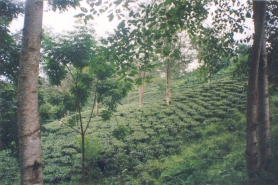 A Tea Garden, Nampong, Changlang district |
It may be safely said that due to lack of flat land most of the people who inhabit the hilly tracts of the district depend upon Jhoom or shifting cultivation for their livelihood. This perhaps, explains the relative backwardness of the tribal living in the hilly interior villages. Since productivity is poor, not more than 3 to 4 months requirements can be raised per family by this method of cultivation. For rest of the year the families have to look for alternative means for procurement of food. In the interior some are engaged in collection of food from forest areas. Crops like Arum, Tapioca, Sweet potato, yam, etc. partly meet their food requirement. In the plains area majority of the population have already settled on land as permanent cultivators where they practice both dry and wet rice cultivation.
The main crops grown by the inhabitants are rice and millet. Other crops are maize, root crops like yam, Arum, Tapioca, sweet potato and local vegetables varieties such as chilly, ginger, garlic, potato, pumpkin, gourd, brinjal etc. Besides, tobacco, betel vine, oilseeds, spices etc. are also grown. In Manmao and Khimiyong areas opium is also cultivated.
Although agriculture is the main occupation of the villagers, it is subsistence only. The district is deficient in food grain production. Therefore, for supply of rice and wheat the district has to entirely depend upon other states. Scarcity of flat land, increased population coupled with increased illiteracy, poverty and lack of trained local people are the main hurdle to the progress of agriculture.
Efforts to improve the economic condition of the cultivators are being made. The cultivators are given assistance for land development, construction and renovation of irrigation channels, purchase of plough bullocks, improved seeds, manures and other inputs. Besides with a view to transmitting scientific and progressive technology in the field of agriculture demonstration programmes are taken up from time to time. By providing essential inputs in the form of improved seeds, fertilizers, plant protection chemicals and by increasing substantially the area of cultivation under HYV programme it has been possible for the district to raise production of various crops.
TEA, COFFEE AND RUBBER CULTIVATIONS
| There is a congenial atmosphere for raising of cash crops like, Coffee, Tea, Big Cardamom and rubber in Changlang District. Tea plantation is taken up at almost all parts of the district. The goverment has been encouraging the people for cultivation of tea gardens providing special Tea packages for people of this area for couples of years. |
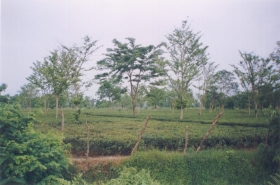 A Tea Garden, Bordumsa, Changlang district |
As Bordumsa is suitable for rubber and Tea plantations, newly Tea and Rubber plantations are rapidly coming up there and tea plantations in other parts of Changlang district, places like Nampong, Changlang and Namtok.
HORTICULTURE
Soil and climatic condition prevailing in this district is ideal for horticulture development. Therefore, emphasis is given on opening of horticulture gardens through execution of schemes like, supply of fruit grafts, plants of improved variety at subsidy cost, opening of people’s horticulture garden, opening of compact horticulture garden on subsidy, provision of hand tools, demonstration on planting, maintenance and raising of nurseries. Fruits like orange, pineapple, jackfruit, banana, pears, papaya, walnut, plum, peach, litchi, guava, mango, lemon, citronella, black pepper, coconut, large cardamom and others are grown in different parts of the district.
It has been observed that the farmers accepted all the schemes enthusiastically. As a result, their economic conditions have been raised to a certain extent with increase in production level, particularly, the farmers in the area of intensive agriculture and horticulture activities, like Miao, Diyun, Bordumsa, Kharsang, lower parts of Changlang, Nampong and Jairampur are producing a considerable amount of marketable surplus of rice, oilseeds, fruits, vegetables, chilies and sugarcane Of course, similar achievements are not there in the area of limited agricultural/horticultural activities due to certain infra-structural inadequacy, undulating geographical situation, poverty and illiteracy of the farmers.
IRRIGATION
The area brought under irrigation increased from 1611 hectares in 1997-98 to about 2049.17 hectares in 1998-99, covering about 11.32% of the net area under cultivation. There is increasing demand for irrigation facilities from the farmers of settle cultivation. But, the progress on this front has been far from satisfactory. Therefore, with a view to accelerating the irrigation facilities the Government has created a new department of irrigation and flood control recently. Due to limited irrigation facilities, cultivation is done solely under rain fed condition and hence there is severe economic set back in the year when there is prolonged dry-spell.
LIVESTOCK
Live stock rearing is a common practice of the entire tribal. It plays an important role in the socio-economic life of the tribal. Generally, animal and birds are reared for food as well as social and religious purposes. In the Tribal society, sometime, the number of livestock he possesses also assesses socio-economic status of a person or family. Among the livestock, cattle, pig, goat, poultry-bird and buffalo are important.
In order to motivate the people to take up livestock rearing as their subsidy occupation a number of measures are being taken up by the Government. The Government is providing cross breed cows, pig and poultry etc. and also arranges financial assistance through banks to the villagers desirous of opening livestock farms in the villages.
PISCICULTURE
Fishes are quite tasty and nutritious and are often a good source of income. For the poor villagers fishing is an alternative means for procurement of foods.
The district’s rivers, streams, natural ponds and marshy water areas offer ample scope for a good crop of fishes every year. The department of fisheries had taken steps in different directions for fish culture development. From time to time, training facilities are offered to the Pisciculturists in technical aspects and material assistance is extended for breeding and growing high yielding variety of crops.
Due to peculiar nature of land fish farming in a big manner is not feasible. Therefore, emphasis was so long given to the development of fisheries in plains and valleys only. At present, steps are being taken to develop in hilly areas as well as by constructing artificial ponds and barrages across small hilly enclaves. Till the end of March’99 about 110.9 hectares of water areas has been brought under fish farming.
Fish farming is non traditional in the tribal society. Therefore, training scheme about scientific method of pisciculture is being imparted to the fish farmers free of cost. It is highly profitable activity and therefore, the people should be encouraged and motivated to develop new and existing resources.
FOREST RESOURCES
In tribal society life of the people is closely linked with forests. The people enjoy customary right over forest products for their domestic requirements. Undoubtedly, forests products serves the basic human need of shelter, fuel, food and feed.
Once the entire area of the district was covered with a wide range of luxuriant forest species. With the increasing demand for wood and wood products due to increase in population, depletion of the forests began. The traditional method of cultivation (Jhooming) of the people also contributed greatly towards decimating the forest area.
The district is better known for its valuable timber resources, which supports a number of wood based, industries like saw mills, veneer mills and plywood units in the district. The incomes generated by these industries were the main source of revenue of the state exchequer. The government earned revenue of Rs. 1904.97 Lakhs from the forest products, during the year 2001-02.
Various schemes have been formulated for forest developmental works in order to produce industrial raw materials and to maintain the desired percentage of forest coverage in the area. Apart from conservation and protection of forests, the Government has taken up schemes to raise rubber, tea, coffee and cardamom plantation and other forest developmental works in order to improve the living standard of the people. The people are also encouraged to raise plantation through ‘APNA-VAN’ Scheme in their own village land. Seedlings are distributed free of cost to the people for planting in their private land.
It is seen that the area under reserve forest has been increasing gradually due to various conservation and protection measures taken by the forest department. Whereas the area under unclassified forest has been declining continuously. Therefore, if present unplanned felling of trees is left unchecked then not only the forest based industries but also the people of the area may have to face the problem of raw material in near future.
The district having six Forest Divisions, namely Territorial Division, Social Forest Division, Wild Life Division. Arunachal Pradesh Forest Corporation & Tiger Reserve Division which are functioning.
MINERAL RESOURCES
The most important mineral deposit found in the district are oil and coal. The Oil was first explored at Kharsang by Oil India Limited in the year 1973. Thereafter, Oil India started drilling of exploratory wells at Kumchai, Manabhum and Kherem. Up to March 1998-99 the company has produced 50,529 M.T. crude oil and 1,42,52,749 cum associated gas. The present crude oil production is 163 KL per day. The company has also provided direct employment to about 118 persons in the district.
Besides, extensive survey carried out by the Geological Survey of India has reported a large quantity of coal deposit at Namchik and Namphuk area.
Other mineral deposits likely to find in the district are sand stone, clay, saline water, liquid platinum, pyrite and pyrrhotite. However, geological survey has not been done so far and therefore, no authentic information of the occurrence of these minerals is available.
Recently Government of Arunachal Pradesh has appointed Assistant Director of Industries (Mines & Minerals) to survey and explore occurrence of minerals.
INDUSTRY
Industry plays an important role in the economic development of any place. It provides subsidiary occupation as well as employment opportunity for growing population.
Though the district has abundant natural resources the scope for development of large scale industries is very less due to lack of infra structural facilities. However, small scale and cottage industries is developing in the district.
The district has 4 medium scale industries, there are 228 registered small-scale industries in the district of which 146 are functioning. The units include wood based, agro based, chemical based and demand based. As per 1991 census 11,762 persons (12.3 percent) are industrial category of workers in the district.
TEXTILE AND HANDICRAFTS
The Textile and Handicrafts department has bifurcated from Industry department very recently. The district has a unique distinction in traditional colourful handloom products. The peoples are also expert in cane and bamboo handicrafts. Indeed, handloom and handicraft are the oldest cottage industries of the local people.
The Textile and Handicrafts department provides yarn, tools and implements and others on 50 percent subsidy basis, working sheds on nominal rent, impart training free of cost and selling of finished products of the entrepreneurs through sales emporium at reasonable prices.
| No | Name of Centre | Location | Type of works | Number of Empoloyees / Trainees |
| 1 | Emporium | Changlang | Sales | 1 |
| 2 | Emporium | Miao | Sales | 1 |
| 3 | Crafts Centre | Changlang | Carpet, Tailoring, Knitting, Weaving, Wood Curving, Bees rearing & Bead Neckless | 24 |
| 4 | Weaving Centre | Changlang (Yanman) | Weaving | 8 |
| 5 | Weaving Centre | Vijoynagar | Weaving | 4 |
| 6 | Weaving Centre | Nampong | Weaving | 8 |
| 7 | Weaving Centre | Manmao | Weaving | 6 |
| 8 | Weaving Centre | Miao | Weaving | 5 |
The numbers of Sale Emporiums, Craft Centres and Weaving Centres with distribution of Trainees are given below:
In recent years the Government has taken steps to educate the villagers in the technique of Handloom, Handicrafts and Sericulture so that this sector could be of real benefit to the people. The department has set up a seed production and demonstration center in different administrative head quarters of the district to carry out village level extension works. Besides, one composite demonstration cum training center has been established at Bordumsa to impart training to the villagers. The assistance provided to the rearers is free supply of silkworm seeds, improved rearing appliances, mulberry saplings, marketing of cocoons etc
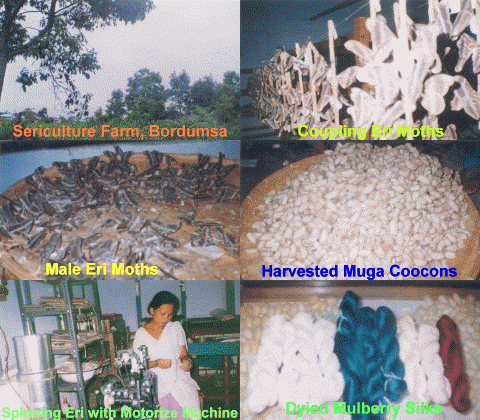 SERICULTURE: The Sericulture is part of the Textile and Handicrafts
department in the Government of Arunachal Pradesh. It is an Agro base
Cottage industry which has combination of Agricultural and Industrial
aspects. The agricultural aspect has comes under as process of Jungle
cutting, ploughing and hoeing; whereas, the industrial aspect has comes
under as process of Silkworms rearing, reelings and spinning od Coocons.
SERICULTURE: The Sericulture is part of the Textile and Handicrafts
department in the Government of Arunachal Pradesh. It is an Agro base
Cottage industry which has combination of Agricultural and Industrial
aspects. The agricultural aspect has comes under as process of Jungle
cutting, ploughing and hoeing; whereas, the industrial aspect has comes
under as process of Silkworms rearing, reelings and spinning od Coocons.
Sericulture is mainly found in Bordumsa, Changlang and Nampong area. In view of favourable soil and topography of land this sector has considerable scope for expansion. Therefore, for further growth of Sericulture Industrie and smooth functioning of the Sericulture industries, the Government has developed following Sericulture Centres and Farms:
| Sericulture Centre / Farm | Location | Area in Acres |
| Eri seed Production Centre | Changlang | 6 |
| Mulberry Silkworm seed Farm | Changlang | 20 |
| Collective Mulberry Garden | Changlang | 7 |
| Demonstration cum seed production Centre | Nampong | 8 |
| Composite Demonstration cum Training Centre | Bordumsa | 12 |
| Mulberry Nursery cum Chowki rearing Centre | Bordumsa | 6 |
| Reeling Centre | Bordumsa | -- |
Besides, the department has selected 37 private Sericulture beneficiaries for development of 37 Acres of Mulberry plantation under Northeast Action Plan, Central Silk board. Now, 37 Acres of Mulberry Gardens are successfully coming up under this scheme in this district as given below:
| Mulberry Garden | Area in Acres |
| Changlang | 9 |
| Nampong | 6 |
| Bordumsa | 22 |
TRANSPORT AND COMMUNICATION
Road transport has given a variety of economic and social benefits in facilitating the movement of persons and goods. No proper development is possible in any field without having a good communication network and transport system. Therefore, the need for construction and improvement of road is assuming increas importance.
In the matter of accessibility, the district enjoys a fare network of road communication compared to other districts of Arunachal Pradesh. Except Vijoynagar, which depends upon ration sorties, all the administrative head quarters are connected by roads. As on 31.3.99 the total length of road in the district was 1,218.48 Km approximately. It has an average of about 26.13 Km of road length per 100 Sq. Km of area which Arunachal Pradesh as a whole is 14.63 Km. However, the conditions of most of the road is not satisfactory. It requires frequent repair particularly during rainy season. Moreover, roads are small in width with narrow and weak bridges and culverts.
The conditions of rural linked roads are also not satisfactory. Most of the village linked roads are kaccha and it becomes unfit for vehicle movement during rainy season. However, these roads have made possible execution of various developmental works in the villages. As many as 54% villagers are having kaccha/ pucca road connections. Nearly 13% of the total villages are situated within the distance of 5 Km from motorable roads and about 33% villages are situated beyond 5 Km from motorable roads. There are still some villages where porter track is the only means of communication. In these areas, porters are still indispensable for touring Government staff.
Road is the only link between the district and the neigbouring state, Assam, for movement of good and passengers. Therefore, the Government has given priority for construction of new roads and keeping the existing roads in a good shape so that movement of goods and developmental activities are not affected by periodic dislocation of communication network.
For movement of passengers the Arunchal Pradesh State Transport Department introduced operation of passenger bus services in December 1976 in Miao, Margherita route. Today the department is heaving a fleet of 20 numbers of buses, which operates in 14 different routes carrying about 1,500 passengers daily. Still there are two circle headquarters namely Vijoynagar and Namtok, which could not be connected with the District Headquarter by APST bus Service.
The telecommunication facility is also expanding fast in the district. Except Khimiyong, Vijoynagar and Namtok, all the admnistrative centers are provided with telephone facilities. With setting up of satellite earth stations at Changlang, Miao, Bordumsa and Jairampur, telecommunication link within the district and with other places of the country has also improved greatly.
Besides, there are 6 nos. of Sub-Post Offices of which 4 are equipped with telegraph sets and 26 nos. of extra departmental branch post offices (EDBPO) functioning in the district.The Arunachal Pradesh police department also helps the administration for sending and receiving the messages through WT Net.
Community Information Centres
Recently, Central Government has set up four Community Information Centres (CICs) one each at Changlang, Miao, Bordumsa and Nampong Community Development Blocks having Computers and Internet facilities to assist the State government and district administration for implementation of Citizen centric services to people and exploitation of Information Technology power and board-band Internet facilities.
POWER
Changlang district has vast resources for generation of power. The dependable sources are water, coal, petroleum and natural gas. If these resources are properly harnessed it can help economic development as well as generate a good amount of revenue for the state.
The district has one micro-hydel project at Changlang having installed capacity of 400 KW and seven diesel-generating sets of 250 KV installed capacity each.
With the increase in population and their economic activities over the years, the demand for power supply is becoming more and more. However, there is a vast gap between the power generated by existing sources and its requirement. Therefore, to make up the deficiency the district has to depend upon the power supply from Assam State Electricity Board.
COOPERATION
Co-operative movement started in Changlang District in the year 1956 with opening of Tangsa General CO-operative Stores Limited at Changlang. Since then consumer co-operative societies were opened gradually at administrative centers and other places with the purpose of distributing essential consumer goods to the Govt. employees and local people. In the beginning, societies activities were confined to trading only but with increased need of the people movement later on diversified its activities in various other fields, such as marketing, processing, credit etc.
At present, there are 15 societies of which one is credit Co-operative society and 14 are non-credit co-operative societies with total membership of 2960 persons. In terms of number the progress is impressive. However, some of the societies are either uneconomical or defunct due to many reasons.
A co-operative society is a voluntary association of persons for self help. However, in this district the movement is yet to become movement of the people. It is unfortunate that in spite of government effort there is lack of enthusiasm among the local people to start co-operative societies. The reason for this is running loss due to mismanagement, corruption, misappropriation of money etc.
BANKING
Banks are of vital importance in the process of economic development. But due to extreme economic backwardness the people did not feel necessity of financial institutions earlier. With the increase in implementation of developmental works only the people started earning substantial amount of money income. It is only in 1977 the State Bank of India started a branch at Changlang realizing the need for tapping saving from the public and credit mobilization. The district has at present four branches at Changlang, Miao, Jairampur and Bordumsa.
Besides, the Arunachal Pradesh Co-operative Apex Bank Limited is running three branches at Changlang, Bordumsa and Jairampur.
PUBLIC DISTRIBUTION AND RATIONING
There is scarcity of essential commodities like food grains, sugar, fuel and others due to inadequacy of production and marketing facilities. The essential commodities are distributed to the people through fair price shops. At present, there are 93 fair price shops of which nine are run by co-operative societies and 84 run by the private entrepreneurs. There are three petrol pumps, three Kerosene Oil dealers and one LPG (Light Petroleum Gas) distributor functioning in the district. Except Vijoynagar, which is feed by air dropping, all administrative centres essential commodities are supplied through road transport.
MEDICAL AND PUBLIC HEALTH
Health and family welfare services occupy a significant place in a welfare state. These services, which include control of communicable diseases, sanitation, health, family welfare and child health care services are extended to the people through a network of various types of health and medical institutional services. There is one District Hospital, 4 Primary Health Centers, one Health Unit and 24 Health Sub-Centers in the district. In addition to above, 3 Homoeopathic Dispensaries, one Ayurvedic Dispensary, one Medical Team, one Opium De-Addiction Center, 7 Family Welfare Center and one Leprosy Controlling Center functioning in the district for specialized treatment on particular line. The number of beds available in the hospitals is 128 in 1998-99. The numbers of Doctors and Nursing Staff was 29 and 44 respectively. Thus, the doctor and population ratio is 1 : 3,294 and authorized bed and population ratio is 1 : 746. Still there are some circle HQs where there is no doctor to attend the patients. Further, hospital conditions are made more uncertain due to lack of medicines and other facilities.
Apart from rendering health care services, the department also educates the people about hygiene, sanitation, family planning and nutrition through health education.
In spite of some shortcomings in certain programs, the overall progress seems to be quite encouraging.
EDUCATION
Economic development is very much related with the development of human skill, which is possible only through proper education.
In the field of general education the progress attained by the district is significant. At present, there are one Degree College, eight Higher Secondary School, ten Secondary School, 25 Middle School and Primary School functioning in the district with an enrollment of 22,587 students including Vivekanada Kendriya Vidyalaya, Rangfrah Vidya Niketan and Others.
To provide in-service training to the teaching staff, two training institute namely, District Institute of Education and Training (DIET) and State Institute of Education (SIE) are functioning in the district since NEFA (North East Frontier Agency) time. In fact, Changlang has been famous for these two institutes since the NEFA time.
EMPLOYMENT
With the spread of education and exposure to the modern way of living the problem of unemployment is increasing every year. The total number of job seekers registered in the employment cell at the district HQ has stood at 1076 of which 804 are male and 272 female. However, this figure may not represent the exact unemployment situation due to various limitations. Further, The educated youths having technical qualification may not prefer to go to the employment cells for registration. The out turn of pass outs from the schools and colleges is also increasing year by year but except the Government department there is no other agency or industrial establishments to employ the people. If we look over the response from the applicants for the Govt. job as advertised by the departments we find the number of applicants far exceed the number of vacancies which indicate alarming growth of educated unemployment in the district.
WATER SUPPLY
The water supply activities are implemented by the Public Health Engineering Department. Almost all the water supply schemes are directly tapped from the streams/rivers by gravity. The department has also constructed ring wells/hand pumps in the plains area like Bordumas, Diyun, Kharsang and Miao. Drinking water supply so far covered 267 villages in the district.
Under the sanitation program, the department has taken up construction of low cost latrines in the villages. Garbage clearance is also taken up under this programme.
RURAL DEVELOPMENT AND POVERTY ALLEVIATION PROGRAMME
With view to improving the economic condition of the poorest among the poor living in the rural areas. The District Rural Development Agency has been implementing various developmental works through the integrated Rural Development Programme and other allied programmes like Jawahar Rojgar Yojana (JRY) Employment Assurance Schemes (EAS) Training of Rural Youth for Self Employment (TRYSEM), Indira Awas Yojana (IAY), Development of Women and Children in Rural Areas (DWCRA), Millian Well Scheme (MWS) sponsored by the Central and State Governments during the period 2001-02. The District Rural Development Agency implemented various programme and achieved the following targets under Rural Development and poverty alleviation programme, SGSY-172 Beneficiaries, JGSY-74000 Man days, EAS-167000 Man days, TRYSEM- under training. DWCRA-Groups, IAY-555 houses.
SOCIAL WELFARE
Various social welfare schemes are being implemented by the Social Welfare Department. Welfare of Old age, Maternity benefit, Family benefit, Balika Samridhi Yojna etc are the welfare measures taken up by the department for the benefit of the weaker section of the society.
In addition to above, schemes pertaining to women and children, programmes like Immunization, Special nutrition programme, Pre-school education and Health check up services are being implemented through ICDS projects functioning in the district.