 |
| Spring 2007 Newsletter |
| Agility
Getting Started � Advice from the Pros and their Pariah Athletes |
 |
 |

|
 |
|
Jennie Larkin
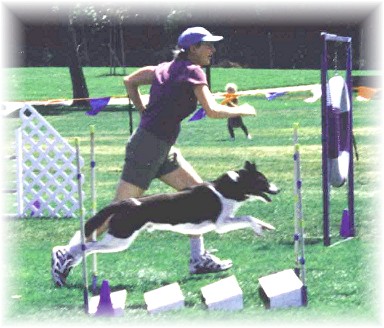
& CDCA-Dog of the Year Fuligin Ged Tycho, CDCA-V, CDCA-HC, CGC, CDX, RA, AX, AXJ, NAP, NJP Sire: AKC/UKC/CDCA CH. Pleasant Hill Jordan, ROMX Dam: CDCA CH. Pleasant Hill Mimi Breeder: Donna Dodson 1. What inspired you to get involved in agility? I started training my pet shelty to jump over obstacles when I was a kid. What I really wanted to do at the time was ride horses, but that wasn't possible. So instead I set up obstacles of pillows in the house and made the dog jump through them and lived vicariously. When I decided to get a dog, I decided that I wanted a Canaan Dog and that I wanted to do both agility and obedience with my Canaan Dog. Even though I had never done nor seen either of these events. It just seemed like a fun thing to do. 2. We all know that dogs (in any breed) have different abilities and interest levels. Was there a particular personality trait that you recognized in your Canaan(s) that lend itself to this sport? Tycho loves to jump. Tycho adores jumping. He also loved running around and doing the obstacles. Although he was very fast and motivated, he was not "crazy driven" like some dogs and always always knows exactly where his person is. It is the keen bonding and awareness, as well as his innate athleticism, that made him an ideal agility companion. His intelligence and apparent ability to read my mind also made him a wonderful partner, as sometimes he seemed to know what I wanted him to do, without my ever consciously telling him. 3. Performing in Agility also calls for obedience. A dog must take direction from his handler in order to work a course. What basics does the dog need before introducing him to the sport of agility? The dog must have attention to the handler and be willing to take directions from the handler. Most of agility is the dog cueing off the handler's body, not verbal cues. Therefore the dog must be very aware of the handler and willing to read and act on these cues in a variety of settings. This means the dog must have extensive socialization so it is not worried about the surroundings and is willing to ignore the surroundings and focus on the handler. Basic obedience cues to start agility training are come, wait/stay, sit, and maybe down. But if your dog routinely "blows you off" or decides that something else is more interesting than you, then the basic attention must be built up. The relationship between the dog and the handler is essential to obedience and agility. 4. Every dog has his strengths and weaknesses. Were there any specific obstacles that your Canaan(s) had to overcome? If so, what training tips can you offer. Tycho had a lot of fear of the teeter. He also found the weave poles to be pointless and rather stupid. We overcame the fear of the teeter through copious amounts of freshly cooked chicken. The weave poles he learned to execute flawlessly, but I also had to learn to not practice them much (because he really did not like them and would slow down significantly with each repetition). The two lessons here is that bribery works really well to get your canaan dog to do things he is reluctant to do. Learn what your dog adores and use that knowledge. The one area that we were always weak on was from me, not from Tycho. I never taught him to work at a distance from me, so I could not "layer" obstacles: that means send him out to an obstacle at great distance (often with additional obstacles between us). That is a handling issue, however, and is a flaw with my training and handling and has nothing to do with the dog! How to overcome this? Teach the dog early on how to work at a distance. (I still haven't managed this one!) 5. What advice can you tell the newcomer who wants to train their Canaan in this sport? Have fun. Do NOT drill!!! Teach your dog to spin right and left. Get just a few things for your backyard to practice. Take private lessons and/or rent a facility to practice. Hour long class lessons are for the birds, but they are better than nothing. If you take group classes, recognize how exhausting they are on the dog. Crate train your dog � he will need to have his "down time" in training and in trials. And remember � the dog is always right. If he didn't do what you wanted him to, the fault is with you. Your job is to find out what you did wrong and correct it. 6. Please provide a brief bio about your accomplishments in agility with your Canaan(s). Please include a couple of pictures to accompany your responses. Tycho (Fuligin Ged Tycho CDX, RA, AX, AXJ, NAP, NJP) is my "Novice A" dog, which means that he is the first dog I ever formally trained and competed. He is the best dog! The fact that he only has a dozen AKC titles is indicative of my limitations as a trainer, as he was capable of so much more. Tycho and I started training in agility when he was over 2 years old. We started with Candy Gaiser, who was wonderful because she was used to working "non-traditional" breeder (harriers, foxhounds, lurchers, and sighthounds). We took a year or so detour and earned his CD then went back to agility, taking lessons with Sharon Freilich. Once we started competing, Tycho swept through his Novice and Open titles in short order and was racking up Excellent legs, when we moved to the east coast (causing another delay). Tycho did best when we were cross-training and competing in both agility and obedience. Tycho was the first Canaan Dog to earn advanced titles in both obedience and agility. There is no greater joy than the intense sense of "one-ness" and complete communication you can get when you are running an agility course together: sometimes all I did was think what I wanted him to do, and he would do it. Did I mention that agility is really intense and very fun? |
| Tycho and Jennie |
 |