 |
| Spring 2007 Newsletter |
| The "Raw Deal" - a look at raw feeding By CCO Contributing Editor: Michelle Harrington |
 |
 |

|
 |
| Have you always had your dogs on raw? If not, what inspired you to move away from a commercial to a raw diet? Please be as detailed as possible.
Our Canaan Dogs have enjoyed raw since the first day they took over our home in 2001. We have also been fortunate enough to obtain our dogs from breeders who also fed raw, so all of our dogs have been raw feed since birth. As Breeders ourselves, we encourage our new puppy homes to feed a raw diet as well. What was your starting point with information? Did you have a mentor? Was there a book(s), an article(s), seminar, that prompted you to research the raw alternative? We began with the Internet, and through different sources increased our knowledge over the years. We subscribed to several different raw feeding groups, and bought many books that gave us more than enough information to implement our own raw feeding program. As soon as we felt comfortable with the ins and outs, we began to make our own modifications. The raw diet is centred on different philosophies. For example, some people follow the �BARF� diet and some follow other raw practitioners. Is there a specific diet that you follow or have you adapted your own diet after digesting other sources? Please be as detailed as possible. For a majority of the time we followed the BARF diet promulgated by Billinghurst. As a beginner, it was easy to find information on this style of raw feeding. Although many resources were readily available as guidance, the BARF diet also became complicated with the variety of supplements that had to be included to create the �balance over time approach.� Over time we realized that our style of feeding evolved so much over the years that what, and how, we fed our dogs no longer fell in line with the Billinghurst model. After some research we made a more complete transition to the Prey Model approach which more closely resembled the style of feeding that we have graduated to over the years. A simplified comparison between Prey Model and the BARF model can be explained as: Red meat vs. White meat, No Vitamin C vs. Adding Vitamin C, and No veggies/no grains vs. adding veggies and grains. Prey Model is a diet meant to closely resemble that of wild wolves: whole prey (or body parts), no grains, no veggies (except what is in raw tripe), and no supplements. Additionally, the Prey Model suggests feeding 80-85% muscle meat, 10-15% edible bones, and 5-10% organs, whereas the Billinghurst model suggests feeding 60% RBMs (one to one bone to meat ratio), 15% fruits/veggies, and 10-15% offal. What were the top three things ( name more if desired) that you noticed overall after implementing the raw diet? The draw for us was providing our dogs with a healthy lifestyle; a way to avoid or minimize disease and increase longevity. The advantages we enjoy from feeding our dogs raw include: increased strength of immunity, vigorous puppies, clean white teeth, smaller, less-smelly bowl movements, and luxurious coats. Are there any supplements, if any, that you use to enhance your Canaan�s diet? What do you feel are the most significant supplements that your dog should not do without? Salmon oil is the only supplement we use on a regular basis; however we wouldn�t have to supplement at all if we could get our dogs to eat more fish. We prefer using cold pressed wild salmon oil that is pink or red in color without the artificial color additives. Other supplements we treat as a �medicine cabinet� and use as the need arises. For example, we occasionally use Probiotics and Vitamin C to balance the immune system in times of stress. When traveling ( on vacation, showing, performance trials) do you modify their diet? Or do carry out the same regiment that they would when dining at home? While traveling we primarily feed meaty beef bones and raw chicken. We take lots of camping trips and find it easy to pack a cooler full of raw food items. Do you change your Canaan�s diet according to season? We are a bit more lax supplementing with Salmon oil in the summer, but find it more necessary in the winter. During the Colorado summers we used to supplement with brewer�s yeast and garlic to keep the little beasties at bay. However, since the summertime is awful for mosquitoes and ticks in Minnesota, we now use a home-made spray consisting of rose geranium oil to repel ticks, and a garlic spray around the yard to keep mosquitoes away. Do you have a veterinarian that supports your decision to go �raw� or did you have to convince them? Did you have to switch veterinarians? Our Colorado vet was open to the idea of feeding raw, and in time he converted. We have found it more difficult to locate a good Minnesota vet that supports raw, though we find it less necessary since we are comfortable with our choices and natural rearing philosophies. How do people react when you mention that your dog(s) is on a raw diet? Curious? Leary? Supportive? Most people are very curious about the raw diet. We love spreading the word and encouraging others to do their own research. We have converted vets, family, friends, and co-workers. Even the squeamish or skeptical ones come around eventually. What advice would you give to someone who is contemplating the �raw way�? Are there ways to modify a commercial diet to receive some of the benefits of a raw diet. Start with on-line resources, or an easy read. If you are interested in the Prey Model approach, try �Work Wonders� by Tom Lonsdale, published in 2005. Although these titles are a bit outdated, if you are interested in the BARF diet, consider �Grow your Pups with Bones� by Ian Billinghurst published in 1998, and �Nutrition for Dogs and Cats: The Ultimate Diet� by Kymthy Schultze, published in 1998. Alternatively, if you want a more practical/hands on guide, try �Raw Dog Food� by Carina Beth MacDonald, published in 2004. The best way to start is to just jump right in and convert all at once. Though remember to keep it simple and introduce variety gradually. You�ll be less likely to encounter issues. Those needing a transition period can start by getting rid of all those processed treats and replace them with grain-free items, like freeze-dried liver, or dried duck breast strips. You can also give your dog a weekly marrow bone as a �treat.� Then replace one meal at a time with raw beef short ribs, beef necks, or ox-tails. If you have trouble with the raw aspect, I�ve heard of some people slightly cooking ground beef and adding a raw egg (shell included). At the very least kibble fed dogs should be supplemented with Fish Body Oil. When you see how much your dog enjoys it, and the improvement in his health, you can become adventurous and try new things. If you make the choice to transition slowly, be careful not to mix raw meat with kibble in one meal as they are digested at different rates and might cause problems. If you have children, how do they feel about the raw diet? Recently I ran across some of our youngest son�s kindergarten school work (now almost a 3rd grader). The �Pet Report� called for the child to draw a photo of their pet and to give specific information regarding their pet. In crayon, our son drew one of our Canaan Dogs, with something below her mouth that I could not make out. When I read the third line, �Food pet eats� I had to laugh. He wrote, �Cold meat.� I wonder what the teacher thought of that. Our boys have become very savvy in their knowledge since then. Until last year, I never considered the impact feeding a raw diet had on our children. One day I mentioned that one of our pups might not be fed raw in their new home, and the boys became noticeably upset. They asked me if I had explained to the new owners why feeding raw is better, and if I told them how easy it was to do. To this day they still worry about that puppy because they see how happy the pups are when they eat raw in our home. Out of all the pups we have placed, we have been very fortunate that only one is kibble fed, and the boys and I are still working on them :-) How many meals do your Canaan(s) get on a daily basis? Can you provide a sample of what a typical daily �raw diet� consists of for your Canaan(s). Please be specific as possible. Puppies here eat three times a day and adults usually twice a day. Most of our dogs have fast metabolisms and didn�t do well with only one daily meal, but that seems to have changed a bit with the Prey Model, as with larger prey they will �gorge and rest.� Under the Billinghurst style we viewed meals in bundles of four; feed raw chicken sprinkled with Vitamin C for three meals, and then feed a ground beef or fish/veggie mush meal with various supplements for the fourth meal. Under this model our dogs would get veggies and supplements every other day. We also focused on using a more concentrated version of deep green foods as some veggies do not have enough nutritional or mineral content due to soil depletion. Once a week our dogs would also get recreational marrow bones. Since our pups would eat three meals a day, we fed chicken morning and night, with a mush meal for lunch. In switching over to the Prey Model approach, we have eliminated all supplements (save salmon oil), unless a particular dog could benefit from an extra supplement here and there. Now all meals consist of mostly meat and organs with some bone. We found an organic farm nearby where we obtain free range grass fed organic beef, and another source where we can buy whole fresh organically feed chickens and eggs. Now the dogs eat whole chickens, whole rabbits and different meaty beef cuts with bone. The dogs love it, and it is easier for us to feed. Any dietary changes for a bitch during pregnancy? Our females change their food preferences a bit during the different stages of pregnancy. Around the 6th week they like a like more organ meat and fish, and closer to their due date we hardly give any bone. A few days post-whelp they go back to meat with bones. Please feel free to list resource links that you think would be helpful for others learning about the raw diet. Yahoo groups are a huge resource; there is a raw feeding group for virtually every state, or geographic region in the US and abroad. There are also groups for many of the large metropolitan areas. This is a particularly good group to join if you are having trouble locating a raw food source in your area: Carnivore feeders and feed suppliers at http://pets.groups.yahoo.com/group/CarnivoreFeed-Supplier/ For anyone looking for a vet that will support or tolerate a raw diet you may want to try looking here. http://www.k9snaturally.com/prorawvets.htm For a comparison between Prey-Model vs. BARF, see http://rawfed.com/myths/preymodel.html Tom Lonsdale�s site, check the diet guide under the RBM link www.rawmeatybones.com And although this site is geared towards cats, much of the information can be applied to dogs as well. http://www.rawfedcats.org/naturesway.htm This is a very cool that site shows the bone content in various chicken parts http://www.serve.com/BatonRouge/nutrition/bones_in_chicken_parts.htm Someone once suggested this site to me as providing some useful information on Wolf and Raw Diets. http://k9joy.com/ BACK |
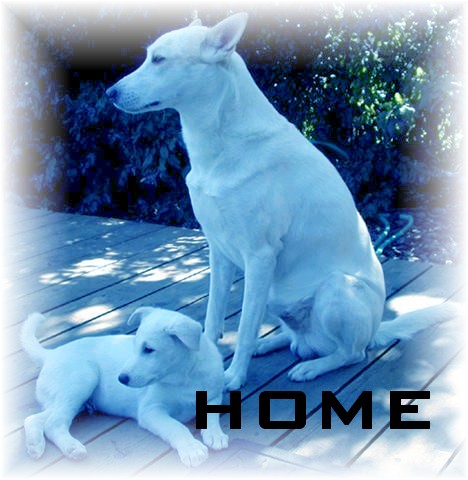
| Logan and Gabe Sanchez with MidSummer pups "Mackenzie' and Dylenn "Sheba" |
 |
| Wendy and Victor Sanchez (Minnesota) MidSummer Canaan Dogs http://www.midsummercanaandogs.com/index.shtml |