
Books were extremely costly to produce, and were considered rare and prized possessions owned only by the wealthiest people and institutions. They were commonly chained to their lecterns or shelves (the Brunswick codex even had its own lock forming part of the binding), and anyone caught spiriting one away was subject to heavy, even brutal, punishments. Unfortunately, the pages missing from this manuscript are as irrecoverable as any of the fingers or hands which may or may not have been chopped off in punishment for their theft.
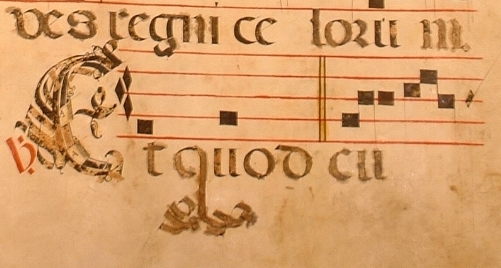
Had his superior scolded him for daydreaming, or maybe for complaining because of the monotony of his work? Perhaps, as a way of showing that he was indeed dedicated to his task, despite his superior�s reprimand, he penned his protestation in Arabic and made it part of the decoration. Mujahed, faithful servant.
As Spain was under Moorish, and thence Arabic language domination for nearly 800 years, that a Christian monk might know some Arabic is not a stretch of the imagination.
Whatever the explanation for the scrolling decoration around the bottom of this letter, the preceding is only one of limitless possibilities. The curious curving lines have succeeded in drawing attention to the chant dedicated to arguably the most important personage in Roman Catholicism; namely Peter, the traditional founder of Christianity in the West.
Although the origins of the manuscript remain in some doubt, what is certain is that it served a useful purpose for many years as a service book for a monastic choir. Philip II of Spain, after Elizabeth I�s restauration of Protestantism in England, ordered the production of many liturgical books which were to be smuggled into England along with Roman Catholic priests. The Brunswick Codex, however, contains some marginal notes, called glosses, in Spanish, which suggest that it was used in Spain. If, as is suspected, the book was produced and used in Spain before making its way to England after the Protestant Reformation, then it has been useful three times over; as a liturgical book for the Spaniards, a holy relic for the Counter-Reformation in England, and today, as a window into the arts, religion, and fanciful meanderings of our forefathers.
John David Eaton
Brunswick, Georgia
4 March 2004

