Progress report:
Monitoring of aboriginal Asiatic Black bears and other rare animals in upper Jang Dang valley, eastern part of Jirisan National Park, South Korea, through May-June 2006.
By Alexey A. Zborovskiy, MS.
Introduction
As of fall 2006, very little is known about present distribution and number of the aboriginal bears in the Jirisan National Park. The supervisor of the given project, Prof. Sang Hoon Han, believes that Park harbors between 10-20 such animals. My goal was to contribute in locating these elusive individual bears. The objectives and methods of a project are described in the corresponding proposal: “Monitoring of moonbears and other rare animals in eastern Jirisan National Park through May-June of 2006”, a work plan by Alexey A. Zborovskiy.
Accomplishments
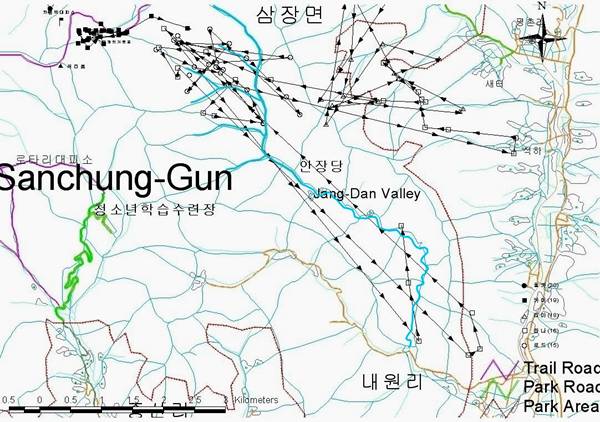
In Jang Dang, the exact work area was determined after consulting with my co-workers, which monitor reintroduced young bears in uppermost parts of the valley (Figure 1).
Fig. 1. Locations of 5 reintroduced radio-marked bears in Jang Dang valley in 2006.
To avoid possible difficulties, related to determination between the sign of the reintroduced and the aboriginal bears, I did not look for the later in areas frequently visited by the former. Though such determination was potentially possible, our primary goal at the moment is to find place (or places), inhabited MAINLY by aboriginal bears. The reasoning here is that, if few such animals are still present in Jirisan, why should they concentrate in upper Jang Dang, used by sometimes as many as 5 radio-marked bears, if both space and food are available throughout the Park? Our time is limited, so we must spend it for exploration of areas, free from radio-marked bears. In addition, these areas should meet one more criteria: they must be capable of holding native bears, i. e. - should be extensive enough and should hold some good bear habitat.
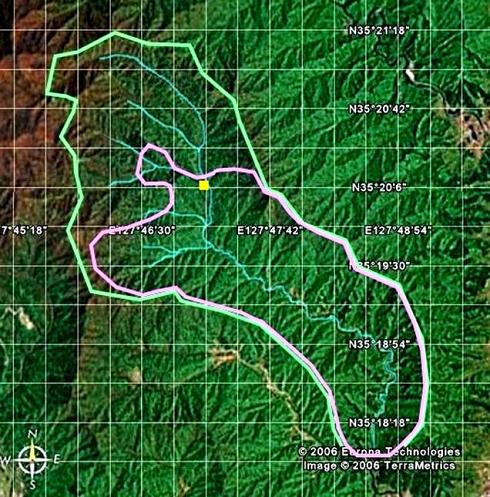
The area within the rose polygon, shown on Figure 2 (below), meets both of the above criteria. This polygon was built based on analysis of radio-locations of reintroduced bears (Figure 1), combined with my own visual evaluation of the habitat. I thoroughly looked for native (aboriginal) bears there.
Fig. 2. Jang Dang valley (green polygon) and study area (rose polygon). (!) WGS-84 LAT/LONG grid is shown here. The small yellow square indicates my base camp. See above text for more comments.
The characteristic of habitat
The rose polygon (study area) is about 5,1 km long and app. 1,65 km wide. The area is covered by non-primary, almost exclusively broad-leafed forest with few spots of pine and larch. The potential source of food for bears - different species of oak (Querqus sp.) - are dominating there.
I evaluate this area as good potential bear habitat, with two important reservations. First: the large trees, which usually grow in river-beds, providing Asiatic Black bears with shelter throughout the year, are absent there. In addition, the majority of study area slopes are quite steep and, in most cases, is covered by extremely dense bamboo brushwood. Such circumstances, of course, can never influence bears survival and reproductive rates positively. (See also Attachment 2). Second: the area is relatively small, while number of gardens and apiaries situated around Jang Dang is significant. For such animals like bears it is absolutely not difficult to walk some 10-20 km per day. Thus, any bear, even from relatively remote upper tributaries of Jang Dang, can be easily killed near someone-s garden or apiary (unless sufficient measurements are taken, see Attachment 2).
Results
of our search for aboriginal bears
The author has experience
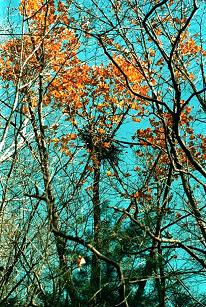
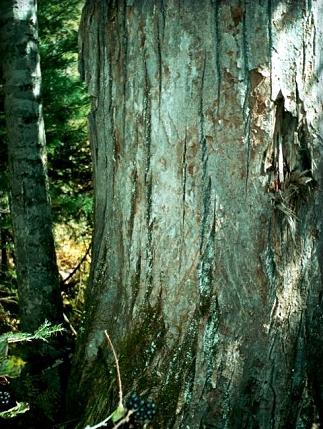
in determining places visited by bears: on the below Figures 3 a, 3b,
3c, and 3d you can see examples of author's personal photos, taken in
Russia. However, despite weeks of search, none of such or similar
signs were detected. For example: both the direct field observations
and data, collected by sensor-cameras showed that the study area is
inhabited by large number of boars (Sus scrofa), which are potential
food competitors of bears. In such circumstances, it would be
expected that, if any wild bears live in area, they would tend to
climb oak trees - in order to obtain acorns before last are eaten by
boars. But there was no single oak tree with broken branches/bear
clawmarks found in the area.
Fig. 3a. The oak tree, damaged by foraging Asiatic Black bear. Russia.
Fig. 3b. Relatively recent scraps on the poplar. Russia.
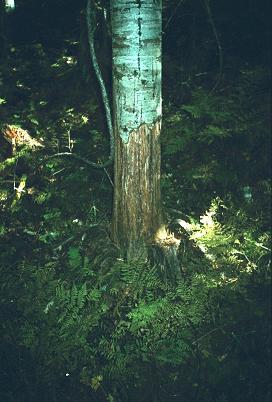
Fig.
3c. The abies, mortally damaged by Asiatic Black bear. Russia.
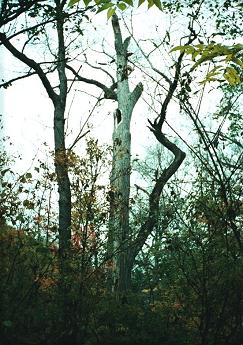
Fig.
3d. A tree-den of the Asiatic Black bear. Russia.
There were no bear footprints, beds, scats, hair etc. found either.
Nearly 90 km were hiked in search for evidences of bears in the study area (an average = 1,5 km per day). On some routes, sensor-cameras (n=6) were installed. In May-June, a total 11 films were exposured and analyzed. However, no bears were photographed.
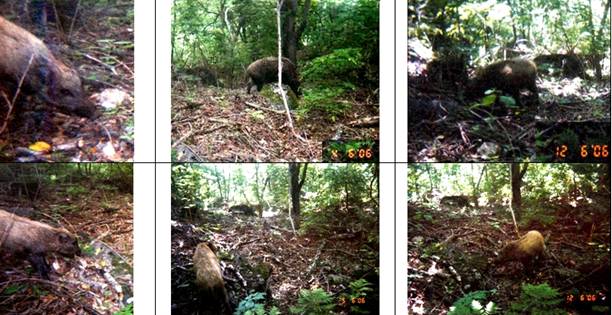
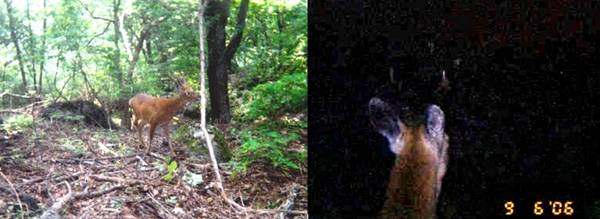
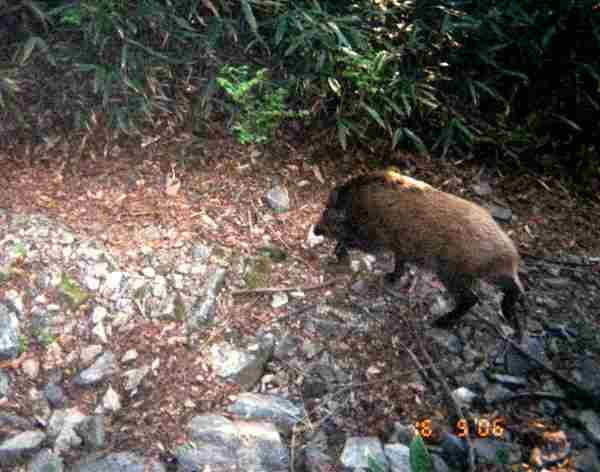
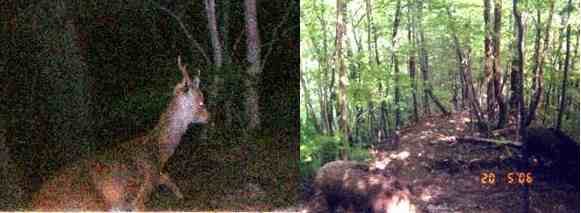
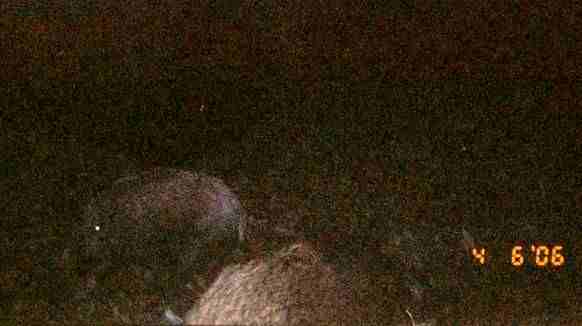
The only large mammals, photographed by sensor-cameras, were wild boars and the roe deers (Attachment 1).
The scats and footprints of relatively small mammals, including leopard cat, raccoon dog, and other, were common in work area.
Conclusion
There
were no aboriginal bears in Jang Dang valley in the period of the
study. But I do not say that aboriginal bears can not be found in
Jang Dang in a future (in 2007-2008, for example), because, as well
known, these large animals (under normal conditions) are able to move
hundreds kilometers and to shift their home ranges easily.
I suggest that further research on native bears shell be done in other parts of Jirisan National Park.
ATTACHMENT 1
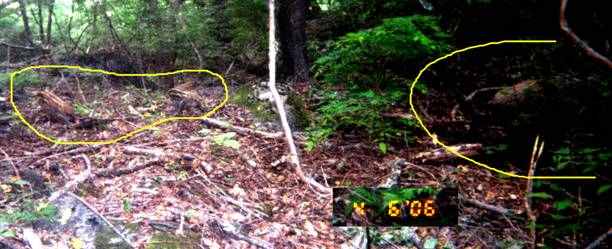
Samples of photographs from sensor-cameras (coordinates are given in Tokyo map format). (See next report for samples of ALL photos taken in Jang Dang).
Camera #46: N35 19 15.9 E127 46 32.5
Boars:
Three boar cubs (left) follow their mother (right)
Roe deers:
Camera #48:
Boar, N35 19 59.2 E127 47 07.0:
Roe deer and boars, N35 19 46.6 E127 47 02.8:
Camera #51: N35 19 28.8 E127 46 49.4
Boars:
ATTACHMENT 2
Some management recommendations, resulting from project.
As mentioned (see: The characteristic of habitat), no original lowland forest, characterized by larger trees, left in our study area. The absence of owls is one of indicators of absence of larger trees. I didn't hear a single owl while spending nights in Jang Dang. My private observations, combined with filed data, make me firmly feel that the largest trees, which formerly decorated Korean lowlands, are now nearly gone in this part of a country. They often can be found in the rich people's houses - in forms of pompous huge tables and benches. No doubts, last will last for centuries, but trees, from which they're made, are gone. Such furniture is in fact nothing other than sad symbol of Man's neglect upon habitat of his lesser kins and kiths - the wild animals.
As it can be observed anywhere in South Korea (and, unfortunately, in many other countries today), greedy people take from Nature all the best, leaving all the worse for the animals. This is why majority of National Parks protect the highlands only. Highlands are difficult to cultivate... However, too many animal species can only live in lowlands. It is not strange, therefore, that majority of large mammals, including bears, have been extinct or nearly extinct in South Korea.
The present situation must be improved by means of:
- Educating people in the basic Human Values, implanting ideas of gratitude and generosity towards our Mother Nature;
- broadening the existing wildlife habitat of South Korea, restoring and protecting Korea's lowland forests and other.
Such measurements will contribute in restoration of dozens animal species, including Asiatic black bear and the brown bear, the Manchurian deer, spotted deer, leopard, and perhaps even Siberian tiger. This would also return beauty and health to Korean rivers in their middle and lower flows, and can even attract more tourists to country. There is no need to grow rice and other food in nearly every valley, as it is done today! At least, many kinds of food can be cultivated without need to destruct all Korea's lowland forests.