____________________________________________________________
17 January 2005
Since we assumed that after new baby arrives, we will have even
less discretionary time, Justin decided to take Malachi away for
a weekend, to give Erin a few days with no responsibilities. Justin
had very much enjoyed the White Peak area (in the Peak District
National Park) during his marathon, so with
no pun intended, he decided to take a hiking tour over Martin
King weekend.
The first day was just the drive up, walking around Matlock (a village near their bed and breakfast), and then settling in for the night. They ate at a fish and chips shop; Malachi loved the fish, so Justin got stuck with the jacket potato.
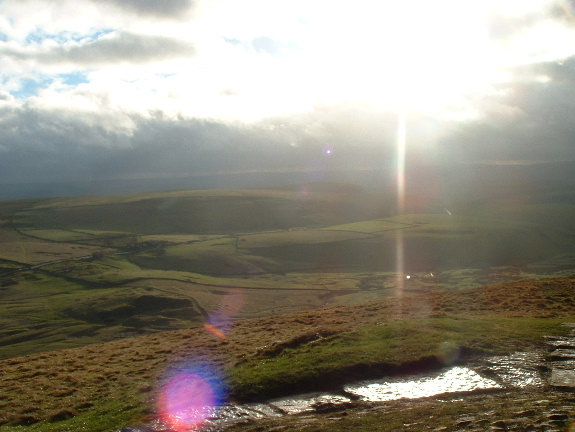
Day two was a busy day. After a full-English breakfast, they set out for the Hathersage area, a short drive away. They climbed a steep, rocky path which ended at a small cliff overlooking the valley (Malachi was in a backpack). It was very overcast, but the sun peeked through occassionally. After reaching the highest point, they turned left down the side, to a flat grassy path. Justin let Malachi walk a little, and then they headed down for lunch in the car.
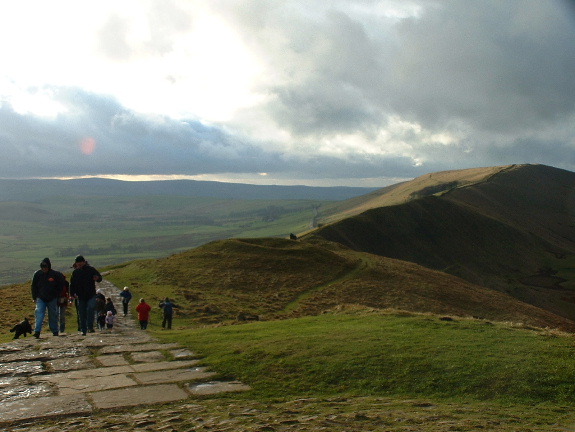
After lunch was Malachi's nap, so Justin drove through the north of the Peak District. The route he took was extremely scenic; at one point he saw a path he wanted to hike, but Malachi had fallen asleep. They continued to their destination: Mam Tor. This was a much more popular destination. The path up was made of flagstones. Not a very rugged hike. It was very windy, which irritated Malachi. But more great scenery. All around peaks and valleys, green with stone fences. A few villages. England.
At the top of Mam Tor the trail continues down the other side, so they did too (the flagstones eventually ended, so it was just a normal path). It just kept going along the peaks of hills. Justin wanted to follow it until he collapsed, but they needed to get back for dinner. Another great hike.
From the top of Mam Tor
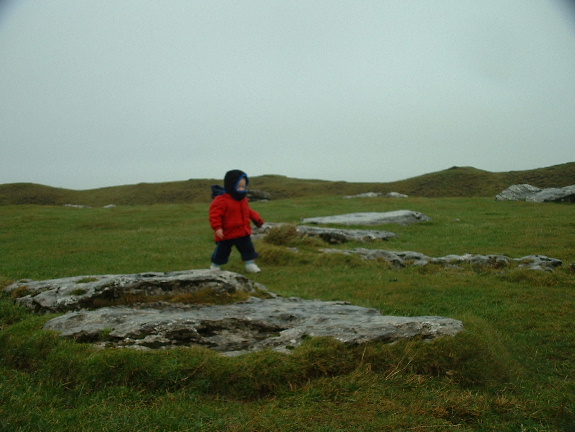
The plan for the last day was to stop at Arbor Low, then walk around the south part of the Peak District. But they met with such vicious weather at Arbor Low (an ancient stone circle, like Stonehenge), that Justin decided to just head home. It was cold and the wind was driving the freezing rain sideways. Arbor Low was a good stop, but hard to appreciate chasing Malachi in the mud and weather.
Malachi romping around a prehistoric sacred site
And then they drove home. The trip confirmed Justin's previous opinion of Derbyshire and the Peak District: it's his favorite part of England.
22 May 2004
Justin ran a marathon in Cleveland a few years ago. He didn't
have any burning desire to repeat that pain until we
arrived in England. Our first April here, we happened to turn
on the TV during the London marathon. It looked like such an
experience that he knew he had to try it. But, unless you run
under a certain time or are part of a charity which has positions,
the only way to get a slot in the race is by lottery. Two more
Aprils went by, and two rejections. Since we didn't think we
would be here another April, Justin found another marathon
that looked good: White Peak marathon, in the Peak District
National Park, a few hours northwest of us.
Since Justin's marathon was a few hour's drive from home, we wanted to stay the night in the area to make it easier the day of. A friend of Justin's from work, Shepherd, was also running the marathon, so all four of us went up together. We stayed the night near Rugely, a small town about 40 minutes from Thorpe, where the marathon started. We made some wrong turns, so it ended up taking us 80 minutes to actual find the start line, but because we left early, we were exactly on time.
The rest of the day Justin and Shepherd ran, and Erin worked her
way towards the finish line by car, stopping to take pictures
of the guys. We headed home right away, stopping at McDonald's
for some much desired calories. Justin provides below more details
of the day; if you've never run a marathon, it will probably
be very long, boring and not make much sense. If you have run a
marathon before, it will just be long and boring.
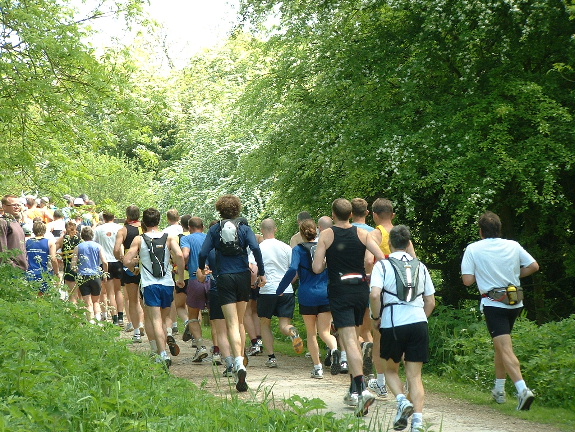
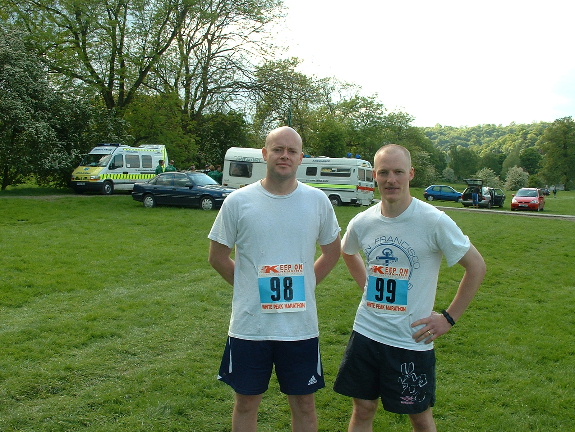
From left to right:
a view of the trail
starting (Justin is in the middle, shoes with orange bottoms, Shepherd just
to his right)
done!
White Peak Marathon , 22 May 2004:
I will write this in the first person here. When I accepted that London wasn't going to happen, I quickly saw I had two other options: run a city or a trail marathon. Although a city marathon was my first inclination, British city marathons, with the exception of London, just aren't that big. Also, the cities don't necessarily shut down roads, so the runners may be stuck on a narrow shoulder. I'd already done a smaller city marathon at Cleveland, and I didn't like the thought of running right next to cars, so I focused on trail marathons.
White Peak seemed like the perfect one. It isn't a road race, but the terrain is mostly paved or very firm, packed dirt or limestone. Only a short section is some firm gravel stuff, which wasn't bad. Unlike some other trail runs, it is well marked, so I wouldn't need to deal with maps while running. It is fairly close. The timing was right. And the scenery sounded great.
A few guys from work expressed some interest when they found out I was planning on running the London marathon - they decided to give White Peak a try along with me too. Fairly soon after signing up, one guy dropped out. Then a few weeks before the marathon, another guy began making hints that he might not make it. And two days before, the third guy pulled out. The fourth stuck it out: Shepherd. He had never run a marathon before, and hadn't done much training, but he wasn't about to back out. It really makes a race much more fun when you're running it with someone you know, so it was great that we could run it together.
I learned two things from my
first marathon: train, and start the race with a full belly. For
the first, I
started training in February, running about 15 miles during the
weekdays and doing a longer run about every other weekend, working up
to a 21-mile run a few weeks before. I was worried that all that
work was for nothing: when we went to Norway two weeks before the
race, I wasn't able to run much at all. Then the week before, I
picked up a slight fever or cold from Malachi, which left me
weak and not feeling so great. But I kept up my training as best
I could.
The morning of the race, we were in a bed and breakfast. I ate until
I was uncomfortably full: two poached eggs on toast, a big bowl of Alpen,
grapefruit, a huge cup of tea, juice. Right before the race I had
a banana. I also put two granola bars in my pockets for during the
race. It ended up being perfect - I didn't even need the granola bars,
altough I ate one at mile 18 just so I didn't carry them the whole
way for nothing.
The weather was perfect, and that's not an exaggeration. It was slightly cool, but shorts and a t-shirt were fine for a run. The sun was out, muted by clouds occassionally. A slight breeze, barely noticeable, kept changing directions, as did the course. Perfect really is the best description.
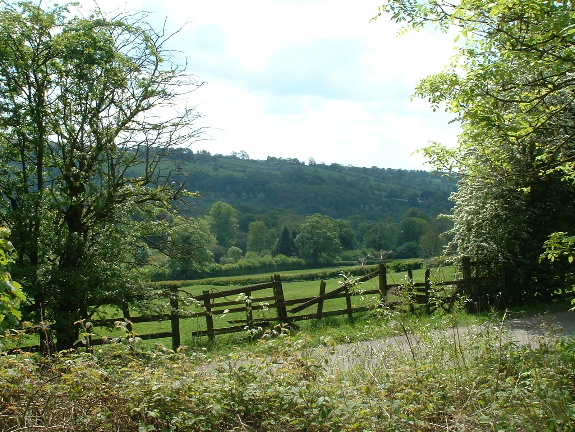
The scenery surpassed anything I expected. The trail runs by field after field of stone-walled sheep pastures of various shades, depending on use or light. The valleys stretched out, showing these endless fields. Occassionally there was some variance, such as a road, a cliff, a small village, a river, or the trail might go through a forest. But Shepherd put it best. When we were driving around Thorpe, looking for the start line, we had a great view of the valleys with stone-walled fields. Shepherd looked out, nodded his head, and said, "Now this is England."
White Peak marathon is a very small marathon, probably even for trail runs; the maximum allowed is 200. I think we were probably somewhere between 150 and 200, which they said was an unusually high year. Shepherd and I started near the back, since the other runners seemed pretty serious and we were planning on starting at a slower pace. It took us 26 seconds to reach the start line.
The first third (9 miles) was fairly uneventful. We enjoyed a relaxed pace but still regularly passed people. The difference in training showed itself early. At mile 2, Shepherd said with much disbelief, "We're only at mile 2? I thought we were a lot farther than that." For the next few miles, we were mostly focused on looking around and staying out of the way of bikes (it's a public trail, so there were quite a few bikers and hikers, but it wasn't a big deal). There were about five water stations total, mile markers at every mile (although not the easiest to spot), and two places with EMTs. Two bikers stayed in the rear to make sure everyone made it. It was a well organized event. I took water at every break, and walked while I drank it. It gave me a quick chance to rest, and allowed me to drink without swallowing a bunch of air.
I could tell Shepherd was going to have a fun day when I could hear him breathing heavily at mile nine. Soon after that he had to take a break. The pace we had maintained for the first nine miles was perfect to start with, but when Shepherd dropped back I knew that was a good time to set a new pace. That second third of the race was what carried me. I pushed the entire time and passed quite a few people. The scenery was still great, and even though I was straining, I was actually having a good time. The course loops back on itself at mile 11. I passed Shepherd about 5 minutes later. He said he was going to quit when he reached mile 13. I don't think I was able to say anything coherent. Erin stopped around mile 13 and took a picture of me.
The fun was gone by the time I reached the final third. At Cleveland, I had died at mile 18. I wasn't to that point yet, but that mile 18 marker did seem a long time coming. My pace was slowing, but I was still passing people (some walking). The trail to that point had been either uphill or level. Only one incline was steep enough to require any extra effort, but even an extremely slight incline, done over 20 miles, can take its toll. I knew there were three declines, all in the 20s, so I was very much looking forward to mile 20 and the first decline. I think White Peak must be the only race in which the declines are not only worse, but significantly worse, than the inclines. The first decline had warning signs to bikers not to ride down the slope. It gave a slope of 1:8. Maintaining one's balace running down a steep hill is difficult, but doing so after running 20 miles is near impossible. I tried to get as much as I could out of gravity's help, but I was relieved when the drop ended and I could continue on the nice, gentle incline. The next drop, around 21 or 22, was the same way, but much longer. I never thought the end would come. At mile 24 I was hurting. I was doing well on time, which I think my legs took into account: they quit on me soon after I passed 24, so I slowed to a brisk walk. People I had passed were now passing me. I planned to walk until I reached mile 25, but after only about two minutes I reached the third decline. I couldn't waste a decline by walking down it, even a 1:8 decline, so I picked it back up to a pathetically slow run. I never did see mile markers for 25 or 26, so I wasn't quite sure where I was. I walked two short sections after the decline but before the last bit before the finish, maybe a total of five minutes, all at a brisk pace. Since I didn't know where I was, the finish line snuck up on me. I ran the last part, just about the last 2/10 of the 26.2, took the mug of water and bag someone handed to me, and collapsed on a blanket with Malachi.
My goals before the race (in order from first to last):
1) finish under 4 hours
2) beat Oprah (4:29)
3) beat my old time (4:51)
4) finish under 5 hours
5) finish
At 24 miles I was at 3 1/2 hours, so I knew, unless I broke my leg going down a hill, that I would make it. I crossed the finish line at 3:50.00 (3:50.26 official time - they don't account for the time to reach the start line). I probably could have cut about five minutes off if I had ran the entire last two miles, but I think I was a little worried that if I pushed too much, I would collapse at 25 1/2 and then have to stop completely - I was willing to sacrifice five minutes to be sure that I would make my top goal. Plus my legs told me they wouldn't go a step farther unless it was by walking.
I was only a little sore for about 24 hours, and then felt fine. I expected the marathon to be a lot of things, but fun wasn't one of them. After Cleveland I said I would never run another marathon, but now I would very much like to. It was a great run on a perfect day, and after four months of preparation, kind of a let-down now that it's over.
I must add a short description of Shepherd's experience here. As I mentioned above, this was his first marathon, and he didn't really train for it. But he was very enthusiastic about the whole experience. When he stopped at mile 9, he thought for sure he would not finish. Around mile 11 he started to get a little hungry. By mile 13 he was starving. By mile 15 he was "starting to look at leaves," wondering if they were edible. When we were looking for a place to eat the night before, I kept mentioning McDonald's, so McDonald's food was all he could think about. He kept imagining himself walking to the counter and "ordering three #4s." As he got farther along, he got faint and dizzy. He missed a mile marker, so he didn't know how far he had to go. He asked the last person who passed him how far, but the guy got it wrong. Eventually, the sweepers on bikes caught up to him. They asked him if he was alright - all he could say was, "I'm starving." One lady had food in her backpack, which she gave him. That helped him keep walking. He almost collapsed going down the final descent, but survived. We were waiting at the finish line, a bit worried, when we finally saw him walk out of the trees with the bikers. He finished in a very painful 5 1/2 hours, but he finished. He said it was the hardest thing he's ever done in his life. I don't know that he wants to run another one, but then again, I said that once too.
For the previous day of our trip, click here.