 |
|
|
|
|
|
|
|
|
|
|
|
|
|
|
|
|
|
|
|
|
|
|
|
|
|
|
|
|
|
|
|
|
|
|
|
|
|
|
|
Debra Domenici's Health Issues Page |
|
|
My name is Debra Wetzel Domenici. This page is about the health issues that I have in my daily life. ** Warning: This page contains descriptions about health issues and procedures. Some people may not be able to handle this. Please use caution in continuing. Also, I am not an expert on the information discussed here. The information is what I gathered by the research I have done. If you have more questions about these conditions, please talk to a doctor. **
My health problems are as follows: |
|
 |
|
Gastroesophageal Reflux Disease (GERD) |
|
|
| What is Gastroesophageal Reflux Disease? |
|
|
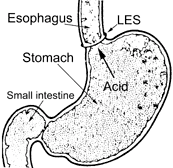
| Gastroesphageal reflux disease (GERD) is a digestive disorder that affects the lower esophageal sphincter (LES)- the muscle connecting the esophagus with the stomach. Many people, including pregnant women, suffer from heartburn or acid indigestion caused by GERD. Reflux is quite common in babies where they spit up a lot. |
|
|
|
Gastroesophageal refers to the stomach and esophagus (tube that food travels through from your mouth to your stomach). Reflux means to flow back or return. Gastroesophageal reflux is the return of the stomach's contents, including food and stomach acid, back up into the esophagus.
In normal digestion, the LES opens to allow food to pass into the stomach and closes to prevent food and acidic stomach juices from flowing back into the esophagus. Gastroesphageal reflux occurs when the LES is weak or relaxes inappropriately allowing the stomach's contents to flow up into the esophagus. This can burn the esophagus and cause damage.
The severity of GERD depends on LES dysfunction as well as the type and amount of fluid brought up from the stomach and the neutralizing effect of saliva. |
|
|
| What are the causes of GERD? |
|
| Dietary and lifestyle choices may contribute to GERD. Certain foods and beverages, including chocolate, peppermint, fried and fatty foods, coffee, or alcoholic beverages, may weaken the LES causing reflux and heartburn. |
|
|
| Who gets GERD? |
|
|
| More than 60 million American adults experience GERD and heartburn at least once a month, and about 25 million adults suffer daily from heartburn. |
|
|
| What is the treatment for GERD? |
|
|
Lifestyle and dietary changes are the recommended treatment. Avoiding foods and beverages that can weaken or affect the pressure of the LES and irritate the esophagus lining is recommended. These include fried and fatty foods, peppermint, chocolate, alcohol, coffee, citrus fruit and juices, and tomato products. |
|
 |
|
|
|
|
|
| Descreasing the size of portions at mealtime may also help control symptoms. |
|
|
|
|
|
|
| Eating meals at least 2-3 hours before bedtime may lessen reflux by allowing the acid in teh stomach to decrease and the stomach to empty partially. |
|
|
|
|
Losing weight if overweight. |
|
|
|
|
|
|
|
|
Stopping smoking. |
|
|
|
|
|
|
Elevating the head of the bed on 6 inch blocks or sleeping on a specially designed wedge reduces heartburn by allowing gravity to minimize reflux. |
|
|
|
|
|
| Medications may be prescribed to reduce the acid in the stomach. Some people may require medication or surgery. |
|
|
|
| My experience with GERD |
|
|
| I experience reflux if I lay down too soon after eating or if I eat certain foods. Soda, tomato products, and koolaid can cause my reflux to act up. I have to take medication at times to help control the GERD. |
|
|
| Check out these sites for more information about GERD: |
|
| GERD |
|
|
| Heartburn |
|
|
|
Interstitial Cystitis |
|
|
| What is Interstitial Cystitis? |
|
|
| Interstitial Cystits is a bladder condition that produces the same symptoms as a bladder infection, but with no obvious cause. It is an inflammation of the tissues of the bladder. It can cause the bladder muscle to not stretch like it should. There is no known cause for the inflammation. |
|
|
| What are the symptoms of Interstitial Cystitis? |
|
| Symptoms are: |
|
|
need to urinate frequently; |
|
|
|
|
|
|
|
|
|
|
|
|
|
urgent need to urinate; |
|
|
|
|
urinary discomfort including pain, burning or cramping. |
|
|
|
|
|
|
| Who gets Interstitial Cystitis? |
|
|
| This condition is neither well-recognized nor easily diagnosed. There are approximately 50,000 cases diagnosed each year in the United States, although it is estimated that there may be as many as half-a-million affected individuals. It affects mostly women and generally occurs after age 40. There is usually a 4 year delay between the time the first symptoms occur and the condition is diagnosed. |
|
|
Page 2 |
|