Neferneferaten-Nefertiti
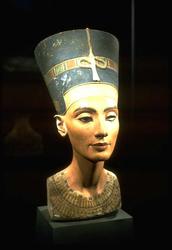 Nefertiti first appears on the scene
when she becomes the Great Royal Wife of Akhenaten. Scholars still debate
her origins, some believing that she was a princess from another
land. Those believing her to be of Egyptian origin are also divided. One
camp claims her as the daughter of Aye and Tiy, and the other claims her
as the oldest daughter of Amenhotep III and another wife besides Tiy,
possibly Sitamun. Whatever her parentage, Nefertiti was married to
Akhenaten and gave birth to six daughters. It is
possible that she also had sons, although no record of this has been found.
Nefertiti first appears on the scene
when she becomes the Great Royal Wife of Akhenaten. Scholars still debate
her origins, some believing that she was a princess from another
land. Those believing her to be of Egyptian origin are also divided. One
camp claims her as the daughter of Aye and Tiy, and the other claims her
as the oldest daughter of Amenhotep III and another wife besides Tiy,
possibly Sitamun. Whatever her parentage, Nefertiti was married to
Akhenaten and gave birth to six daughters. It is
possible that she also had sons, although no record of this has been found.
It was a practice in Egyptian art not to portray the male heirs as
children; therefore, it is possible that Tutankhaten was her
son. Nefertiti moved with her husband to Akhenaten and is shown there
participating in all the religious ceremonies. It was only through the
combined royal pair that the god Aten's full blessing could be
bestowed. Nefertiti is displayed with a prominence that other Egyptian
queens were not. Her name is enclosed in a royal cartouche, and there are
in fact more statues and drawings of her than of Akhenaten. Some have
even claimed that it was Nefertiti, not Akhenaten, who instigated the
monotheistic religion of Aten.
It is around Year 15 that Nefertiti mysteriously disappears from
view. It could be that she died, although no
indication of this exists to this date. Some scholars think that she was
banished for some reason, and lived the rest of her years in the northern
palace, raising Tutankhaten. Reasons given for the banishment are
two-fold. One, it could be that she disapproved of the slow return to the
worship of Amun, which was taking place at the time, with Smenkhkare
becoming co-regent and moving back to Thebes to reopen some temples. Or,
she actually became a pharaoh, taking the name of Smenkhkare and ruling
beside Akhenaten until his death. There is no concrete evidence for any
of these theories to be taken as fact, and so we are left with Nefertiti
disappearing from the story of Amarna.