artigo elaborado por
Dep. Engenharia Civil
Universidade de Sidney (EUA)
publicado em
Set 2001
|
1.
GENERAL INFORMATION
Height: 1,368 and 1,362 feet (417 and 415
meters)
Owners: Port Authority of New York and New
Jersey
Architect: Minoru Yamasaki, Emery Roth and Sons
consulting
Engineer: John Skilling and Leslie Robertson of
Worthington, Skilling, Helle and Jackson
Ground Breaking: August
5, 1966
Opened: 1970-73; April 4, 1973 ribbon
cutting
Destroyed: Terrorist attack, September 11,
2001
2.
THE STRUTURAL SYSTEM
^^
Voltar acima
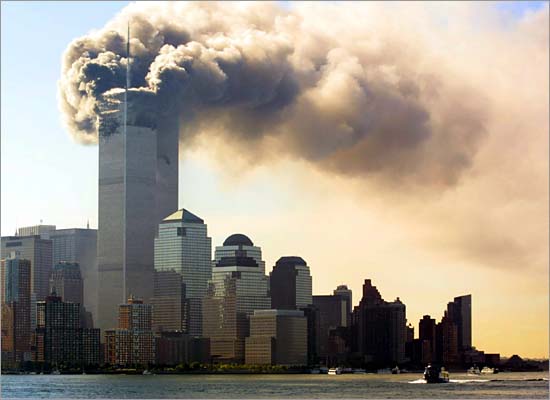
Yamasaki and engineers John Skilling and Les
Robertson worked closely, and the relationship between the towers’ design and
structure is clear. Faced with the difficulties of building to unprecedented
heights, the engineers employed an innovative structural model: a rigid "hollow
tube" of closely spaced steel columns with floor trusses extending across to a
central core. The columns, finished with a silver-colored aluminum alloy, were
18 3/4" wide and set only 22" apart, making the towers appear from afar to have
no windows at all.
Also unique to the engineering design were its
core and elevator system. The twin towers were the first supertall buildings
designed without any masonry. Worried that the intense air pressure created by
the buildings’ high speed elevators might buckle conventional shafts, engineers
designed a solution using a drywall system fixed to the reinforced steel core.
For the elevators, to serve 110 stories with a traditional configuration would
have required half the area of the lower stories be used for shaftways. Otis
Elevators developed an express and local system, whereby passengers would change
at "sky lobbies" on the 44th and 78th floors, halving the number of
shaftways.
(Taken from http://www.skyscraper.org/)
The structural system, deriving from the I.B.M. Building in
Seattle, is impressively simple. The 208-foot wide facade is, in effect, a
prefabricated steel lattice, with columns on 39-inch centers acting as wind
bracing to resist all overturning forces; the central core takes only the
gravity loads of the building. A very light, economical structure results by
keeping the wind bracing in the most efficient place, the outside surface of the
building, thus not transferring the forces through the floor membrane to the
core, as in most curtain-wall structures. Office spaces will have no interior
columns. In the upper floors there is as much as 40,000 square feet of office
space per floor. The floor construction is of prefabricated trussed steel, only
33 inches in depth, that spans the full 60 feet to the core, and also acts as a
diaphragm to stiffen the outside wall against lateral buckling forces from
wind-load pressures."
(Taken from http://www.greatbuildings.com/)
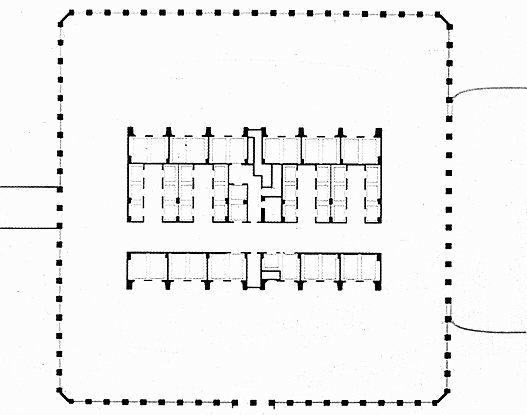
Typical Floor Plan of the World Trade Center:
A perimeter of closely spaced columns, with an internal lift
core. The floors were supported by a series of light trusses on rubber
pads, which spanned between the outer columns and the lift core.
3.
WHY DID IT COLLAPSE?
^^
Voltar acima
Tim Wilkinson, Lecturer in Civil Engineering
(This is an initial suggestion on
one possible reason for failure, and should not be regarded as official
advice)
The structural integrity of the World Trade Center
depends on the closely spaced columns around the perimeter. Lightweight
steel trusses span between the central elevator core and the perimeter columns
on each floor. These trusses support the concrete slab of each floor and
tie the perimeter columns to the core, preventing the columns from buckling
outwards.
After the initial plane impacts, it appeared to
most observers that the structure had been severely damaged, but not necessarily
fatally.
It appears likely that the impact of the plane
crash destroyed a significant number of perimeter columns on several floors of
the building, severely weakening the entire system. Initially this was not
enough to cause collapse.
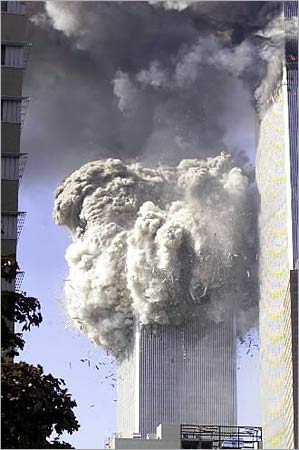
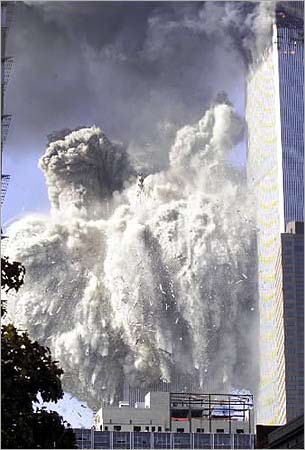
However, as fire raged in the upper floors, the
heat would have been gradually affecting the behaviour of the remaining
material. As the planes had only recently taken off, the fire would have
been initially fuelled by large volumes of jet fuel, creating potentially
enormously high temperatures. The strength of the steel drops markedly with
prolonged exposure to fire, while the elastic modulus of the steel reduces
(stiffness drops), increasing deflections.
Modern structures are designed to resist fire for
a specific length of time. Safety features such as fire retarding
materials and sprinkler systems help to contain fires, help extinguish flames,
or prevent steel from being exposed to excessively high temperatures. This
gives occupants time to escape and allow fire fighters to extinguish blazes,
before the building is catastrophically damaged.
It is possible that the blaze, started by jet fuel
and then engulfing the contents of the offices, in a highly confined area,
generated fire conditions significantly more severe than those anticipated in a
typical office fire. These conditions may have overcome the building's
fire defences considerably faster than expected.
Eventually, the loss of strength and stiffness of
the materials resulting from the fire, combined with the initial impact damage,
would have caused a failure of the truss system supporting a floor, or the
remaining perimeter columns, or even the internal core, or some
combination. Failure of the flooring system would have subsequently
allowed the perimeter columns to buckle outwards. Regardless of which of
these possibilities actually occurred, it would have resulted in the complete
collapse of at least one complete storey at the level of impact.
Once one storey collapsed all floors above would
have begun to fall. The huge mass of falling structure would gain
momentum, crushing the structurally intact floors below, resulting in
catastrophic failure of the entire structure.
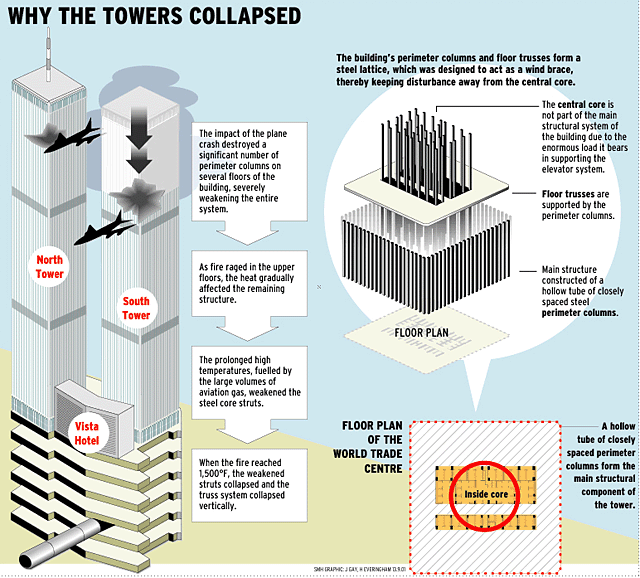
Sydney Morning Herald graphic
The only evidence so far are photographs and
television footage. Whether failure was initiated at the perimeter columns
or the core is unknown. The extent to which the internal parts were
damaged during the collision may be evident in the rubble if any forensic
investigation is conducted. Since the mass of the combined towers is
close to 1000000 tons, finding evidence will be an enormous
task.
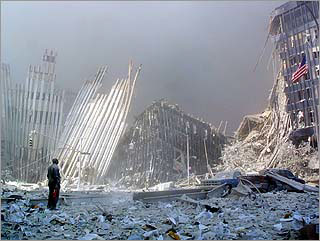
Perimeter columns, several storeys high, and still
linked together, lie amongst all the debris on the ground.
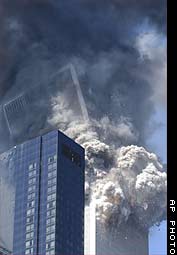
The bottom left photograph shows the south tower
just as it is collapsing. It is evident that the building is falling over
to the left. The North Tower collapsed directly downwards, on top of
itself. The same mechanism of failure, the combination of impact and
subsequent fire damage, is the likely cause of failure of both towers.
However, it is possible that a storey on only one side of the South Tower
initially collapsed, resulting in the "skewed" failure of the entire
tower.
The gigantic impact forces caused by the huge mass
of the falling structure landing on the floors below travelled down the columns
like a shockwave faster than the entire structure fell. The clouds of
debris coming from the tower, several storeys below the huge falling mass,
probably result from the sudden and almost explosive failure of each floor,
caused by the "shockwave".
(Pictures taken from various news sources on the
Internet)
4.
WHAT OTHER ENGINEERS SAY
^^
Voltar acima
Taken from Engineering News
Record
In the aftermath of the Sept. 11 terrorist attacks
in New York City and Washington, D.C., which brought down the twin 110-story
towers of the World Trade Center and damaged the Pentagon, designers and
contractors say they are skeptical that signature structures can be hardened
against extreme acts of barbarism.
"Only the containment building
at a nuclear powerplant" is designed to withstand such an impact and explosion,
says Robert S. Vecchio, principal of metallurgical engineer Lucius Pitkin Inc.,
referring to the hijacked Boeing 767 airplanes, heavy with fuel, that slammed
into each WTC tower.
The attacks appeared to be coordinated and in
parallel. In Manhattan, at least two hijacked Boeing 767 airplanes, one with 92
people on board and the other with 65, crashed into the World Trade Center's
twin towers, disappearing within and triggering fire and explosions. The north
tower, called One WTC, was hit at 8:45 a.m.; the south tower, Two WTC, at 9:03
a.m. Another hijacked airliner, a Boeing 757 with 64 people on board, crashed
into a section of the Pentagon at 9:40 a.m.
Some 50,000 people work
at the World Trade Center and some 23,000 at the Pentagon. Specifics on death
tolls and damage were not available at press time. WTC rescue efforts were put
off until Sept. 12 because the area was still a "hot zone" late in the day on
Sept. 11, with falling debris from the stumps that were once among the world's
tallest buildings, and a thick blanket of soot for blocks around. In addition,
the 47-story Seven WTC collapsed in the evening, causing more chaos. "It'll take
about a year to clean up" the remains, says Vecchio.
Sources close
to the carnage indicate that those below the 89th floor in the north tower and
the 60th floor in the south tower were most likely to have survived. Reports
indicated that at least 200 of the 400 firefighters at the scene are presumed
dead and 78 police officers were missing.
Confirmation of
collateral damage to the numerous subway lines that converge under the WTC was
not available. The owner, the Port Authority of New York and New Jersey, which
just leased the WTC complex to Silverstein Properties, New York City, set up a
command center across the Hudson River in Jersey City, N.J., trying to locate
its employees, who were on floors 63 to 85 in the north tower. Additionally, in
the hours after the attack, the port authority located temporary quarters at
sites at John F. Kennedy International Airport in Queens; at the Teleport on
Staten Island; and in Newark, N.J.
The port authority issued the
following press release: "Our hearts and our prayers go out to the families of
the countless people, including many members of the port authority family, who
were killed today in this brutal and cowardly attack. We at the port authority
are doing everything in our power to rescue and care for the injured, and to
comfort and assist the families of the victims."
Meanwhile, Jim
Rossberg, director of the Structural Engineering Institute of the American
Society of Civil Engineers, is organizing two forensic teams, one for the WTC
and the other for the Pentagon.
The twin towers, framed in
structural steel, had exterior moment frames with 14-in. steel box columns
spaced 39 in. on center. The configuration created a complete tube around the
building. The central steel core carried gravity loads only. The exterior tube
provided all the lateral resistance. Horizontal steel trusses spanned 60 ft from
the exterior wall to the core. Concrete on metal deck completed the floor
diaphragm.
Each tower contained about 100,000 tons of steel and 4
in. of concrete topping on the 40,000-sq-ft floors, according to Henry H.
Deutch, assistant to the chief structural engineer for construction manager
Tishman Realty & Construction Co. Inc., New York City, during the
construction of the WTC and currently head of HHD Consultants Inc., Osceola
County, Fla.
Deutch says that originally, the north tower contained
asbestos in its cementitious fireproofing as did the first 30 stories of the
south tower. He believes the asbestos, which had been encapsulated, was removed
after the 1993 bombing. In a press conference, Mayor Rudolph W. Giuliani said
the city's health department had tested the air in the area and found no undue
amount of chemical agents.
The attacks were witnessed by hundreds
of people in each of the locales. Vecchio, who was part of the investigation of
the 1993 bombing of the WTC, was an eyewitness to the Manhattan debacle from
Pitkin's office about 1¼2-mile north of the trade center. "The explosions were
so tremendous," he says. "You could smell the jet fuel in the
air."
Millions across the nation also "saw" the towers collapse,
through live television news coverage. The south tower fell at 10 a.m. and the
north tower at 10:29 a.m.
Reports indicate that the impact of each
plane compromised the structural integrity of each tower, knocking out perimeter
columns and the interior structure. The explosions then caused further damage,
sweeping through several floors. "These were airliners scheduled for long
flights, full of fuel, causing massive explosions," says Richard M. Kielar, a
Tishman senior vice president. "No structure could have sustained this kind of
assault," says Kielar.
As the fires burned, the structural steel on
the breached floors and above would have softened and warped because of the
intense heat, say sources. Fireproofed steel is only rated to resist 1,500 to
1,600° F. As the structure warped and weakened at the top of each tower, the
frame, along with concrete slabs, furniture, file cabinets, and other materials,
became an enormous, consolidated weight that eventually crushed the lower
portions of the frame below.
Jon D. Magnusson, chairman-CEO of
Skilling Ward Magnusson Barkshire Inc., Seattle, one of the successor firms of
Skilling Ward Christiansen Robertson, structural engineer for the original World
Trade Center, agrees: "From what I observed on TV, it appeared that the floor
diaphragm, necessary to brace the exterior columns, had lost connection to the
exterior wall."
When the stability was lost, the exterior columns
buckled outward, allowing the floors above to drop down onto floors below,
overloading and failing each one as it went down, he says.
A big
question for implosion expert Mark Loizeaux, president of Controlled Demolition
Inc., the Phoenix, Md., is why the twin towers appeared to have collapsed in
such different ways.
Observing the collapses on television news,
Loizeaux says the 1,362-ft-tall south tower, which was hit at about the 60th
floor, failed much as one would like fell a tree. That is what was expected,
says Loizeaux. But the 1,368-ft-tall north tower, similarly hit but at about the
90th floor, "telescoped," says Loizeaux. It failed vertically, he adds, rather
than falling over. "I don't have a clue," says Loizeaux, regarding the cause of
the telescoping.
The twin towers were part of a seven-building
complex designed by architect Minoru Yamasaki that covers eight city blocks. An
800 x 400-ft foundation box, 65-ft-deep and with 3-ft-thick retaining walls, is
under more than half the complex, including the twin towers and the adjacent
hotel. The complex was completed in phases beginning in 1970 (ENR 7/9/64 p. 36).
The 1.8-million-sq-ft Seven World Trade Center, constructed in the mid-80s, also
had a steel moment frame from the seventh story up (ENR 11/28/85 p.
30).
Security measures were tightened at the 12-million-sq-ft WTC
complex after a terrorist bomb on Feb. 26, 1993. That bomb blew out one section
of a north tower basement X-brace between two of the perimeter columns. The
blast ripped out sections of three structural slabs in the basement levels
between the north tower and the hotel, threatening the structural integrity of
the foundation box. It did little damage to the north tower's structural tube,
other than the affected X-brace. Damage was extensive to the other building
systems, however, because the bomb compromised major utility lines in the
basement, and the brace compromised the central core wall, allowing soot and
smoke to shoot up the building core (ENR 3/15/93 p. 12).
In
Washington, Pentagon officials were still assessing the damage and the fire was
still burning nearly seven hours after the building was hit. At press time there
were no details about injuries and fatalities.
The impact was
between the newly renovated Wedge I and the about-to-be-renovated Wedge II,
according to an aide in the Pentagon's Renovation Office. Wedge I "did hold up,"
the aide says.
Reports of damage also remain sketchy and Pentagon
officials decline to discuss specifics. However, the Pentagon aide reports that
the plane slammed into the southwest side of the Pentagon adjacent to the
heliport. The airliner reportedly hit at the first and second floors, but later
the upper three floors collapsed.
The U.S. Dept. of Defense's
6.5-million-sq-ft headquarters, built as a temporary structure 58 years ago, was
not constructed with fire-resistant or bomb-resistant materials. The overdue,
multiyear renovation includes technologically advanced materials designed to
ward off severe damage from such attacks (ENR 9/4/00 p. 58).
Fire
was leaping out the windows, primarily on the upper floors of the unrenovated
section. The adjacent renovated section appeared to have less damage, likely
because of the reinforced glass windows and firewalls used in the renovation
that was completed less than a year ago.
In the aftermath of the
1993 bombing, WTC structural consultant Leslie E. Robertson, Skilling's project
engineer for the original job, was convinced that the terrorists had meant to
take down the twin towers. After the events of Sept. 11, there's little doubt
that Robertson was correct.
^^
Voltar acima
National Council of Structural Engineering Associations
http://dwp.bigplanet.com/engineers/
According to one of the designers of the World
Trade Center (WTC), the towers were originally designed to take the impact of a
Boeing 707; and the impact of the aircraft this morning did not take the
buildings down. In fact, WTC One stood for 1 hour and WTC Two stood for 1 3/4
hours after impact. Engineers familiar with the chain of events suspect that
heat from the massive and extraordinary fires weakened the structures and
initiated the progressive collapses.
John Hooper, a structural engineer
from Skilling, Ward, Magnusson, Barkshire, the structural engineering firm that
evolved from Skilling, Helle, Christianson, Robertson, which was the structural
engineering firm of record for the WTC, provided the following facts to NCSEA:
WTC One was 1368' tall, and WTC Two was 1362' tall. Each 110-story tower had a
floor plate that was 208' by 208'. The central core of each was 86' square.
Around the perimeter of the buildings, columns were spaced at 3'-3" on center,
with 48"- deep plate girders at each floor. At the third level, the columns
transitioned in an arch-like formation to a 10'-0" spacing for the lower story.
Floors were supported by steel trusses spanning 60', from the core to the
perimeter wall, on each side of the building. The buildings are also thought to
have been the first buildings to use non-asbestos fireproofing. The fibers of
the spray-on fireproofing product were reportedly ceramic rather than
asbestos.
NCSEA has contacted FEMA and will coordinate and make available
structural engineers in the New York and Washington D.C. areas. NCSEA will also
coordinate and provide the services of Member Structural Engineering
Associations throughout the U.S., as needed.
The National Council
of Structural Engineers Associations is extremely saddened with the day's news,
including the collapse of the World Trade Center in New York City. Our hearts
and prayers go out to all the victims and their families.
^^
Voltar acima
AISC Task Force to Investigate World Trade Center
Collapse
The American Institute of Steel
Construction, Inc. (AISC) has contacted FEMA and the leading structural
engineering associations and is forming a special task force to investigate the
structural collapses of the World Trade Center buildings resulting from the
terrorist attacks on September 11, 2001.
AISC is the technical
institute responsible for developing and maintaining the standards for design
and construction of steel buildings in the United States. Information developed
by this task force will enable AISC to determine if modifications are needed in
existing standards.
“AISC strives to create a steel building
specification that makes use of the latest available design data and
construction technology,” said Nestor R. Iwankiw, AISC’s Vice President of
Engineering and Research. “The special task force of nationally recognized
experts will investigate and determine the various factors that contributed to
the collapses and make recommendations to AISC’s Specification, Blast and Fire
Committees.”
Much speculation is currently underway about the cause of
the collapses. Most engineers currently believe the collapses occurred as a
result of a combination of extraordinary events, including the initial aircraft
impacts and explosions, which destroyed part of the structure, and the
subsequent extreme fire, which progressively weakened the remaining structure.
The ensuing collapses may have occurred when the weight of the buildings above
the points of impact exceeded the reduced load carrying capacity of the
remaining structure. It is believed that the collapse of the 47-story building
adjacent to the twin towers was caused by a combination of its foundations and
structure being weakened by the collapsing twin towers and
fire.
“We’re saddened about this terrible disaster and the loss of
life,” said AISC President H. Louis Gurthet, P.E. “Our hearts and prayers go out
to the victims and their families.”
^^
Voltar acima
British Engineers Give Their Theory
Taken
from BBC
http://news.bbc.co.uk/hi/english/world/americas/newsid_1540000/1540044.stm
The design of the World Trade Center saved
thousands of lives by standing for well over an hour after the planes crashed
into its twin towers, say structural engineers.
"It was the fire
that killed the buildings - nothing on Earth could survive those temperatures
with that amount of fuel burning" Structural engineer Chris
Wise
But the towers' ultimate collapse was inevitable,
as the steel cores inside them reached temperatures of 800C - raising questions
why hundreds of rescue workers were sent into the doomed buildings to their
deaths.
The steel and concrete structure performed amazingly well,
said John Knapton, professor in structural engineering at Newcastle University,
UK. "I believe tens of thousands of lives have been saved by the structural
integrity of the buildings," he told BBC News Online. "They had a lot of their
structure taken out, yet they remained intact for more than an hour, allowing
thousands to escape."
But as fires raged in the towers, driven by
aviation fuel, the steel core in each building would have eventually reached
melting point - 800C. The protective concrete cladding on the cores would
certainly have been no defence in these extraordinary
circumstances.
"Nothing is designed or will be designed to
withstand that fire" World Trade Center construction
manager
"It was the fire that killed the buildings.
There's nothing on Earth that could survive those temperatures with that amount
of fuel burning," said structural engineer Chris Wise. "The columns would have
melted, the floors would have melted and eventually they would have collapsed
one on top of each other."
The building's construction manager,
Hyman Brown, agreed that nothing could have saved it from the inferno. "This
building would have stood had a plane or a force caused by a plane smashed into
it," he said.
"I would have given the
order to get out - you would have thought someone with technical expertise would
have been advising them" Professor John Knapton, Newcastle University "But steel
melts, and 24,000 gallons (91,000 litres) of aviation fluid melted the steel.
Nothing is designed or will be designed to withstand that fire."
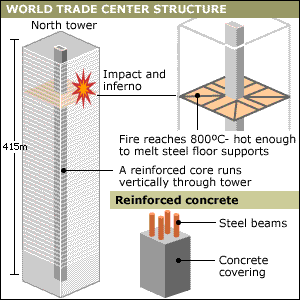
Once the steel frame on one floor had melted, it collapsed
downwards, inflicting massive forces on the already-weakened floor below. From
then on, the collapse became inevitable, as each new falling floor added to the
downward forces. Further down the building, even steel at normal temperatures
gave way under the enormous weight - an estimated 100,000 tonnes from the upper
floors alone.
"It was as if the top of the building was acting like
a huge pile-driver, crashing down on to the floors underneath," said Chris
Wise.
Early in the unfolding horror, some office workers were told
to stay where they were - dreadful advice, said Professor
Knapton.
The towers withstood impact but not inferno. People's only
hope was to run and keep running - reaching open ground. The building could have
fallen over sideways, he points out, potentially bringing even greater
devastation.
Another 47-storey building belonging to Salomon
Brothers caved in later, weakened by the earlier collapses, and more nearby
buildings may still fall, say engineers.
But the eventual collapse
of the twin towers was so predictable that the order should have been given to
withdraw emergency services within an hour, said Professor Knapton. He watched
in horror, knowing the building would fall within two hours. The hundreds of
dead firemen and police officers should simply not have been there, he
said.
"I think they should not have gone in at all," he said. "If
they did decide to take the risk, they should have been pulled out after an
hour."
But in the panic and horror, the order was never given for
rescue workers to abandon the building. "Mistakes were made," said Professor
Knapton.
"It was like a horror film and I think people's
rationale had gone" Professor John Knapton
"It sounds harsh - this had never happened in the
world, so you can hardly criticise them. But I would have given the order to get
out. You would have thought someone with technical expertise would have been
advising them." But he acknowledged that the sheer scale of the tragedy probably
overwhelmed the operation commanders. "I think everyone was not thinking. It was
like a horror film and I think people's rationale had gone," he
said.
The building's design was standard in the 1960s, when
construction began on what was then the world's tallest building. At the heart
of the structure was a vertical steel and concrete core, housing lift shafts and
stairwells. Steel beams radiate outwards and connect with steel
uprights, forming the building's outer wall. All the steel was covered in
concrete to guarantee firefighters a minimum period of one or two hours in which
they could operate - although aviation fuel would have driven the fire to
higher-than-normal temperatures. The floors were also concrete. The building had
to be tough enough to withstand not just the impact of a plane - and the
previous bomb attack in 1993 - but also of the enormous structural pressures
created by strong winds.
Newer skyscrapers are constructed using
cheaper methods. But this building was magnificent, say experts, in the face of
utterly unpredictable disaster.
^^
Voltar acima
Trade Center architect discusses buildings
Taken from CNN
http://www.cnn.com/2001/US/09/12/wtc.architect.cnna/index.html
(CNN) -- When they were completed in the early
1970s, the Twin Towers of New York's World Trade Center were the tallest
buildings in the world. That designation didn't last long -- Chicago's Sears
Tower took the title in 1974, a year after Two World Trade Center was finished
-- but the buildings' standing as a New Yoork City landmark, anchors amid the
office-tower canyons of Manhattan's financial district, remained
unchallenged.
Tuesday, the buildings -- daytime home of more than
50,000 workers -- were destroyed when two hijacked passenger jets were flown
into the structures.
CNN's Leon Harris spoke with Aaron Swirsky,
part of the architectural team led by World Trade Center chief architect Minoru
Yamasaki, on the way the building was designed.
LEON HARRIS, CNN
ANCHOR: So many of us had thought for so long that the Twin Towers were
invincible. We had heard for so many times over the years that the buildings
have been built to withstand an impact from the crash of a
plane.
Let's talk right now on the telephone with Aaron Swirsky.
He's in Jerusalem. He was one of the original architects of the complex, as I
understand it.
Is that the case, Mr. Swirsky?
AARON
SWIRSKY, ARCHITECT: I was working with Minoru Yamasaki, who is the architect of
the building. But I was one of the workers with him. We were a team of 14
architects, and I was one of the members of the team.
HARRIS: As a
member of the team, and having such insight to how this building was
constructed, could you believe that a plane could bring these buildings
down?
SWIRSKY: No, as a matter of fact, one of the rationales of
the structure of the building was that it would be built as a pipe. And that
proved itself to work during the explosion of 1993, when a hole was brought into
the building, and it survived. But somehow, nobody could foresee anything like
(Tuesday's incident).
Also, at that time, the planes were not like
these types of planes that we have now. I think the biggest plane was a
100-passenger plane, something like that, and the fuel capacity of those planes
was not like they are today.
The criterion was that if a plane
hits, it would go right through it. And nobody could foresee something like
that. The tower was protected in such a way that the damage would be limited to
one story, but it wouldn't travel to the other stories.
HARRIS: The
planes that crashed yesterday were much bigger than that. They were
757s.
SWIRSKY: And also the fuel capacity is much more
tremendous.
HARRIS: Exactly. That's what I want to ask you about.
Which was it that made the biggest difference? Was it the impact felt from the
larger plane, or was it the heat generated by the burning and that much
fuel.
SWIRSKY: I imagine, when I saw the pictures of the implosion
of the building, it looks like the fuel must have leaked right to the core of
the building, and from there it was the massive explosion that caused the
building to collapse. So it was something completely unforeseen, so far as the
design criteria was (concerned).
HARRIS: Let me ask one final
question, if I may. Considering what you know about the building -- you say it
was constructed like a pipe, these two buildings -- and the manner in which we
saw them collapse, does that give you any hope at all that the way it collapsed,
there will be more packets inside, at the bottom, where survivors could be
found?
SWIRSKY: Well, I sure hope so. We pray that there will be
survivors and that this won't happen again. It's a terrible, terrible,
incredible tragedy
^^
Voltar acima
|
