|
|
1. INTRODUCTION
Throughout the history of architecture, there has been a continual quest for height. Thousands of workers toiled on the pyramids of ancient Egypt, the cathedrals of Europe and countless other towers, all striving to create something awe-inspiring. People build skyscrapers primarily because they are convenient -- you can create a lot of real estate out of a relatively small ground area. But ego and grandeur do sometimes play a significant role in the scope of the construction, just as it did in earlier civilizations.
Up until relatively recently, we could only go so high. After a certain point, it just wasn't feasible to keep building up. In the late 1800s, new technology redefined these limits. Suddenly, it was possible to live and work in colossal towers, hundreds of feet above the ground. In this edition of HowStuffWorks, we'll look at the innovations that made these incredible structures possible. We'll examine the main architectural issues involved in keeping skyscrapers up, as well as the design issues involved in making them practical. Finally, we'll peer into the future of skyscrapers to find out how high we might go.
This is how "cheerleader pyramids" work, and it's also how real pyramids and other stone buildings work. There has to be more material at the bottom to support the combined weight of all the material above. Every time you add a new vertical layer, the total force on every point below that layer increases. If you kept increasing the base of a pyramid, you could build it up indefinitely. This becomes infeasible very quickly, of course, since the bottom base takes up too much available land.
In normal buildings made of bricks and mortar, you have to keep thickening the lower walls as you build new upper floors. After you reach a certain height, this is highly impractical. If there's almost no room on the lower floors, what's the point in making a tall building? Using this technology, people didn't construct many buildings more than 10 stories -- it just wasn't feasible. But in the late 1800s, a number of advancements and circumstances converged, and engineers were able to break the upper limit -- and then some. The social circumstances that led to skyscrapers were the growing metropolitan American centers, most notably Chicago. Businesses all wanted their offices near the center of town, but there wasn't enough space. In these cities, architects needed a way to expand the metropolis upward, rather than outward. The main technological advancement that made skyscrapers possible was the development of mass iron and steel production. New manufacturing processes made it possible to produce long beams of solid iron. Essentially, this gave architects a whole new set of building blocks to work with. Narrow, relatively lightweight metal beams could support much more weight than the solid brick walls in older buildings, while taking up a fraction of the space. With the advent of the Bessemer process, the first efficient method for mass steel production, architects moved away from iron. Steel, which is even lighter and stronger than iron, made it possible to build even taller buildings.
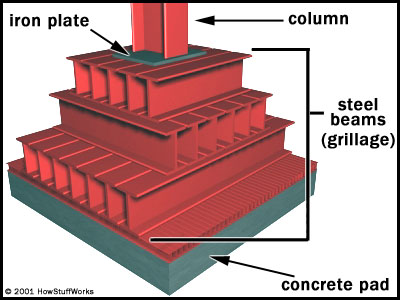
In this giant three-dimensional grid -- called the super structure -- all the weight in the building gets transferred directly to the vertical columns. This concentrates the downward force caused by gravity into the relatively small areas where the columns rest at the building's base. This concentrated force is then spread out in the substructure under the building. In a typical skyscraper substructure, each vertical column sits on a spread footing. The column rests directly on a cast-iron plate, which sits on top of a grillage. The grillage is basically a stack of horizontal steel beams, lined side-by-side in two or more layers (see diagram, below). The grillage rests on a thick concrete pad poured directly onto the hard clay under the ground. Once the steel is in place, the entire structure is covered with concrete.
This structure expands out lower in the ground, the same way a pyramid expands out as you go down. This distributes the concentrated weight from the columns over a wide surface. Ultimately, the entire weight of the building rests directly on the hard clay material under the earth. In very heavy buildings, the base of the spread footings rest on massive concrete piers that extend all the way down to the earth's bedrock layer. One major advantage of the steel skeleton structure is that the outer walls -- called the curtain wall -- need only to support their own weight. This lets architects open the building up as much as they want, in stark contrast to the thick walls in traditional building construction. In many skyscrapers, especially ones built in the 1950s and '60s, the curtain walls are made almost entirely of glass, giving the occupants a spectacular view of their city.
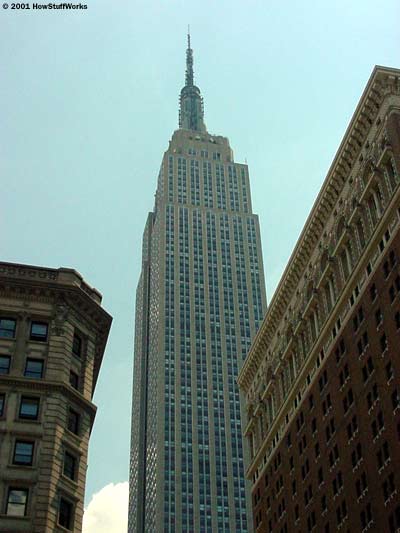
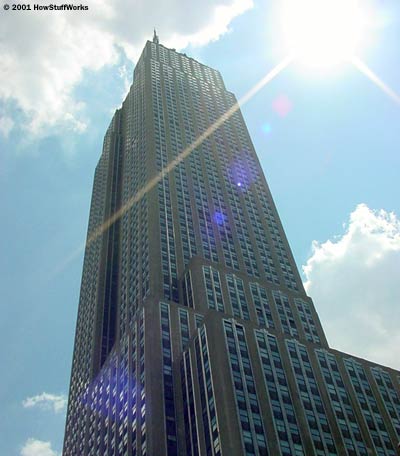
Once you get more than five or six floors, stairs become a fairly inconvenient technology. Skyscrapers would never have worked without the coincident emergence of elevator technology. Ever since the first passenger elevator was installed in New York's Haughwout Department Store in 1857, elevator shafts have been a major part of skyscraper design. In most skyscrapers, the elevator shafts make up the building's central core. Figuring out the elevator structure is a balancing act of sorts. As you add more floors to a building, you increase the building's occupancy. When you have more people, you obviously need more elevators or the lobby will fill up with people waiting in line. But elevator shafts take up a lot of room, so you lose floor space for every elevator you add. To make more room for people, you have to add more floors. Deciding on the right number of floors and elevators is one of the most important parts of designing a building. Building safety is also a major consideration in design. Skyscrapers wouldn't have worked so well without the advent of new fire-resistant building materials in the 1800s. These days, skyscrapers are also outfitted with sophisticated sprinkler equipment that puts out most fires before they spread very far. This is extremely important when you have hundreds of people living and working thousands of feet above a safe exit. Architects also pay careful attention to the comfort of the building's occupants. The Empire State Building, for example, was designed so its occupants would always be within 30 feet (ft) of a window. The Commerzbank building in Frankfurt, Germany has tranquil indoor garden areas built opposite the building's office areas, in a climbing spiral structure. A building is only successful when the architects have focused not only on structural stability, but also usability and occupant satisfaction.
The most basic method for controlling horizontal sway is to simply tighten up the structure. At the point where the horizontal girders attach to the vertical column, the construction crew bolts and welds them on the top and bottom, as well as the side. This makes the entire steel super structure move more as one unit, like a pole, as opposed to a flexible skeleton.
For taller skyscrapers, tighter connections don't really do the trick. To keep these buildings from swaying heavily, engineers have to construct especially strong cores through the center of the building. In the Empire State Building, the Chrysler Building and other skyscrapers from that era, the area around the central elevator shafts is fortified by a sturdy steel truss, braced with diagonal beams. Most recent buildings have one or more concrete cores built into the center of the building. Making buildings more rigid also braces them against earthquake damage. Basically, the entire building moves with the horizontal vibrations of the earth, so the steel skeleton isn't twisted and strained. While this helps protect the structure of the skyscraper, it can be pretty rough on the occupants, and it can also cause a lot of damage to loose furniture and equipment. Several companies are developing new technology that will counteract the horizontal movement to dampen the force of vibration. Some buildings already use advanced wind-compensating dampers. The Citicorp Center in New York, for example, uses a tuned mass damper. In this complex system, oil hydraulic systems push a 400-ton concrete weight back and forth on one of the top floors, shifting the weight of the entire building from side to side. A sophisticated computer system carefully monitors how the wind is shifting the building and moves the weight accordingly. Some similar systems shift the building's weight based on the movement of giant pendulums.
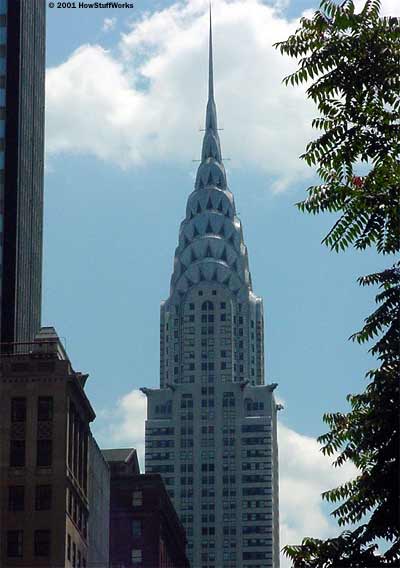
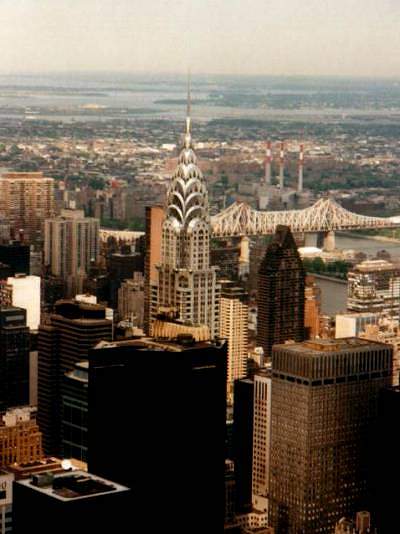
The earliest skyscrapers, built in the late 1800s, were very basic boxes with simple stone and glass curtain walls. To the architects who built these skyscrapers, the extreme height was impressive enough. In the period around 1900, the aesthetic began to change. Buildings got taller, and architects added more extravagant gothic elements, hiding the boxy steel structure underneath. The art deco movement of the 1920s, '30s and '40s extended this approach, creating buildings that stood as true works of art. Some of the most famous skyscrapers, including the Empire State Building and the Chrysler Building (above), came out of this era. Things shifted again in the 1950s, when international style began to take hold. Like the earliest skyscrapers, these buildings had little or no ornamentation. They were made mostly with glass, steel and concrete.
Since the 1960s, many architects have taken the skyscraper to new and unexpected places. One of the most interesting variations has been the combination of several vertical skeleton sections -- or tubes -- into one building. The Sears Tower in Chicago, the most famous example of this approach, consists of nine aligned tubes that reach to different heights. This gives the building an interesting staggered appearance.
By all accounts, the skyscraper race is far from over. There are more than 50 proposed buildings that would break the current record. The 1,550-ft 7 South Dearborn building, nearing completion in Chicago, will squeak by the 1,483-ft Petronas Towers. China is working on the Shanghai World Financial Center, which it says will be something more than 1,500 feet. The proposed pyramid-shaped World Center for Vedic Learning in Jabalpur, India, will tower over the city at 2,222 ft. One of the most ambitious projects, Hong Kong's 4,029-ft Bionic Tower, will include 300 stories. The 7 South Dearborn building and several other conservative structures, are already in construction. But, the more ambitious buildings in the group are only theoretical at this time. Are they possible? According to some engineering experts, the real limitation is money, not technology. Super tall buildings would require extremely sturdy materials and deep, fortified bases. Construction crews would need elaborate cranes and pumping systems to get materials and concrete up to the top levels. All told, putting one of these buildings up could easily cost tens of billions of dollars. Additionally, there would be logistical problems with the elevators. To make the upper floors in a 200-story building easily accessible, you would need a large bank of elevators, which would take up a wide area in the center of the building. One easy solution to this problem is to arrange the elevators so they only go part way up the building. Passengers who want to go the top would take an elevator halfway, get off and then take another elevator the rest of the way. Experts are divided about how high we can really go in the near future. Some say we could build a mile-high (5,280 ft, or 1,609 m) building with existing technology, while others say we would need to develop lighter, stronger materials, faster elevators and advanced sway dampers before these buildings were feasible. Speaking only hypothetically, most engineers won't impose an upper limit. Future technology advances could conceivably lead to sky-high cities, many experts say, housing a million people or more. Whether we'll actually get there is another question. We might be compelled to build farther upward in the future, simply to conserve land. When you build upward, you can concentrate much more development into one area, instead of spreading out into untapped natural areas. Skyscraper cities would also be very convenient: More businesses can be clustered together in a city, reducing commuting time. But the main force behind the skyscraper race might turn out to be basic vanity. Where monumental height once honored gods and kings, it now glorifies corporations and cities. These structures come from a very fundamental desire -- everybody wants to have the biggest building on the block. This drive has been a major factor in skyscraper development over the past 120 years, and it's a good bet it will continue to push buildings up in the centuries to come.
|