 |
| Where did all these shiny balls and blinking lights come from? |
| What is a yule log? |
| In Victorian times, people had already started decorating trees with candies and cakes hung with ribbon. In 1880, Woolworths first sold manufactured Christmas tree ornaments, and they caught on very quickly. Martin Luther, in the 16th century, is credited as being the first person to put candles on a tree, and the first electrically lighted Christmas tree appeared in 1882. Calvin Coolidge in 1923 ceremoniously lit the first outdoor tree at the White House, starting that long tradition. Fake snow and tinsel... Who knows? |
| Up until the 19th century, the custom of burning the Yule log flourished in England, France, Germany and among the South Slavs. Out of oak, families carved a heavy, wood block. They placed it into the floor of their hearth as the base of their winter fire.. |
| Poinsettias were attached to Christmas starting in 1828. Joel Roberts Poinsett, then the first U.S. ambassador to Mexico, imported the plant from Mexico. According to the Encyclopedia Britannica: In warm climates, the poinsettia grows outdoors as a winter-flowering leggy shrub about 3 metres (10 feet) high |
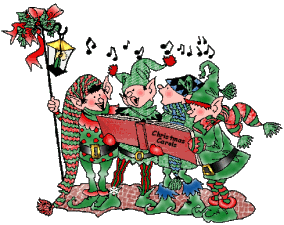
| In the Middle Ages in England and France, carols were dances accompanied by singing. In the French Midi, for example, the "carol" was a kind of round dance. In time, the word "carol" changed its meaning, referring only to certain kinds of songs. The Anglo-Saxon tradition favoured gathering together small choirs on the village green to sing carols and Christmas songs for the pleasure of passers-by. A number of currently very popular American Christmas carols come directly from France and England. |
 |
| The church forbade the use of mistletoe in any form, mindful of its idolatrous associations. As a substitute, it suggested holly. The sharply pointed leaves were to symbolize the thorns in Christ's crown and the red berries drops of his blood. Holly became a nativity tradition. The Christian ban on mistletoe was in effect throughout the Middle Ages |
| What about poinsettias? |
| Where did the ideal of going door-to-door singing come from? |
| What is the holly for? |
| Christmas Eve is a big deal for religious reasons, such as the midnight mass, and also for retail reasons. 1867 was the first year that Macy's department store in New York City remained open until midnight on Christmas Eve. "All Jewish holidays start at sundown the evening before (not at calendar midnight). Our holidays start with ceremony the evening before: rituals, candle-lighting, whatever... at sundown and they last until the following sundown, and then they're over." |
| If Christmas is the 25th, why do we start to celebrate on the night before? |
| The whole story of Rudolf appeared, out of nowhere, in 1939. Santas at Montgomery Ward stores gave away 2.4 million copies of a booklet entitled "Rudolf the Red-Nose Reindeer." The story was written by a person in the advertising department named Robert May, and the booklet was illustrated by Denver Gillen. The original name of the reindeer was not Rudolf, according to the book "Extraordinary Origins of Everyday Things," by Charles Panati. The original name was Rollo, but executives did not like that name, nor Reginald. The name Rudolf came from the author's young daughter! In 1949, Gene Autry sang a musical version of the poem and it was a run-away best-seller. The Rudolf song is second only to "White Christmas" in popularity |
| Where does a reindeer with a red nose fit in to all of this? |
| The 12 days of Christmas are the 12 days that separate Christmas day on December 25 from Epiphany, which is celebrated January 6. Depending on the church, January 6 may mark Christ's baptism (the Catholic tradition), or it may mark the day that the wise men visited the baby Jesus with their gifts. |
| What are the twelve days of Christmas? |
| According to the book Did you ever Wonder... by Jeff Rovin, the word for Christ in Greek is Xristos. The use of the shortened form "Xmas" became popular in Europe in the 1500s. The word Xmas is so common in advertising most likely because "Xmas" and "sale" have the same number of letters, and "Xmas" is significantly shorter than Christmas |
| Why do you often see Christmas written "Xmas" especially in connection with a sale? |
| Christmas cards started in London in 1843 and in America in 1846. Today, about two billion Christmas cards are exchanged every year in the United States. |
| Where did Christmas cards begin? |