| This information was copied from www.crosswinds.net (click link above) South Azerbaijan comprises three provices currently part of the Islamic Republic of Iran: Western Azerbaijan, with its capital in Orumiyeh, Eastern Azerbaijan, with its capital in Tabriz and Ardebil, whose capital is also called Ardebil. A forth Iranian province Zanjan, with the capital in the city of the same name, also has a dominant Azeri population and there are important Azeri communities in and around Hamadan, in Tehran, around Qom and Saveh, Khorasan province, and are scattered throughout many other parts of Iran. Orumiyeh is a large city with a population of 400.000. Formerly known as Rezaiyeh (after Reza Shah), it is built at an altitude of 1,340m on a plateau, about west 25km from the lake of the same name, halfway between Tabriz and the Turkish border (in European languages both the city and the lake are often called Urmia). The southern part of the city is crossed by the Shahar river, taking its waters east to the lake. Orumiyeh is said to have been founded about 3500 years ago. The remains of several ancient settlements are scattered over the plain. It fell to arab invaders in the 7th century, who introduced Islam and was later conquered by Turks and Mongols. In 1900 Christians formed nearly half the population, and an independent Armenian state was proclaimed by Marshimun. However in 1918 with the advance of Turkish troops, many Armenians left - most of the remainder were massacred in the wake of the retreat of the Russian Army from the area. Presently in and around Uromiyeh over 90% of the population is Azeri, followed by a large Kurdish community, and smaller Armenian, Assyrian and Persian communities. In spite of a troubled past these communities live side by side peacefully. The language spoken everywhere is Azeri, but written in the Arabic script. Official signs and documents are written in Farsi. The western part of the Western Azerbaijan province has an important Kurdish population, and in the aftermath of W.W.II the city of Mahabad was briefly the capital of an independent Kurdish state. Today several beautiful buildings still survive, of which the most important are the large square Friday Mosque in the bazaar area, the Church dedicated to the Virgin Mary and a 12th century mausoleum tower. The city is mostly flat, centred around Vilayet Fagih square, where the main commercial artery, Iman avenue, starts. The city museum, focusing on local history an handycrafts, is located on Shahid Beheshti street. The Iranian government assures a reasonable degree of religious freedom and Islam and Christianity live together, both steeples and minarets contribute to the beauty in the horizon. The city is the seat of a Chaldean (Catholic archbishopric) and claims to have been the birthplace of Zoroaster and to have been visited by the three wise men on their way to Bethlehem. Around the city you'll find a large fertile plain that yields grains, fruits, tobacco, and other crops. Lake Orumiyeh with 4700 square kilometres is almost a small sea, and is now quite salty, in fact so salty that most fish cannot live in it, but in bygone ages the water was sweeter and the area even more fertile. Inspite of lacking fish, the lake has a very rich bird life. The banks are rather barren and there are several rocky islands, the largest one 'Kabud' has a mountain reaching 1600 metres. Around the lake there are a few small hotels and a few other resorts. There are ferryboats connecting the two sides of the lake. A bridge across the lake was started in the 1970s, but was abadoned after the Islamic Revolution, with one third of it still missing. So although Orumiyeh is only 120 kilometres from Tabriz, it takes about 5 hours to drive between the two cities, around lake Orumiyeh, through bad roads. Thre no rail connections to Orumiyeh but there are buses to Tabriz, Tehran, Mahabad and other destinations. The bus station lies in the northern part of the city. You can also take some domestic flights, the airport is located about 20 kilometres north of the city - airport code OMH. South Azerbaijan comprises three provinces currently part of the Islamic Republic of Iran: Western Azerbaijan, with its capital in Orumiyeh, Eastern Azerbaijan, with its capital in Tabriz and Ardebil, whose capital is also called Ardebil. A forth Iranian province Zanjan, with the capital in the city of the same name, also has a dominant Azeri population and there are important Azeri communities in and around Hamadan, in Tehran, around Qom and Saveh, in the Khorasan province, and are scattered throughout many other parts of Iran. The most conservative numbers point to 13 million Azeris in Iran (often called 'Tork'), but more realistic estimates indicate about 30 million speakers in the Islamic Republic. The 3 provinces that make South Azerbaijan represent about 30 percent of the Iranian land mass, an area larger than the Republic of Azerbaijan itself. The population, estimated at around 10 million is also bigger. The separation of south and north was made permanent with the treaty of Turkmanchay, signed between Russia and Persia in 1828. The Azeris north of the river Araz were left inside the Russian empire, and apart from brief periods of anarchay stayed with Russian until the breakup of the Soviet Union, when north-Azerbaijan became independent as the Republic of Azerbaijan. Those south of the Araz remain today part of the Islamic Republic of Iran, which suceeded to the Persian monarchy. Urmia Pronounced As: �rm , formerly Rezaiyeh, city (1991 pop. 357,399), capital of West Azerbaijan prov., NW Iran, near Lake Urmia. It is the trade center for a fertile agricultural region where fruit and tobacco are grown. An important town by the 9th cent., Urmia was seized by the Oghuz Turks (11th cent.), sacked by the Seljuk Turks (1184), and later occupied a number of times by the Ottoman Turks. Urmia was the seat of the first U.S. Christian mission in Iran (1835). Around 1900 Christians made up more than 40% of the city's population; however, most of the Christians fled in 1918. |
 |
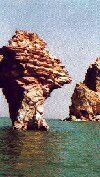 |
| Lake Orumiyah |
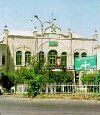
| City Hall |
|
| Orumiyeh notes, page 2 |