 |
 |
 |
 |
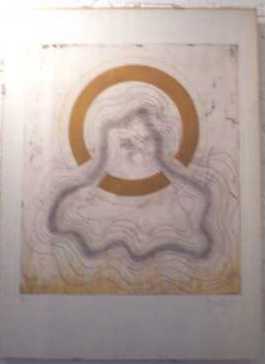
| La Vie, Jorg Neitzert 1973 |
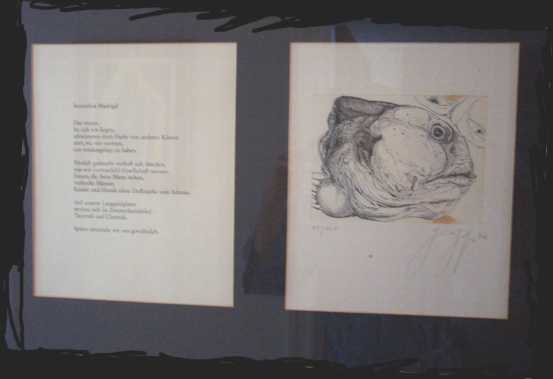
| Scenic Madrigal, Gunter Grass 1974 |
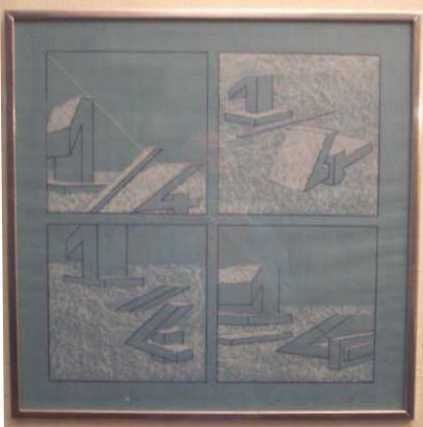
| Winter Quarters, Brian Shaffer 1977 |
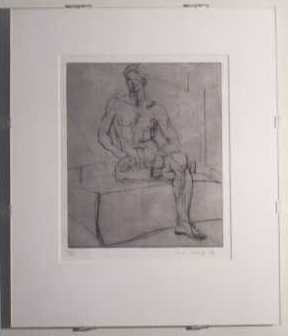
| Seated Male Nude, Hans Abbing 1983 |
| What intrigued me about Jorg Neitzert's lithograph was the intersection between the circle, which I interpreded as representing time and the undulating geological figure traversing the circle (or was it going into the circle?), possibly to flatten out after it had completed its movement across or through the circle. The picture lent itself to the type of meditation about the relationship between man's life in this world and eternity, whereby eternity remains unruptured (inviolate) regardless of what may happend to the life that passes through it. As such, the picture has a Zen like quality to it that speaks of a mystery it does not reveal. |
| It took me some time to unravel the complexities of this logograph, in which the quarters seem to traverse the picture almost in story form, with the beginning of winter depicted in the first quadrant, as the 1 and the 4 seem to come together in a space only sparingly suggests the presence of snow while the sky blue of the background appears to dominate the scene, as is so often the case during the first months of the season. In the second quadrant, the white of the snow seems to predominate, as the 1/4th almost seems to form a geometric space, with a sense of three-dimensional depth in which the 4 seems to dominate the 1. In the third quadrant, despite the continuing predominance of white, the 1 almost appears to be abandoning the 4, restoring the dominance of the 1--a representation of the individual? And finally, in the last quadrant, the numbers appear to have gained their independence, with the fraction mark lying like a board between them, and the white of the snow appears to be receeding, as with the oncoming of Spring. Lending additional complexity to this rather simple lithograph is the fact that the paper itself has been folded diagonally, as if tying together each of the quadrants. |
| The German author Gunther Grass (perhaps best known for his Tin Drum) had originally trained as a stone mason and in the graphic arts, and throughout his career as an author he continued to produce lithographs, and other works of art. This particular picture was one of the many that he produced while he was writing The Flounder (1977). While most of the lithos he appears to have produced during this time are extremely phallic in nature, some integrating in quite humorous fashion his love for cooking and his sense of his manhood, this picture is almost sentimental, if somewhat melancholic in nature. The picture itself is quite symbolic in nature, with the head of the decapitated fish lying virtually on top of the brow of the male forehead. In the accompanying poem speaks about intimacy, sex, infidelity, and the generalized insight that the world outside is not so different from that which is occuring in the here and now. |
| There is something monolithic, almost Herculean about the seated male figure in this lithograph of Hans Abbing's. It is this overpowering masculinity that immediately drew me to the picture when first I saw it as I was strolling down one of Amsterdam's streets with no particular thought of buying a piece of art. While its maleness is without a doubt, the picture does not appear intentionally to seek to convey a sense of the erotic, unless it is through the shere beauty of the man himself. The rough hewn strokes of the stylus used to create the picturelend a stone like quality to the figure, again enhancing the statuesque quality of the nude. Indeed, the man seems to be sitting less on a bed than what appears to be a stone block, squared off as it is at the corners. While there is nothing classical in its pose, the figure seems to have the starkness of classical art, perhaps to be traced to the sense of tranquility that the man seems to exude. |
| Early Acquisitions |
 |